
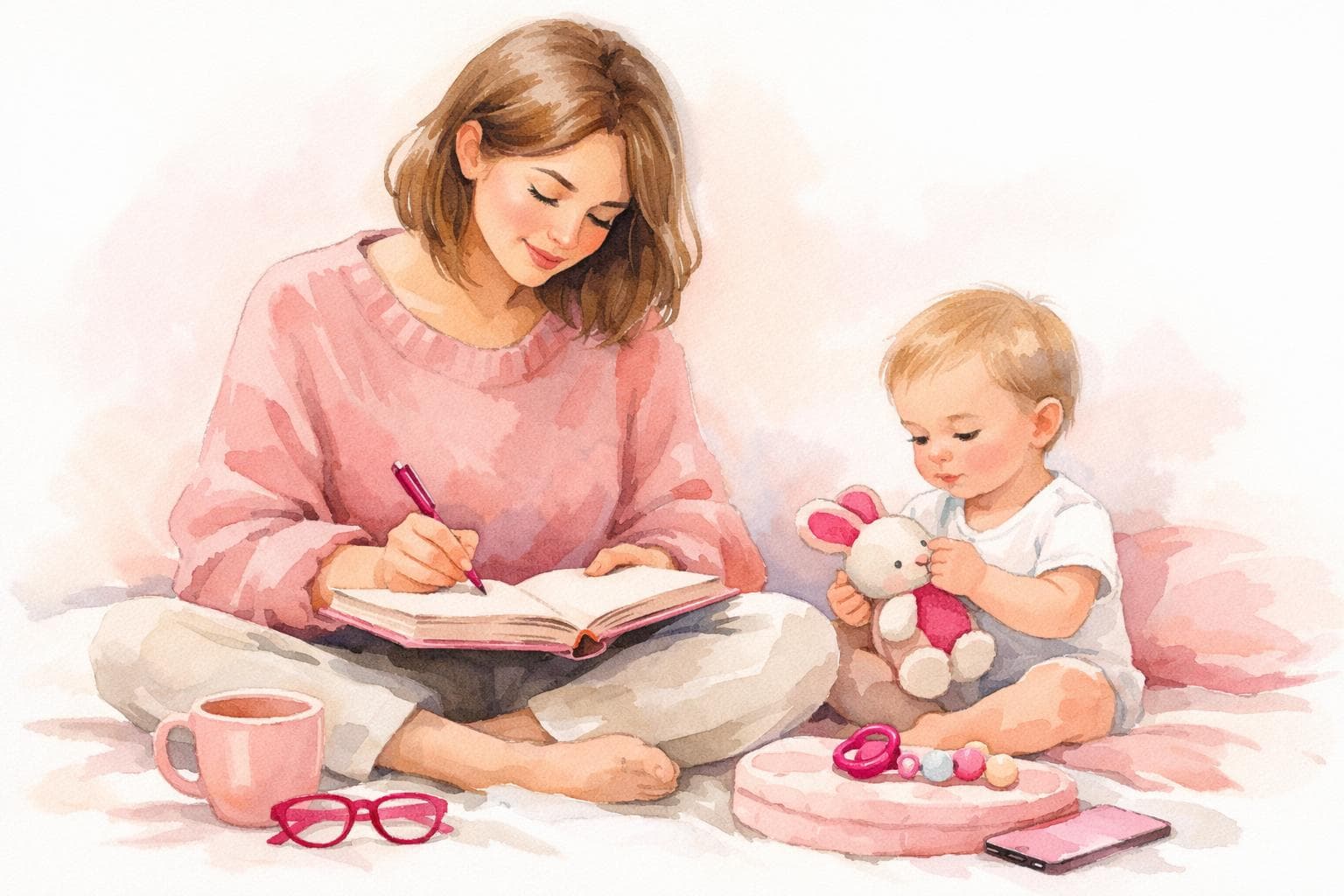
You do not need a leather-bound notebook. You do not need an hour. You do not need beautiful handwriting or deep thoughts. You need a pen, a scrap of paper and three minutes while the baby sleeps.
Journaling is one of the most studied self-help tools for new mothers and one of the least used. Not because it does not work. Because nobody tells you what to write. You open the page and the blankness stares back, and you close it again.
These 60 prompts are designed to fix that. They are short, specific and organised by what you are feeling, not by trimester or week. Go to the section that matches where you are today. Write one answer. That is enough.
Why journaling works for moms
A 2025 meta-analysis by Lim and colleagues examined five randomised controlled trials (n=483) and found that expressive writing significantly reduced postpartum depression symptoms and stress. The benefits appeared within weeks and persisted at three-month follow-up.
A separate RCT by Di Blasio and colleagues found that mothers who wrote about their birth experience for 15 minutes on three consecutive days showed lasting reductions in both depressive and PTSD symptoms, still measurable three months later. The benefits did not fade after the writing stopped.
The Huberman Lab podcast highlighted that over 200 published studies document the impact of expressive writing on mental health, including permanent shifts in how people process traumatic events.
You do not need to write well. You need to write honestly.
"Expressive writing significantly reduces postpartum depression symptoms, lowers stress, and may help prevent PTSD after traumatic births. The benefits appear within weeks and persist at 3-month follow-up." — Lim et al. (2025), meta-analysis of 5 RCTs
How to use these prompts
Pick one prompt. Set a timer for 3 to 5 minutes. Write without stopping, without editing, without judging. If you run out of things to say, write "I don't know what to say" until something comes. It always does.
You can write in a notebook, on your phone, on a napkin. The format does not matter. The act of externalising what is inside your head does.
Processing your birth (prompts 1 to 10)
- What is the first thing you remember from the birth?
- Was there a moment where you felt afraid? What happened?
- What did you need in that moment that you did not get?
- Write down what your body did. Not what the doctors did. What your body did.
- Is there something about the birth you have not said out loud yet?
- If you could go back and tell yourself one thing during labour, what would it be?
- How do you feel about your birth story when other people ask about it?
- What part of the experience do you want to remember?
- What part do you wish you could forget?
- Write a letter to yourself on the day your baby was born.
If your birth was traumatic, these prompts may surface difficult emotions. That is the point, but please do it gently. Our guide to postpartum PTSD can help you understand whether what you are carrying needs professional support.
Your identity now (prompts 11 to 20)
- Who were you before you became a mother?
- What parts of that person are still here?
- What parts feel like they have disappeared?
- When was the last time you did something just for yourself?
- Finish this sentence: "I used to be someone who..."
- Finish this sentence: "I am becoming someone who..."
- What do you miss most about your pre-baby life?
- What has motherhood given you that nothing else could?
- If a stranger asked you to describe yourself without mentioning your children, what would you say?
- Write about a moment this week where you felt like yourself again.
These prompts sit at the heart of matrescence, the developmental identity shift that comes with becoming a mother.
Your body after birth (prompts 21 to 28)
- How does your body feel right now, honestly?
- What has your body done that amazes you?
- What change has been hardest to accept?
- When you look in the mirror, what do you see first?
- Is there something you want to say to your body that you have not said yet?
- Write about one thing your body can do today that it could not do a month ago.
- How do you talk to yourself about your appearance? Would you say those words to a friend?
- What would it feel like to stop trying to "get your body back"?
If these prompts bring up grief, that is valid. Our article on grieving your pre-baby body names what many mothers feel but cannot articulate.
Your emotions (prompts 29 to 40)
# | Prompt |
|---|---|
29 | What emotion showed up most often this week? |
30 | What triggered your last cry? |
31 | Write about a moment you felt joy this week, even a small one |
32 | What are you angry about that you have not admitted yet? |
33 | What are you grieving right now? |
34 | Finish: "Nobody tells you that motherhood is..." |
35 | What would you say if you could be completely honest with your partner today? |
36 | What is the thought that wakes you at 3am? |
37 | What do you need right now that you are not getting? |
38 | Write about a moment you felt like a good mother this week |
39 | Write about a moment you felt like you were failing |
40 | If guilt had a voice, what would it say to you? What would you say back? |
Your relationships (prompts 41 to 48)
- How has your relationship with your partner changed since the baby?
- What do you wish your partner understood without you having to explain it?
- How has your relationship with your own mother changed?
- Who has shown up for you in a way that surprised you?
- Who has disappointed you?
- Write about a conversation you need to have but keep avoiding.
- What does support actually look like for you right now?
- If you could ask for one thing from the people around you, what would it be?
If grandparent dynamics are surfacing here, this article on when your parents become grandparents might help you process what you are writing.
Looking forward (prompts 49 to 55)
- What kind of mother do you want to be in five years?
- What kind of person, separate from being a mother, do you want to be in five years?
- What is one thing you want to start doing for yourself this month?
- What is one thing you want to stop tolerating?
- If you had one free afternoon with no responsibilities, how would you spend it?
- What would you tell a pregnant friend about what is coming?
- Write a promise to yourself for the next chapter.
Gratitude without pressure (prompts 56 to 60)
- What made you smile today, even briefly?
- What is one thing about your baby that fascinates you?
- Name something ordinary that felt good this week.
- Who or what are you quietly grateful for right now?
- Write one sentence about today that you want to remember when your child is ten.
Building a journaling habit that lasts
You do not need to write every day. Research shows that even three consecutive days of expressive writing can produce lasting benefits. But if you want a sustainable routine, here is what works:
Frequency | How to make it stick |
|---|---|
Daily (3 minutes) | Attach it to a trigger: write during the first morning feed or the last minutes before sleep |
Three times a week | Set three specific days; treat them like appointments with yourself |
Weekly (10 to 15 minutes) | Sunday evening works well; review the week, choose one prompt, write |
When you need it | Keep a notebook in your bag or a note on your phone; write when something surfaces |
The key is removing friction. A notebook by the bed. A pen that works. A prompt you have already chosen. The less you have to decide, the more likely you are to write.
If you want more structure in your mornings, our morning routine for exhausted moms includes space for a one-line intention that works as a journaling anchor. And if alone time is the barrier, 30 ways to find it with no help might open a window you did not know existed.
Your words are worth keeping
You will not remember this season the way you think you will. The fog, the love, the fear, the boredom, the beauty: it all blurs. What you write now is the only version of this time that will stay sharp.
Write it down. For yourself. For your child. For the woman you are becoming.
Sources and further reading
- Lim, C. et al. (2025). Expressive writing interventions for postpartum women: a meta-analysis of randomised controlled trials. Cited in MyLifeNote.ai.
- Di Blasio, P. et al. (2015). Expressive writing and postpartum depression and PTSD symptoms. Psychological Reports, 117(3), 856-882.
- Ayers, S. et al. (2018). Feasibility and acceptability of expressive writing with postpartum women: a randomised controlled trial (HABiT). BMC Pregnancy and Childbirth. pmc.ncbi.nlm.nih.gov
- George Mason University Center for the Advancement of Well-Being. (2024). The mental health benefits of journaling. wellbeing.gmu.edu
- Dr. Sarah Allen. (2026). Journaling for new moms: tips for calming anxiety. drsarahallen.com
- Pennebaker, J.W. & Smyth, J.M. (2016). Opening Up by Writing It Down. Guilford Press.