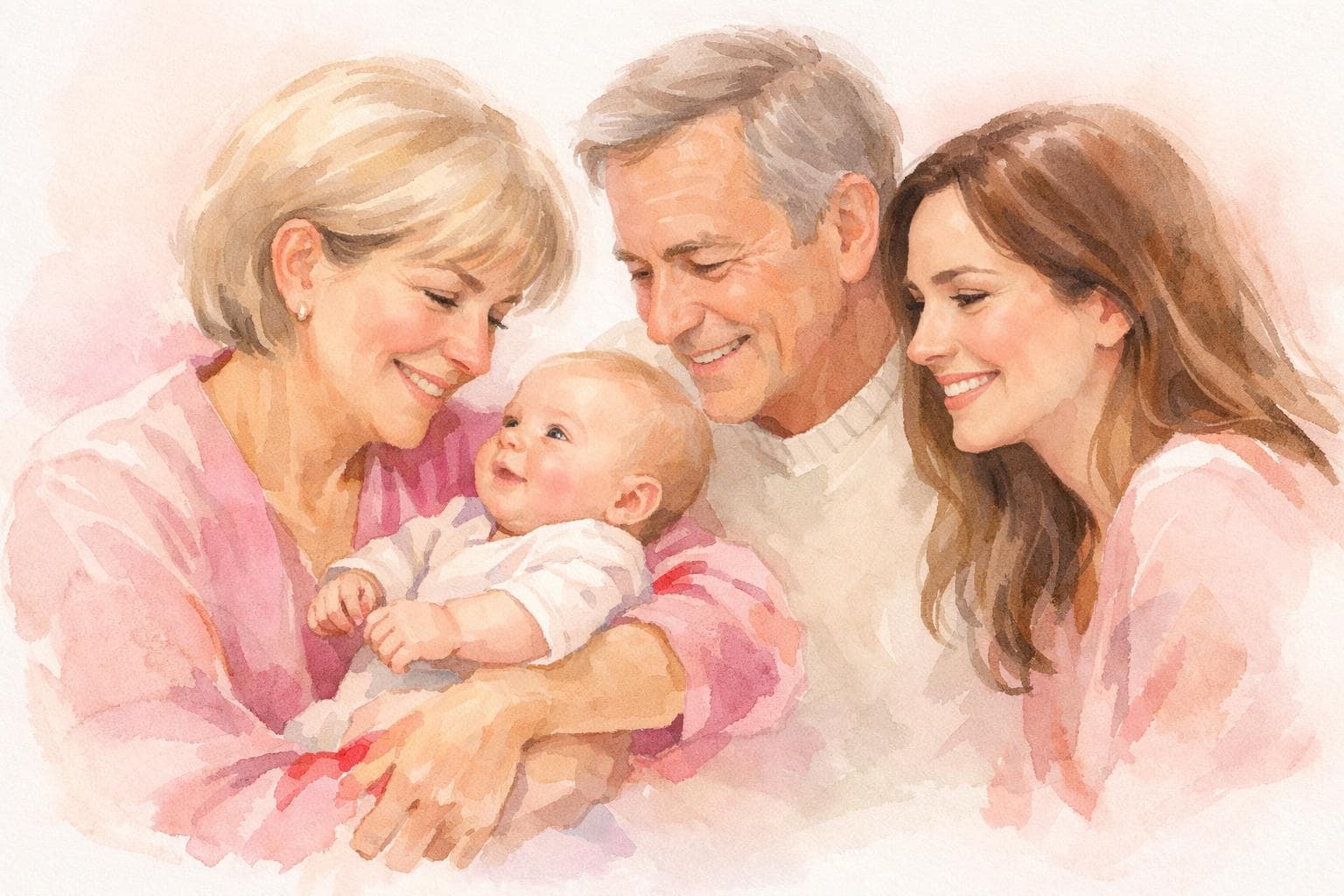
You thought having a baby would bring you closer to your parents. In some ways it did. Your mum shows up with casseroles. Your dad builds a cot. They hold your baby with a tenderness you have never seen before.
And then your mum gives the baby juice at four months. Your dad says you are overthinking the sleep schedule. Someone mutters that they raised three kids without a baby monitor and everyone turned out fine.
Something shifts. Not a dramatic falling-out. More like a quiet, grinding friction that was not there before. You love your parents. You also want to scream at them. Both of those things are true at the same time.
Welcome to one of the least talked-about transitions in new parenthood: the moment your parents become grandparents and your relationship with them starts changing shape.
Why does having a baby change things with your own parents?
Because a baby redraws every power line in the family.
Before the baby, your parents were the experts. They raised you. Their opinions on life, health, food, sleep and discipline sat in a comfortable, unchallenged space. Then you became a parent yourself, and suddenly you have your own opinions. Your own research. Your own instincts. And those do not always match theirs.
A 2024 systematic review published in the Journal of Family Theory and Review described this dynamic through a framework of intergenerational coparenting. The researchers identified five core domains in the parent-grandparent relationship: reciprocity, conflict, coping and adaptation, division of labour and power and authority. When those domains are in balance, the relationship works well. When they are not, tension builds fast.
The power and authority domain is often where the friction sits. Who decides how the baby sleeps? Who gets the final say on screen time? Who is allowed to override whom? These questions might sound small. They are not.
How common is grandparent conflict?
More common than most families admit.
According to the University of Michigan's C.S. Mott Children's Hospital National Poll on Children's Health, 43% of parents reported clashes with grandparents over parenting choices and household rules. The top areas of disagreement were:
- Discipline (57%)
- Meals and snacks (44%)
- Screen time (36%)
- Manners and safety (cited by multiple respondents)
- Treating grandchildren differently from one another
When parents asked grandparents to change their behaviour, results were mixed: 47% did change, 36% agreed but did not follow through and 17% refused outright. About 15% of parents said they had limited the time grandparents spent with their children because of ongoing interference.
These numbers tell a clear story. The conflict is widespread. It is predictable. And in most families, it is never openly addressed.
What the tension actually sounds like
What they say | What you hear |
|---|---|
"We didn't do it that way and you turned out fine" | "Your research and choices do not matter" |
"You're being too strict with her" | "You are a controlling parent" |
"Just give him a biscuit, it won't hurt" | "Your boundaries are not important" |
"You worry too much" | "Your feelings are exaggerated" |
"Let me take over, you need a break" | "You are not coping" |
Most of the time, grandparents are not trying to undermine you. They are drawing from what they know. But intent and impact are different things. And when you are sleep-deprived, hormonally adjusting and trying to find your footing as a new mother, even well-meaning comments can land hard.
It is not just about parenting style
Underneath the surface-level disagreements about sugar and screen time, something deeper is happening. Having a baby often forces you to revisit your own childhood. You start seeing your parents not just as parents but as people, with patterns, flaws and blind spots you might not have noticed before.
Psychologist Dr. Susan Forward writes about this in Toxic Parents, noting that becoming a parent yourself can be the first time you fully recognise the emotional dynamics you grew up with. That recognition does not mean your parents are toxic. But it does mean that old patterns, things like guilt-tripping, emotional control or dismissiveness, can become harder to tolerate once you have a child of your own to protect.
"Conflict happens when disagreements on childrearing exist across generations between parents and grandparents. When reciprocity is absent, the coparenting relationship suffers." - Bai et al. (2023), Integrative Framework of Intergenerational Coparenting
The guilt loop
This is the part that catches most new mothers off guard. You set a boundary with your parents, and then you feel terrible about it. Not because the boundary was wrong. Because setting limits with people who raised you feels like betrayal.
A 2023 Pew Research survey found that mothers are more likely than fathers to feel judged for their parenting decisions. When the person judging you is your own mother, the weight of that judgment doubles. You want her approval and her respect for your autonomy at the same time, and those two needs pull in opposite directions.
If this guilt sounds familiar, you might find it helpful to read about how to ask for help as a mom and emotional exhaustion in motherhood, both of which touch on the invisible emotional labour that sits behind family relationships.
What actually helps
Name what has changed
The first step is acknowledging that the relationship has shifted, out loud, without blame. Something like: "I love how involved you are. I also need to feel like my decisions are respected." That is not an attack. It is an invitation.
Be specific about your boundaries
Vague requests lead to vague compliance. Instead of "please respect how I do things," try "I'd prefer you check with me before giving her any food I haven't introduced yet." Clear, calm, direct.
Assume good intent first
Most grandparents are not deliberately overstepping. They are operating from a different era of parenting and a deep love for their grandchild. Starting from that assumption does not mean accepting everything. It means choosing the tone that keeps the conversation open.
Let some things go
Not every disagreement needs a correction. If your dad gives the toddler an extra biscuit at his house once a week, that is probably not the hill to stand on. Save your energy for the boundaries that genuinely matter to your child's safety and wellbeing.
Get support for the emotional weight
If the relationship with your parents is triggering old wounds or creating real distress, talking to a therapist can help you untangle what belongs to this moment and what belongs to your history. You can read about how therapy can help moms who feel stuck for more on this.
This is not about choosing sides
You do not have to choose between being a good daughter and being a good mother. But you do have to accept that the relationship with your parents will look different now. Not worse. Different. And different, once you find your footing in it, can actually be better.
Your parents gave you roots. Now you are growing your own. Both things can be true.
Sources and further reading
- Xu, Y. et al. (2024). Intergenerational coparenting and child development outcomes: a systematic review. Journal of Family Theory & Review. onlinelibrary.wiley.com
- Bai, Y. et al. (2023). An integrative framework of intergenerational coparenting. Cited in Xu et al. (2024).
- C.S. Mott Children's Hospital. National Poll on Children's Health: Grandparents and parenting disagreements. University of Michigan. mottpoll.org
- Pew Research Center. (2023). Parenting in America Today. pewresearch.org
- Forward, S. (1989). Toxic Parents: Overcoming Their Hurtful Legacy and Reclaiming Your Life. Bantam Books.