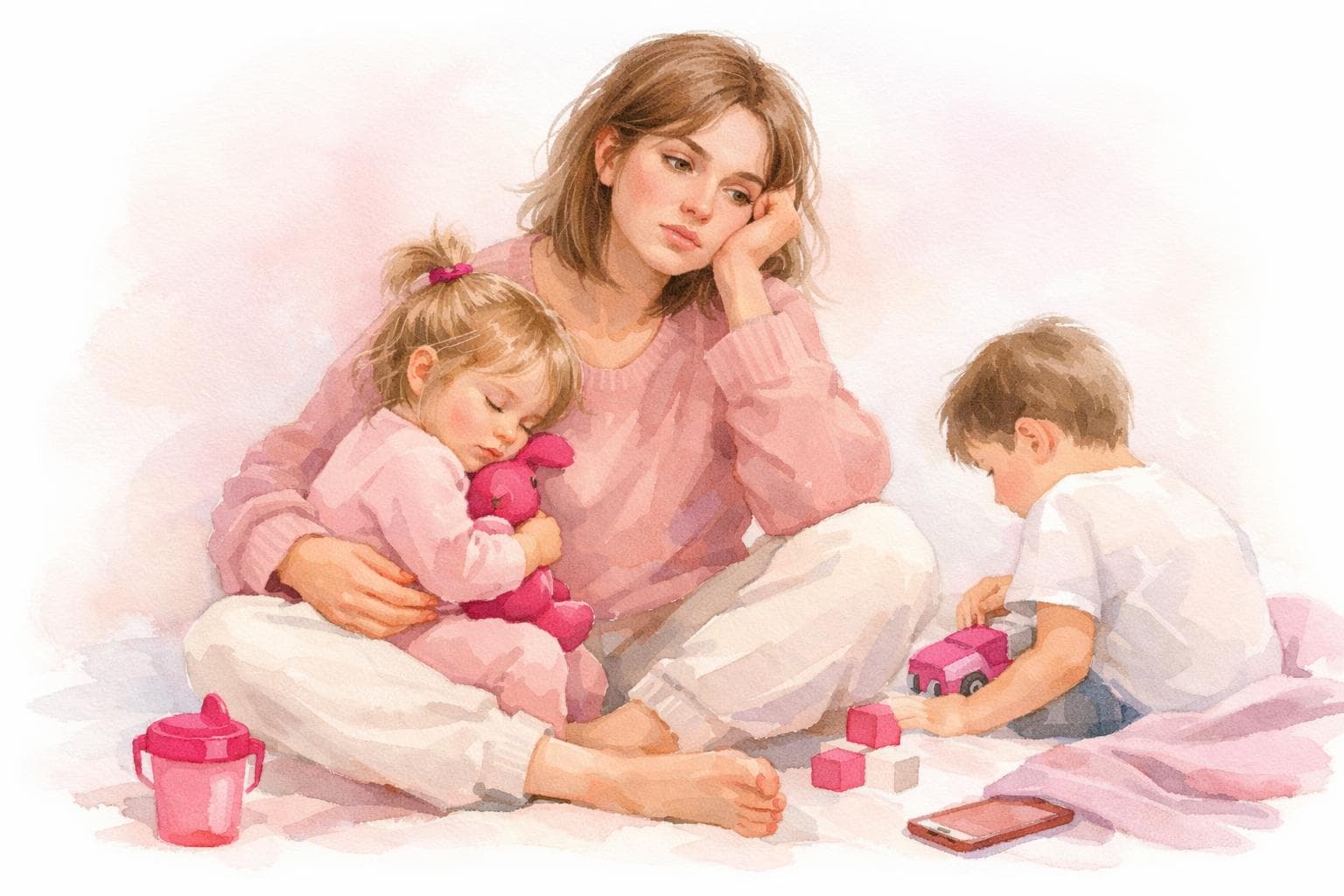
You get through the day. You feed everyone, you answer the emails, you fall into bed and do it again tomorrow. Somewhere along the way, "surviving" became the honest word for what you are doing, and "thriving" started to feel like a marketing term for a life that belongs to someone else. You are not broken. You are describing exactly what the largest recent surveys of motherhood found, in your own words, before you ever saw the data.
Surviving, not thriving describes a documented pattern in modern motherhood where mothers meet the basic demands of caregiving and daily function while systemic gaps in support, affordability and rest prevent genuine wellbeing, rather than reflecting any personal failure to cope. The Motherhood Index 2026, published by Peanut and Nuna in June 2026 from a survey of over 4,000 mothers across the US and UK, found that 93% of mothers report experiencing burnout, with 58% saying they feel burned out often or almost always. Motherly's 2025 State of Motherhood Survey, gathering responses from more than 2,200 US mothers, found that 54% say childcare is barely or not at all affordable, and one in five mothers feel lonely every single day. The Policy Center for Maternal Mental Health issued the United States a C-minus rating in 2025 for how well its systems meet mothers' needs. This is not anecdote. It is a consistent, cross-survey pattern.
The numbers that define the gap
Measure | Statistic | Source |
|---|---|---|
Mothers reporting burnout | 93%, with 58% often or almost always | Motherhood Index 2026 (Peanut/Nuna) |
Mothers getting fewer than 5 hours of unbroken sleep | 70% | Motherhood Index 2026 |
Mothers getting fewer than 4 hours of unbroken sleep | 36% | Motherhood Index 2026 |
Mothers who needed health support but couldn't access it or found it fell short | 48% | Motherhood Index 2026 |
Mothers saying childcare is barely or not at all affordable | 54% | Motherly 2025 State of Motherhood Survey |
Mothers listing childcare costs among their top two financial burdens | 39% | Motherly 2025 |
Mothers feeling lonely every single day | 1 in 5 | Motherly 2025 |
US maternal mental health systems rating | C-minus | Policy Center for Maternal Mental Health, 2025 |
Surviving vs thriving: what actually distinguishes them
Surviving | Thriving | |
|---|---|---|
Sleep | Fragmented; 70% report under 5 hours unbroken, per Motherhood Index 2026 | Consistent, restorative sleep most nights |
Support access | 48% needed health support and could not access it or found it insufficient | Timely, adequate access to physical and mental health care |
Financial stability | Childcare treated as barely affordable by 54% of mothers | Costs manageable within a sustainable share of household income |
Social connection | 1 in 5 mothers report daily loneliness | Regular, reliable adult connection and community |
Career trajectory | 28% say motherhood significantly paused or changed career plans; 22% scaled back ambitions | Career continuity or intentional, chosen change |
Self-perception | Redefining good to include an unsustainable structural load | A definition of good that does not require self-sacrifice as its baseline |
Forbes' 2026 coverage of the Motherhood Index put this distinction sharply: a generation of mothers has quietly redefined good to include an unsustainable structural load, meaning the 93% burnout figure and the fact that most of those same mothers still describe themselves as coping fine are not contradictory. They explain each other.
Why this is a systems problem not a personal one
A systematic review published in BMC Pregnancy and Childbirth confirms that both emotional and practical support are essential for mental wellbeing during the perinatal period, and that a lack of social support consistently increases stress and lowers maternal confidence across the research literature. Motherly's reporting is direct on the implication: if you feel overwhelmed or unsure, you are responding appropriately to the pressures you face. Your feelings are not a personal failing. They are a sign of how much responsibility mothers carry and how much support they deserve.
The maternal career penalty compounds the picture. Motherly found that among Millennial and Gen Z mothers specifically, 50% and 52% respectively have considered leaving their jobs because the cost and stress of childcare outweighs their earnings, a direct financial expression of the same structural gap. Our guide to the cost of raising kids in 2026 covers the specific numbers behind why that calculation increasingly does not work.
What mothers are building instead of waiting for reform
Both surveys found the same hopeful thread underneath the difficult numbers. Motherly's research describes mothers building micro-infrastructures of care, parent pods, rotating childcare arrangements, hybrid meetups and renewed reliance on extended family, essentially prototyping their own safety nets rather than waiting for systemic change. The Motherhood Index 2026 found that 43% of mothers cite stronger motherhood communities as their greatest source of optimism, outranking technology, policy change and mental health innovation combined.
"Good should not mean surviving on burnout, workarounds, and peer-built infrastructure. But for many modern mothers, it does." - Motherhood Index 2026, Peanut and Nuna
This finding connects directly to a pattern covered in our guide to the loneliness epidemic among mothers: the informal, extended networks that used to exist by default now have to be deliberately rebuilt, and doing so is one of the most consistently effective interventions mothers report.
What actually moves the needle from surviving toward thriving
Address burnout directly, not just its symptoms. If exhaustion has become your baseline rather than an occasional low, our guide to emotional exhaustion in motherhood covers the specific pattern that 93% burnout statistic describes.
Close the gap between childcare cost and household income deliberately. Given that 54% of mothers describe childcare as barely affordable, our guides to childcare costs and career decisions and tax credits stay-at-home moms are missing address the financial side of this specific pressure.
Treat community as infrastructure, not a luxury. Since 43% of mothers cite community as their greatest source of hope, actively building it matters as much as any individual coping strategy. Our guide to how to make adult friends after having kids covers exactly this.
Seek support before the gap becomes a crisis. With 48% of mothers unable to access adequate health support when they needed it, knowing where to look matters. Our guide to how to vet a therapist for postpartum anxiety applies well beyond the postpartum period specifically.
Key takeaways
- 93% of mothers report experiencing burnout, with 58% saying it happens often or almost always, according to the Motherhood Index 2026, based on a survey of over 4,000 mothers.
- 70% of mothers get fewer than five hours of unbroken sleep, and 36% get fewer than four, a physiological baseline that makes thriving structurally difficult regardless of individual coping skills.
- 54% of mothers describe childcare as barely or not at all affordable, and 50% to 52% of Millennial and Gen Z mothers specifically have considered leaving their jobs over this exact calculation.
- The gap between surviving and thriving is systemic, not personal. The US received a C-minus rating for maternal mental health system support in 2025, confirming that structural gaps, not individual failure, drive these statistics.
- Community, not policy change or technology, ranks as mothers' greatest source of optimism, cited by 43% in the 2026 survey, suggesting that deliberately rebuilt connection is one of the most accessible levers available right now.
Sources and further reading
- Peanut & Nuna. (2026). Motherhood Index 2026. PRNewswire. prnewswire.com
- Stengel, G. (2026). 93% of mothers are burned out, yet call themselves good. Forbes. forbes.com
- Motherly. (2025). The 2025 State of Motherhood Survey. mother.ly
- Young Eden. (2025). The state of motherhood 2025: what the data reveals, and what moms can do. youngeden.com
- BMC Pregnancy and Childbirth. (2024). Systematic review of social support during the perinatal period.
- Policy Center for Maternal Mental Health. (2025). State of maternal mental health in America: national report card.