
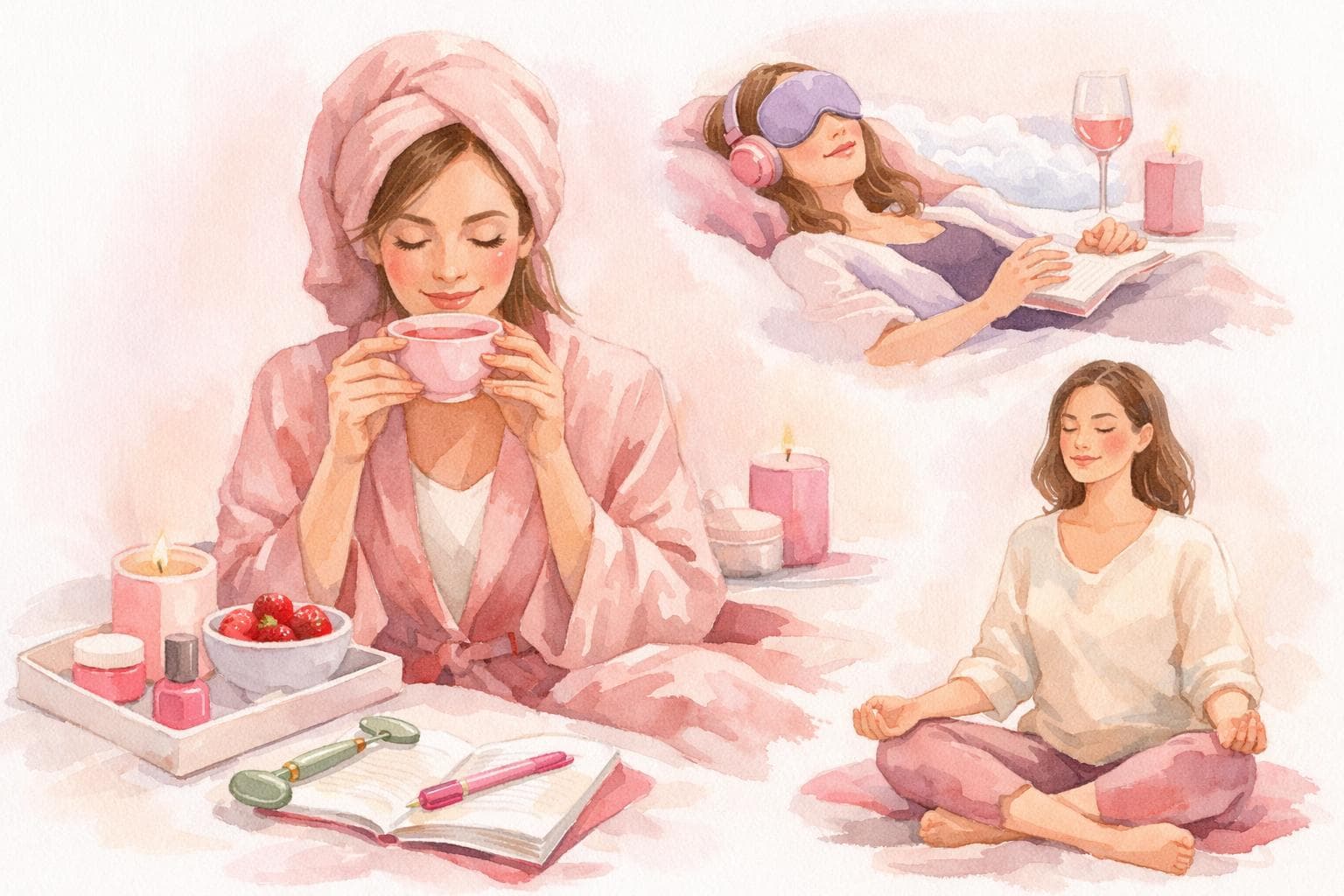
A wellness retreat sounds wonderful right up until you check the price and the childcare logistics required to actually attend one. Flights, a week away from your kids, a deposit that costs more than your monthly grocery bill. For most mothers, that version of rest is not happening this year, or possibly ever.
What you can do is build the same recovery mechanism into 48 hours, in your own house, for close to nothing.
A DIY reset weekend is a structured, self-designed 48-hour period at home built around the same core elements as a wellness retreat, uninterrupted rest, reduced input, gentle movement and reflection, adapted to fit within existing childcare and financial constraints. The World Health Organization officially classifies burnout as an occupational phenomenon resulting from chronic, unmanaged stress, and clinical research on burnout recovery consistently identifies dedicated, distraction-free time as one of the core mechanisms that makes formal retreats effective. The good news, according to Talkspace's clinical guidance on mom burnout, is that getting respite does not require hours away. Even a 10-minute meditation has been shown to improve mental focus and cognitive capacity, and a 20-minute workout or five minutes of stretching can meaningfully boost energy. The retreat industry has simply packaged what your nervous system needed all along into something expensive. This is the version you can build yourself.
Retreat vs DIY weekend: what you actually need from each
Formal retreat | 48-hour DIY reset | |
|---|---|---|
Core mechanism | Uninterrupted time, structured rest, expert guidance | Same uninterrupted time and rest, self-guided |
Cost | Often $500 to $3,000+ for a weekend programme | Near zero; existing home resources |
Childcare requirement | Full coverage for days, often requiring travel | Partial coverage, often manageable with a partner or single trusted helper |
Expert guidance | Present; therapists, coaches, structured sessions | Absent, unless supplemented by your own therapy or reading |
Community element | Built in; other participants on the same journey | Requires deliberate effort, a friend, a phone call, an online group |
Realistic frequency | Once a year, if at all, for most mothers | Monthly or quarterly, given lower cost and logistics |
Neither version is inherently superior. A retreat provides depth and expert structure that 48 hours at home cannot replicate. But the DIY version is repeatable, which matters more for sustained burnout recovery than one intense experience you cannot afford to repeat.
The four elements that actually matter, borrowed from clinical retreat design
Burnout recovery retreats structure their programming around specific, evidence-informed elements. You can build the same elements into a weekend at home.
1. Digital and input reduction. Retreats typically build in digital detox as a core component. At home, this means designating blocks where your phone is in another room, not just silenced. Reduced input is what allows an overstimulated nervous system to actually downshift.
2. Physical rest without guilt. Not a nap you feel obligated to justify. Scheduled, protected rest, treated with the same seriousness as a work meeting, blocked out in advance and defended from interruption.
3. Gentle movement, not exercise as another obligation. A short walk, stretching, slow yoga. The goal is regulation, not performance. Research consistently shows that even brief movement supports mood and energy without requiring an intense workout.
4. Reflection and naming. Retreats often include guided journaling or therapeutic conversation. At home, this can be a private journal entry or a voice note to yourself, naming what has been depleting you and what you actually need going forward.
The 48-hour structure
Time block | Focus | What to do |
|---|---|---|
Friday evening | Transition and boundary-setting | Close out the work week explicitly; tell your partner or support person which hours you are protecting this weekend |
Saturday morning | Digital reduction and gentle movement | Phone in another room for the first two hours; a short walk or stretch before checking anything |
Saturday midday | Protected rest | A genuine nap or quiet hour, scheduled and defended, not squeezed in apologetically |
Saturday afternoon | Reflection | Journal or voice-note what has been draining you lately, without editing for how it sounds |
Saturday evening | Low-input comfort | A favourite meal, a book, an early night; nothing that requires performance or hosting |
Sunday morning | Nature or sensory reset | Time outside if possible; fresh air and natural light support circadian regulation |
Sunday midday | One small joy | A hobby, a creative task, something that belongs entirely to you, unconnected to caregiving |
Sunday evening | Re-entry preparation | A brief version of an evening reset to ease back into the week ahead |
What makes this actually work, not just a nicer to-do list
The difference between a genuine reset and a slightly nicer weekend is protection. Talkspace notes that decluttering a small physical space and creating a dedicated quiet nook can itself function as a retreat-like cue, a signal to your nervous system that this space and time are different from the rest of your week.
"Getting some respite from the busy mom life doesn't mean you must take hours to relax. Embrace quick resets that can be just as effective in refreshing your energy." - Talkspace (2024)
The protection matters more than the activities themselves. If your 48 hours are constantly interrupted by requests, chores or guilt, the structure collapses regardless of how well you planned it. This requires an explicit conversation beforehand, not an assumption that everyone will simply understand.
Who needs to be told, and what to say
Tell your partner or support person specifically which hours are protected, not just that you would like some rest generally. "I need Saturday 9 to 11am to be fully mine, no interruptions" is a request people can actually honour. A vague wish for a relaxing weekend usually dissolves by 10am on Saturday.
If asking for this protected time still feels difficult, our guide to asking for help without feeling weak addresses exactly that barrier. And if the underlying exhaustion feels bigger than any single weekend can fix, our guide to emotional exhaustion in motherhood is worth reading alongside this practice.
When 48 hours is not enough
A DIY reset weekend supports ongoing wellbeing. It is not a substitute for clinical treatment if what you are experiencing is closer to burnout in the WHO sense, chronic, unmanaged and significantly interfering with functioning, or if it overlaps with depression or anxiety. Our postpartum anxiety symptom checklist can help you assess whether what you are carrying needs more than a weekend to address.
Key takeaways
- A DIY reset weekend borrows the same core mechanisms as formal wellness retreats, uninterrupted rest, reduced input, gentle movement and reflection, without the cost or childcare demands of travel.
- Even brief interventions have documented benefit. Research cited by Talkspace found that a 10-minute meditation can improve mental focus, and short movement sessions meaningfully boost energy.
- Protection matters more than planning. Explicitly telling your support person which specific hours are off-limits is what prevents the structure from collapsing under everyday demands.
- The DIY version is repeatable, which matters more for sustained burnout recovery than a single expensive retreat you can only afford once a year, if that.
- This practice supports wellbeing but does not replace clinical treatment if what you are experiencing meets the threshold for burnout, depression or anxiety requiring professional support.
Sources and further reading
- Talkspace. (2024). Battling mom burnout: how to reclaim your energy. talkspace.com
- World Health Organization. (2019). Burn-out an "occupational phenomenon": International Classification of Diseases.
- InPowered Therapy. (2026). Rest as revolution retreat: reclaiming self from mom burnout. inpoweredtherapy.com
- Retreat.guru. (2025). Healing burnout: retreats vs. at-home self-care strategies. blog.retreat.guru
- MentalHealth.com. (2026). Mental health retreats: overview and benefits. mentalhealth.com
- Nagoski, E. & Nagoski, A. (2019). Burnout: The Secret to Unlocking the Stress Cycle. Ballantine Books.