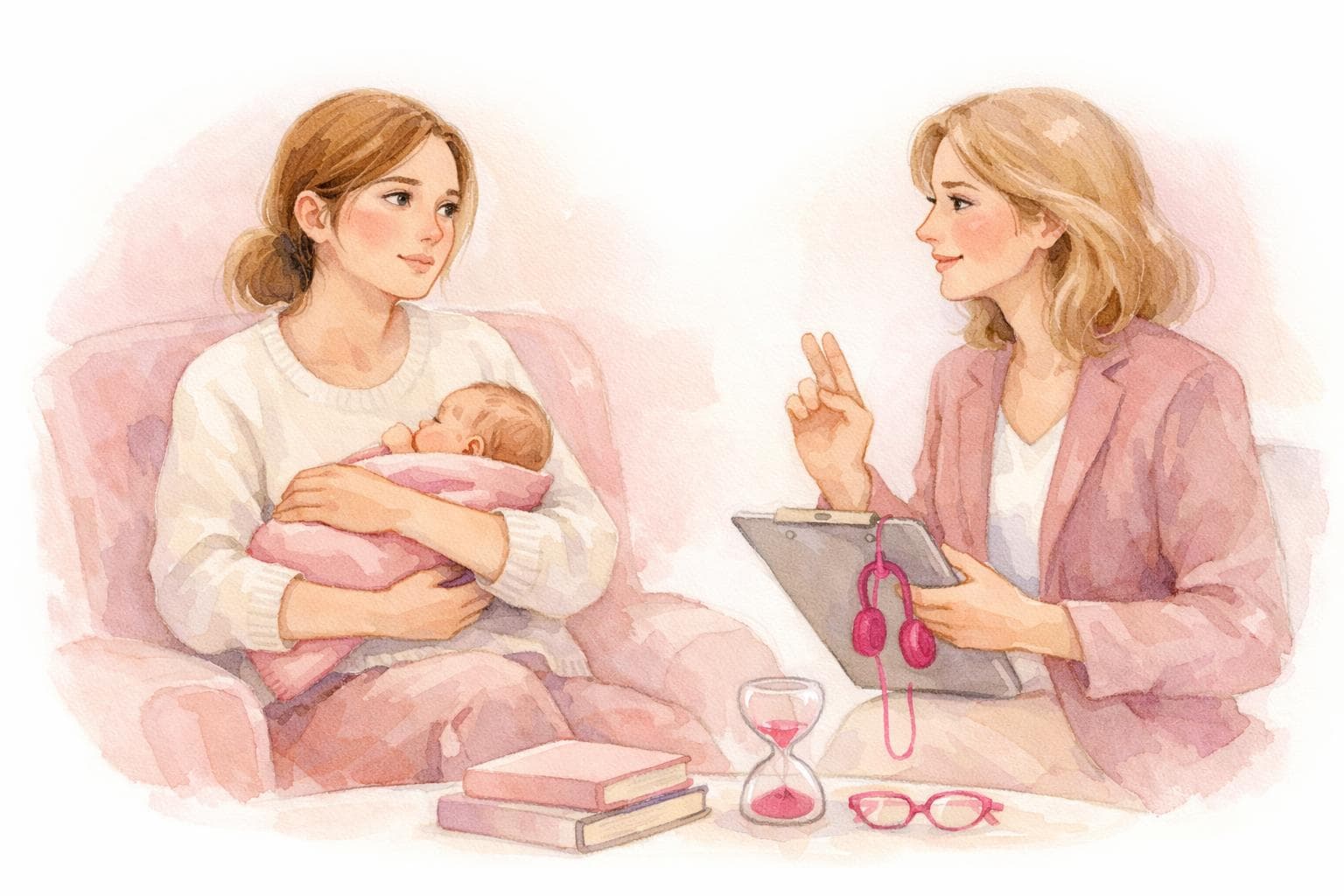

Every new mother worries. You check the breathing. You google the rash. You feel your chest tighten when the babysitter is fifteen minutes late texting back. This is expected. Nobody hands you a newborn and expects calm indifference.
But somewhere there is a line between "I worry because I love this baby" and "the worry has taken over my life," and most mothers cannot find it because nobody ever draws it clearly. This checklist draws it.
Postpartum anxiety is a clinical condition marked by excessive, persistent worry that is difficult to control, interferes with daily functioning, and is accompanied by physical symptoms such as restlessness, muscle tension or sleep disruption, distinguishing it from the situational, manageable worry that is a normal part of early motherhood. According to the DSM-5, generalised anxiety disorder specifically involves excessive, uncontrollable anxiety occurring more days than not, causing functional impairment across areas of life. The Generalized Anxiety Disorder 7-item scale, or GAD-7, is the most widely validated tool for identifying it, with a 2024 psychometric study in BMC Public Health confirming strong reliability specifically in postpartum populations. This article turns the clinical criteria into a practical checklist you can actually use.
The core distinction in one sentence
Normal worry is proportionate, occasional and controllable. Postpartum anxiety is disproportionate, persistent and feels impossible to switch off, regardless of reassurance or evidence that everything is fine.
Symptom-by-symptom checklist
Go through each item and note whether it describes an occasional experience or a near-daily pattern. The GAD-7, validated across multiple postpartum populations including a 2024 Polish study of 278 mothers, asks about the two weeks prior, which is a useful window to use here too.
Symptom | Normal new-mom worry | Postpartum anxiety |
|---|---|---|
Feeling nervous or on edge | Occasionally, tied to a specific trigger | Most days, without a clear or proportionate trigger |
Ability to stop worrying once reassured | Worry settles once you check on the baby or get an answer | Worry persists even after reassurance; a new worry often replaces the old one |
Range of worries | Focused on one or two specific, real concerns | Worry spreads across many domains: health, safety, finances, the future, things that have not happened |
Trouble relaxing | Able to unwind during calm moments | Physically unable to relax even when the baby is sleeping safely nearby |
Restlessness | Mild fidgeting when stressed | Difficulty sitting still; a persistent sense of being wired or on alert |
Irritability | Occasional short temper when exhausted | Frequent irritability that feels disproportionate to the trigger |
Fear something bad will happen | Passing thought, quickly dismissed | Persistent dread, sometimes with a specific catastrophic scenario that repeats |
Physical symptoms | Rare; occasional tension headache | Frequent: racing heart, nausea, muscle tension, shortness of breath |
Sleep | Disrupted by the baby, but able to fall back asleep | Cannot fall asleep even when the baby is asleep, because the mind will not stop |
Impact on daily functioning | Manageable; you can still complete tasks and enjoy moments | Worry interferes with feeding, working, socialising or caring for yourself |
If the right-hand column describes more of your recent experience than the left, that is worth a conversation with your provider, not something to manage alone indefinitely.
Why this distinction is so often missed
Standard postnatal screening in the US typically uses the EPDS, which was designed primarily to detect depression. A 2022 validation study published in BMC Pregnancy and Childbirth found that while the EPDS includes some anxiety-related items, a dedicated anxiety measure like the GAD-7 captures the condition far more reliably. Women's Healthcare, a peer-reviewed clinical journal, notes that perinatal anxiety disorders remain under-recognised precisely because depression screening dominates routine perinatal care, even though anxiety is at least as common.
Our guide to postpartum anxiety screening beyond the EPDS explains this gap in more depth and covers the additional tools, including PASS and PSAS, that capture symptoms the standard screen misses.
Scoring context: what a GAD-7 result actually means
If you take the GAD-7 through your provider, here is how to interpret the result.
GAD-7 score | Severity | What it suggests |
|---|---|---|
0 to 4 | Minimal | Anxiety symptoms are unlikely to be clinically significant |
5 to 9 | Mild | Watch for progression; lifestyle support and monitoring are reasonable first steps |
10 to 14 | Moderate | Clinical evaluation is warranted; therapy is typically indicated |
15 to 21 | Severe | Prompt clinical assessment; combined treatment is often recommended |
Recommended cutoff scores for identifying clinically significant anxiety have varied across validation studies, ranging from 7 to 13 depending on the population studied, according to a psychometric review published in PMC. This variability is one reason a single number should never be the only basis for a decision; the pattern across the whole checklist, alongside how you feel day to day, matters more than any single score.
"Generalized Anxiety Disorder is characterized by excessive, uncontrollable anxiety and feeling worried for at least six months that can cause functional impairment in various areas of life." - Lutkiewicz et al., BMC Public Health (2024)
What to do if the checklist describes you
Name it specifically to your provider. Instead of "I've just been stressed," try "I feel anxious most days, I have trouble relaxing even when the baby is fine, and it's affecting how I function." Specific language gets a more accurate response than vague language.
Ask for the GAD-7, not just the EPDS. Many postnatal check-ups only administer the depression screen. You are allowed to ask for the anxiety-specific tool directly.
Rule out physical contributors. Thyroid dysfunction, anaemia and other postpartum physical changes can produce anxiety-like symptoms. A basic panel is a reasonable first step alongside a mental health conversation.
Know your treatment options. Cognitive behavioural therapy has strong evidence for postpartum anxiety. Our guide to CBT for postpartum depression covers the broader CBT approach, much of which applies directly to anxiety treatment as well.
If intrusive, repetitive thoughts specifically about your baby's safety are part of the picture, that may point toward a related but distinct condition. Our guide to postpartum intrusive thoughts: anxiety or OCD explains how to tell the difference.
Key takeaways
- The core distinction is proportion and control. Normal worry settles with reassurance; postpartum anxiety persists regardless of evidence that things are fine.
- The GAD-7 is the most validated screening tool for perinatal anxiety, with strong reliability confirmed across multiple 2024 studies in postpartum populations specifically.
- Standard postnatal care often screens only for depression, meaning anxiety frequently goes undetected unless you ask for the GAD-7 directly.
- Physical symptoms, including restlessness, muscle tension, racing heart and disrupted sleep even when the baby is asleep, are as important as the worry itself when assessing where you fall on this spectrum.
- If intrusive thoughts specifically about harm to your baby are part of your experience, that may indicate a related but distinct condition requiring different treatment.
Sources and further reading
- Lutkiewicz, K. et al. (2024). Psychometric properties of the generalized anxiety disorder questionnaire (GAD-7) in a Polish postpartum women sample. BMC Public Health, 24, 2706. pmc.ncbi.nlm.nih.gov
- Vogazianos, P. et al. (2022). Validation of the generalized anxiety disorder screener (GAD-7) in Cypriot pregnant and postpartum women. BMC Pregnancy and Childbirth. link.springer.com
- Farrell, M.L. (2022). Update on perinatal anxiety disorders: assessment and management. Women's Healthcare. npwomenshealthcare.com
- PMC. (2016). Diagnostic validity of the Generalized Anxiety Disorder-7 (GAD-7) among pregnant women. pmc.ncbi.nlm.nih.gov
- American Psychiatric Association. (2013). Diagnostic and Statistical Manual of Mental Disorders, 5th Edition (DSM-5).
- Spitzer, R.L. et al. (2006). A brief measure for assessing generalized anxiety disorder: the GAD-7. Archives of Internal Medicine, 166(10), 1092-1097.