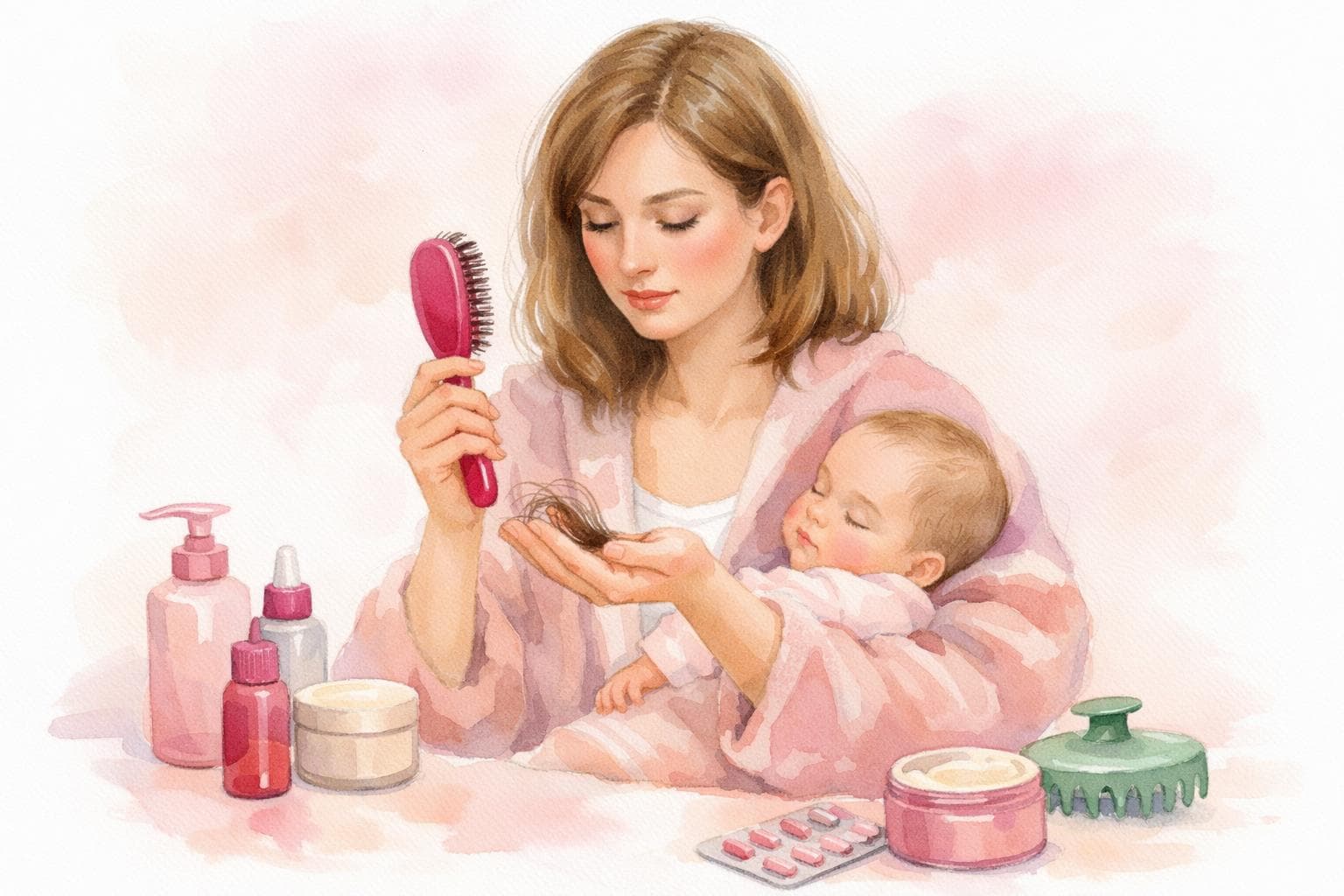
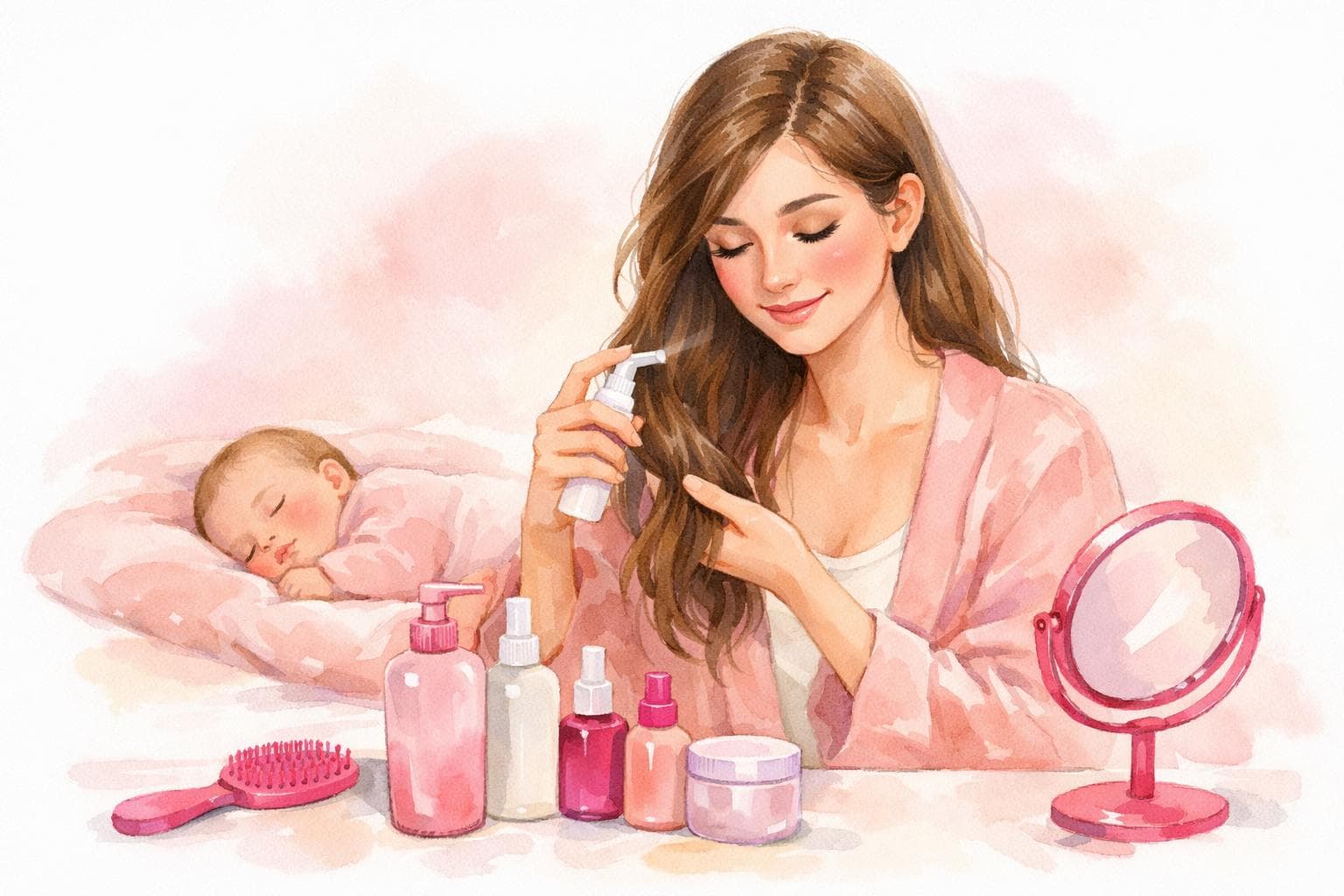
You have already Googled it at 2am while feeding the baby, scrolled past seventeen miracle serums with five-star reviews, and still have no idea which ones are backed by anything real. Some of what circulates online is genuinely useful. A lot of it is just well-marketed hope. And you may not want to start with a prescription medication at all, whether that is a personal preference, a breastfeeding concern, or simply wanting to try the simplest option first.
A no-prescription postpartum hair loss remedy is a topical lotion, serum or habit backed by clinical evidence that you can buy over the counter or use at home, without needing a doctor's sign-off, unlike prescription-strength treatments. Rosemary oil currently sits at the top of that list. A 2015 trial published in Skinmed Journal found that participants applying rosemary oil to the scalp twice daily for six months showed hair count improvement equivalent to those using 2% minoxidil, with significantly fewer side effects. A 2025 review in the International Journal of Trichology, which examined 24 studies on non-conventional topical actives, found consistent, if still-developing, evidence for several plant-based and peptide ingredients as legitimate add-on options. This guide covers nine remedies you can start using today, no appointment required.
For the full timeline of what to expect and when postpartum shedding actually resolves, our guide to postpartum hair loss: the timeline, treatments, and when to worry covers that ground in depth.
The 9 remedies, ranked by evidence strength
# | Remedy | Evidence level | Where to find it |
|---|---|---|---|
1 | Rosemary oil | Strongest of the non-prescription options; comparable to 2% minoxidil in one trial | Pure essential oil, or rosemary-infused shampoos and scalp serums |
2 | Caffeine-infused scalp serums | Moderate; shown to improve circulation and support keratin production | Standalone caffeine serums or added to shampoos and conditioners |
3 | Peptide serums | Moderate; strengthens strands and reduces breakage | Multi-peptide leave-in serums |
4 | Niacinamide and panthenol formulas | Moderate; supports scalp barrier and strand strength | Scalp-focused serums and conditioners |
5 | Saw palmetto, topical | Moderate; a plant-based option that may reduce DHT activity | Serums marketed for hormonal or postpartum shedding |
6 | Ketoconazole or anti-dandruff shampoo | Moderate; supports scalp health directly | Any pharmacy or supermarket, no prescription needed |
7 | Gentle hair care and low-tension styling | Strong; well-established dermatology guidance | Free; a habit, not a product |
8 | Nutrient-rich diet | Strong; addresses genuine postpartum depletion | Whole foods, no product needed |
9 | At-home low-level laser therapy, LLLT | Moderate; growing evidence base | Over-the-counter laser caps or combs |
What each remedy actually does
1. Rosemary oil. Dr. Dara Spearman, a board-certified dermatologist, recommends rosemary oil specifically because it has been scientifically shown to promote hair growth and decrease shedding. Its active compound, carnosic acid, inhibits the enzyme that converts testosterone into DHT, which is directly relevant postpartum, since the sharp drop in estrogen after birth creates a relative DHT surge. Dilute pure essential oil in a carrier oil before applying directly to the scalp, or look for it as a leading ingredient in a shampoo or leave-in serum.
2. Caffeine-infused scalp serums. Caffeine is a stimulant that increases circulation, allowing beneficial nutrients and oxygen to be delivered to the hair follicles, according to Dr. Michele Green, a board-certified dermatologist. Research also suggests caffeine may help block the conversion of testosterone into DHT, the same hormonal pathway rosemary oil targets.
3. Peptide serums. These help fortify weakened strands and reduce breakage, especially during brushing or heat styling, and are frequently recommended by dermatologists as a supportive layer alongside other treatments rather than a standalone fix.
4. Niacinamide and panthenol formulas. Niacinamide, or vitamin B3, soothes the scalp, improves barrier function, and may support healthier follicles. Panthenol, or pro-vitamin B5, moisturises and strengthens the hair shaft, directly reducing breakage during the peak shedding window.
5. Saw palmetto. A plant-derived extract that inhibits 5-alpha-reductase, the same enzyme rosemary targets, and is increasingly included in serums aimed at hormonal or postpartum-specific shedding rather than general thinning.
6. Ketoconazole or anti-dandruff shampoo. Dr. Joseph Kamel, a board-certified dermatologist, notes that ketoconazole or anti-dandruff shampoos may treat underlying scalp disorders which increases hair growth, making them a reasonable, fully over-the-counter addition to any routine.
7. Gentle hair care and low-tension styling. Avoid tight hairstyles like ponytails or buns that increase breakage and place tension on already-vulnerable follicles, minimise heat styling, and use a mild, sulfate-free shampoo. This costs nothing and directly reduces the visible severity of shedding.
8. Nutrient-rich diet. Pregnancy and postpartum recovery deplete iron, protein and B vitamins that hair follicles need to function. Prioritising protein, iron-rich foods and omega-3s supports regrowth from the inside, independent of anything you apply topically.
9. At-home low-level laser therapy. LLLT devices, typically a cap or comb used several times weekly, represent a genuinely non-prescription category with a growing evidence base, and involve no systemic absorption, making them a reasonable option regardless of breastfeeding status.
What to actually look for on a label
The 2025 International Journal of Trichology review is candid about the state of the evidence here: most studies on these topical actives have limited sample sizes and lack comparison with standard therapies, and the researchers note that consumers are frequently targeted with sponsored marketing gimmicks through social media. That does not mean these ingredients are useless. It means the honest expectation is support, not a guaranteed fix.
- Avoid harsh ingredients like alcohol, sulfates or sulfides, which can irritate an already-sensitive postpartum scalp.
- Look for named, studied actives: rosemary extract, caffeine, peptides, niacinamide, panthenol or saw palmetto, rather than vague hair growth blend labelling.
- If using pure essential oils, dilute them in a carrier oil like jojoba before scalp application to avoid irritation.
- Give any product genuine time. Recovery from telogen effluvium takes 6 to 12 months regardless of product use, according to the American Academy of Dermatology, so a lotion supports the process rather than shortening it dramatically.
"Products support the environment; they do not override hormones." - Adapted from KITSCH's 2026 postpartum hair care guidance
When it is time to talk to a doctor anyway
Non-prescription options are a reasonable starting point, but they are not a substitute for medical evaluation if shedding continues past 12 months, hair loss becomes patchy rather than diffuse, or you notice scalp burning, itching or visible redness. At that point, a dermatologist can determine whether a prescription-strength option or further testing is appropriate, something none of the remedies above can substitute for.
Key takeaways
- Rosemary oil currently has the strongest evidence among non-prescription options, with one 2015 trial finding results comparable to 2% minoxidil over six months.
- Caffeine, peptides, niacinamide and panthenol all target different parts of the shedding process, from circulation to strand strength to scalp barrier health, and can reasonably be layered together.
- Gentle hair care and nutrition cost nothing and have the strongest overall evidence base, forming the foundation any topical product should sit on top of, not replace.
- A 2025 review of 24 studies found genuine but still-developing evidence for these ingredients, and cautioned that heavy social media marketing outpaces the actual research in most cases.
- No topical product shortens the core 6 to 12 month recovery window. They support the process; persistent shedding beyond a year still warrants a dermatologist visit.
Sources and further reading
- NBC News Select. (2025). There's no way to prevent postpartum hair loss, but you can set the stage for future regrowth. nbcnews.com
- Bikash, C. (2025). Topical Alternatives for Hair Loss: Beyond the Conventional. International Journal of Trichology, 17(1), 13-19. pmc.ncbi.nlm.nih.gov
- National Council on Aging. (2026). Best hair loss treatments and medications of 2026. ncoa.org
- TODAY. (2026). The best products and ingredients for thinning and fine hair 2026. today.com
- KITSCH. (2026). Postpartum hair loss: what actually helps (and what doesn't). mykitsch.com
- CNN Underscored. (2026). The best hair growth products that'll actually work, according to dermatologists. cnn.com