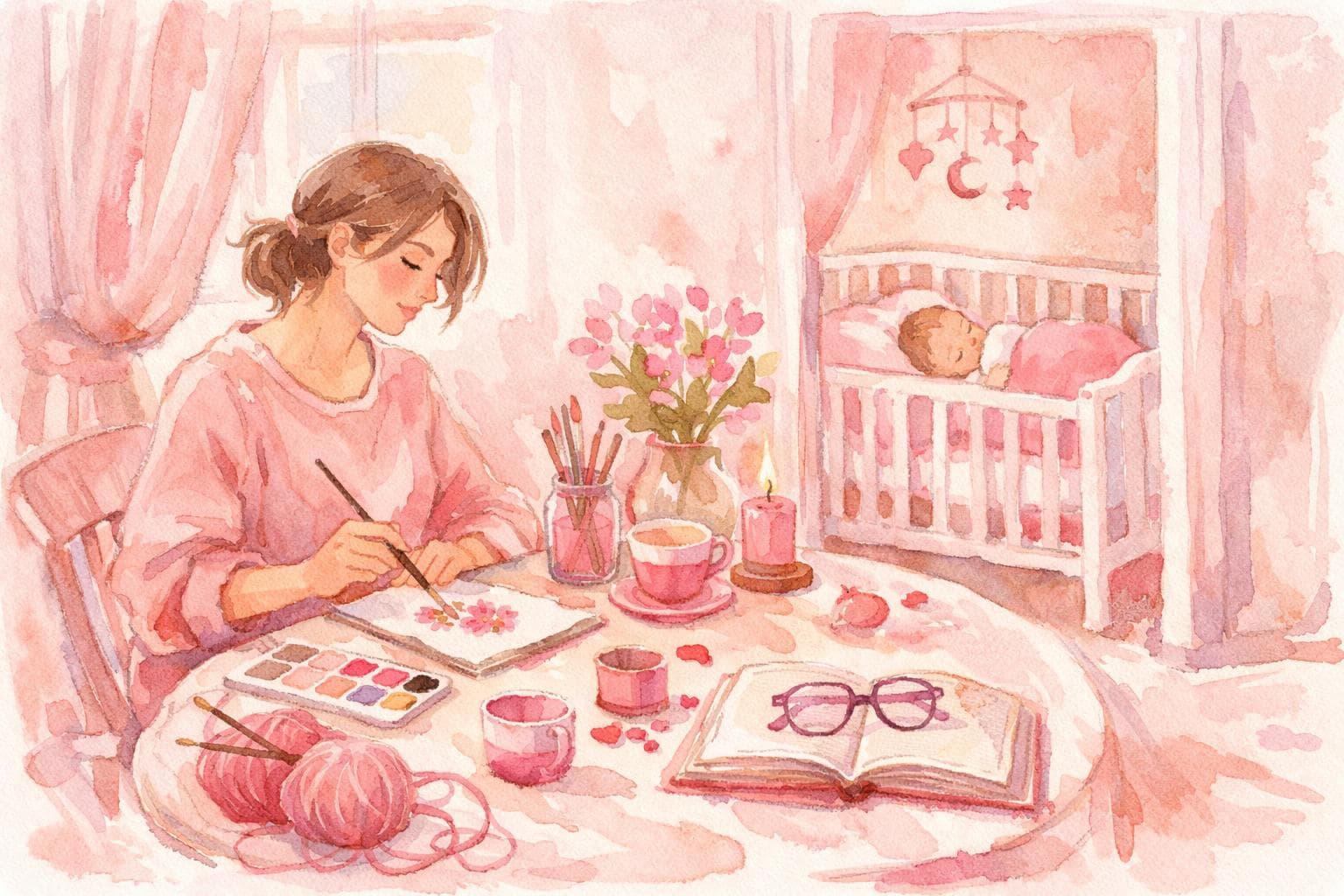
The baby is asleep. The monitor light glows green. You have somewhere between twenty minutes and an hour before it all starts again. And the question hangs in the air: do I clean, scroll or do something that is actually mine?
Most days, the cleaning wins. Or the scrolling does. And by the time the baby wakes, you feel no different than before they went down. Rested, no. Restored, definitely not.
What if nap time became the one window in your day where you did something quiet, absorbing and entirely for yourself? Not productive. Not performative. Just yours.
Why quiet hobbies restore you in ways scrolling cannot
A landmark study published in Psychosomatic Medicine tracked over 1,300 adults and found that enjoyable leisure activities were associated with lower cortisol, lower blood pressure, lower body mass index and better sleep. The researchers defined restorative activities as those that involve little mental effort, provide a sense of "being away," maintain gentle engagement and match the person's interests.
Scrolling social media does not meet those criteria. It keeps your brain in input mode: comparing, reacting, consuming. Quiet hobbies do the opposite. They shift your nervous system from sympathetic activation (scanning, responding, managing) into parasympathetic recovery (restoring, settling, being).
A 2025 scoping review published in Issues in Mental Health Nursing examined 11 studies on hobbies and mental health. Three consistent themes emerged: reduced depression, anxiety and stress; improved quality of life and wellbeing; and greater social connection and support. The review noted that creative hobbies in particular were associated with significantly lower levels of depression and anxiety.
For a mother whose entire day is spent in high-alert caregiving mode, a quiet hobby during nap time is not a luxury. It is one of the few chances your nervous system gets to come down.
"Creative hobbies reduce stress by giving you a sense of mastery and pleasure while silencing mind noise." - Dr. Sherry Pagoto, University of Connecticut, Psychology Today (2025)
What makes a good nap-time hobby?
Not every hobby suits a nap window. The best ones share four qualities:
Quality | Why it matters |
|---|---|
Quiet | No noise that might wake the baby through the monitor |
Low setup | You can start within 60 seconds; no clearing a table or gathering supplies from three rooms |
Pausable | You can stop mid-activity without losing progress if the baby wakes early |
Absorbing | It holds your attention enough to stop the mental to-do list from running |
If an activity meets all four, it fits the nap window. If it only meets two, it might frustrate you more than restore you.
15 quiet hobbies for nap time
Hands-on and creative
- Watercolour a small painting. Keep a postcard-sized pad and a travel set on the kitchen counter. No easel. No prep. Sit, paint, stop when the monitor beeps.
- Embroider or cross-stitch. Repetitive, meditative and silent. Each session adds a visible inch of progress, which feels quietly satisfying in a phase of life where so little stays finished.
- Hand-letter a quote. One brush pen, one piece of paper, one sentence that means something to you today. Three minutes of focused creative work.
- Knit or crochet a few rows. The rhythmic, repetitive motion activates the parasympathetic nervous system. Research on craft-based activities has linked knitting to reduced anxiety and improved self-reported calm.
- Press flowers or leaves from a walk. Collect them during the day, press them during nap time. Low effort, beautiful results over time.
- Collage in a journal. Keep a small pile of torn magazine pages and a glue stick. Arrange images that appeal to you. No rules. No outcome. Just visual play.
Reading and writing
- Read five pages of a novel. Not a parenting book. A novel. Fiction lets your brain enter someone else's world for a few minutes, which is one of the most effective forms of mental rest.
- Write three sentences in a journal. Not a full entry. Three sentences about what you noticed, felt or want today. Over weeks, this becomes a quiet record of a season you will barely remember otherwise.
- Write a letter by hand. To a friend, to yourself, to your child for when they are older. The slowness of handwriting forces your brain to decelerate.
- Read one poem. Poetry is designed to be read slowly. One poem during nap time takes two minutes and can shift your entire inner landscape.
Sensory and restorative
- Listen to a full album with your eyes closed. Not a playlist on shuffle. One album, start to finish. Treat it like a concert for one.
- Do a jigsaw puzzle. Leave it on a tray. Add a few pieces each nap. The ongoing progress becomes something to look forward to.
- Colour in a mandala or pattern book. A clinical trial currently underway is testing mandala colouring for its effects on wellbeing and anxiety reduction during pregnancy. The research interest is not accidental. Structured colouring induces a mild flow state without requiring artistic skill.
- Make a cup of tea and drink it in silence. This sounds too simple to count. It is not. The act of sitting with something warm, tasting it, finishing it before it goes cold is a radical act of self-care when you have not done it in weeks.
- Sit outside and listen. No phone. No book. Just the sounds of whatever is beyond your front door. Ambient noise without content is one of the most restorative sensory inputs for an overstimulated brain.
The trap of "productive" nap time
The pressure to use nap time for chores is real. And some days, the dishes genuinely cannot wait. But if every nap is spent cleaning, folding and tidying, you never get a break. You just move from one form of labour to another.
A 2023 qualitative study found that even when mothers access leisure time, it is typically interrupted or redirected toward household obligations. The study called for greater recognition of emotional self-care, not just physical tasks, as essential for maternal wellbeing.
One approach that works: split the nap. First half for the task that feels most urgent. Second half for you. Or alternate days: chore nap on Monday, hobby nap on Tuesday. The structure removes the guilt because you are not choosing between responsibility and rest. You are scheduling both.
Start with one
You do not need to try all fifteen. Pick the one that made you pause while reading. The one where something in your chest said: I used to do that. Or: I have always wanted to try that.
Then set it up tonight. Put the supplies where you can reach them. And tomorrow, when the monitor goes green, sit down and begin.
If finding any time at all still feels impossible, our guide to 30 ways to find alone time with no help can open the door. And if you are looking for hobbies that work alongside your toddler rather than only during naps, this list for stay-at-home moms has ideas for parallel play activities too.
If the tiredness runs deeper than a hobby can reach, read about emotional exhaustion in motherhood and consider whether therapy might help. Sometimes the reason you cannot enjoy anything is not about time. It is about what is happening underneath.
Nap time is short. But it is yours. Use it well.
Sources and further reading
- Pressman, S. et al. (2009). Association of enjoyable leisure activities with psychological and physical well-being. Psychosomatic Medicine, 71(7), 725-732. pmc.ncbi.nlm.nih.gov
- Cleary, M. et al. (2025). Exploring the impact of hobbies on mental health and well-being: a scoping review. Issues in Mental Health Nursing. tandfonline.com
- MQ Mental Health. (2026). The art of destressing: how creativity creates less stress. mqmentalhealth.org
- Pagoto, S. (2025). How creative pursuits can quiet the noise of stress. Psychology Today. psychologytoday.com
- PMC. (2023). "More than just a manicure": qualitative experiences of maternal self-care during COVID-19. pmc.ncbi.nlm.nih.gov
- Csikszentmihalyi, M. (1990). Flow: The Psychology of Optimal Experience. Harper Perennial.