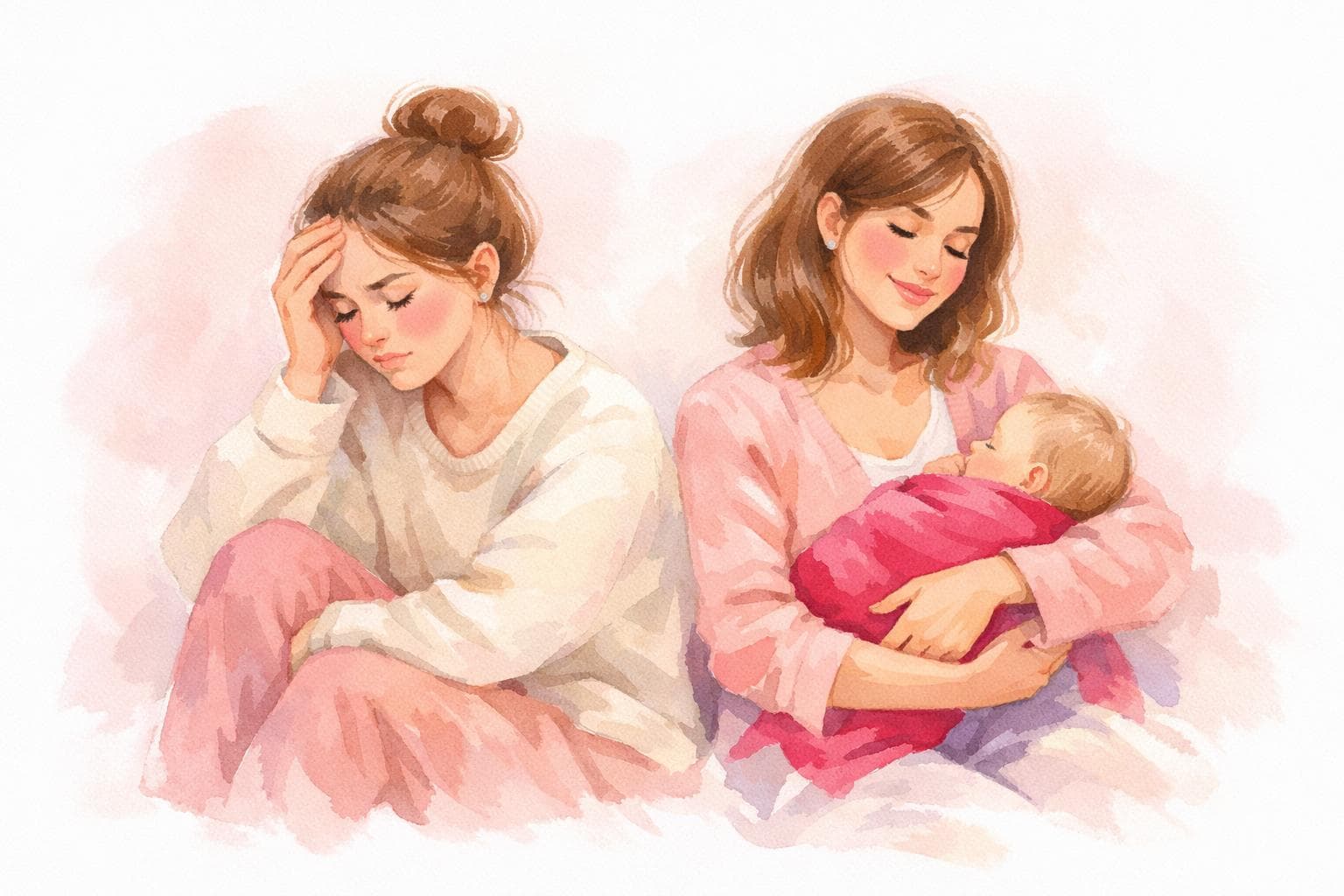
Postpartum depression (PPD) is a mood disorder marked by persistent sadness, hopelessness and emotional withdrawal after childbirth. Postpartum anxiety (PPA) is characterised by excessive, uncontrollable worry, hypervigilance and physical tension in the same period. They are separate conditions with distinct symptom profiles, though they frequently overlap.
This page explains how to tell them apart, why it matters and what to do about each.
Why the distinction matters
Most postnatal screening focuses on depression. The EPDS, used in clinics worldwide, was designed to detect depressive symptoms. Its three anxiety items (the EPDS-3A subscale) have been shown to be inadequate as a standalone anxiety screen, according to a 2024 validation study published in Midwifery.
This means a mother with severe postpartum anxiety but no depression can score "fine" on the standard screen and leave without support. Knowing the difference between the two conditions helps you advocate for the right assessment.
Our detailed guide to postpartum anxiety screening beyond the EPDS covers the tools that catch what the EPDS misses.
Side-by-side comparison
Postpartum depression | Postpartum anxiety | |
|---|---|---|
Core emotion | Sadness, emptiness, hopelessness | Fear, dread, excessive worry |
Thought pattern | "Nothing will get better," "I am a bad mother" | "Something terrible will happen," "I cannot keep the baby safe" |
Energy | Low; fatigue, lethargy, difficulty getting out of bed | High; restlessness, inability to sit still, feeling wired |
Sleep | Difficulty sleeping even when the baby sleeps, or sleeping too much | Cannot sleep because the mind will not stop; hyperarousal at night |
Appetite | Decreased or increased | Often decreased; nausea linked to anxiety |
Bonding | May feel disconnected, numb or indifferent toward the baby | May feel overly attached; cannot let anyone else hold the baby |
Avoidance | Withdrawing from activities, people, the baby | Avoiding specific situations perceived as dangerous (car journeys, bathing the baby) |
Crying | Frequent, sometimes without identifiable cause | Less common; more likely to feel tense than tearful |
Physical symptoms | Body aches, headaches, heaviness | Racing heart, chest tightness, shortness of breath, stomach issues |
Intrusive thoughts | Present in some cases, often passive ("what if I just disappeared") | Common and intense, often about harm to the baby |
Prevalence | Approximately 1 in 7 postpartum women (13-17%) | Up to 1 in 5 postpartum women (17-20%) |
Screening tool | EPDS (Edinburgh Postnatal Depression Scale) | GAD-7, PSAS or PASS (not reliably caught by EPDS alone) |
How they overlap
The Massachusetts General Hospital Center for Women's Mental Health notes that many women with postpartum depression also experience significant anxiety symptoms. One study found that 57% of women with postpartum-onset major depression reported obsessional thoughts. At two weeks postpartum, 19.9% of women with depression also had anxiety symptoms, compared to 1.3% of those without depression.
This overlap means:
- You can have PPD without PPA
- You can have PPA without PPD
- You can have both at the same time (most common presentation)
- Treatment should address whichever condition is present, not just the one that was screened for
"Postpartum anxiety demonstrates a greater prevalence rate than depression and appears to be under-recognised and undertreated comparatively." - ScienceDirect (2020)
How each is treated
PPD treatment | PPA treatment | |
|---|---|---|
First-line therapy | CBT or interpersonal therapy (IPT) | CBT with anxiety-specific focus; exposure-based techniques |
Medication | SSRIs (sertraline most studied for PPD) | SSRIs; sometimes SNRIs for severe anxiety |
Specialist therapy | Not typically needed for mild-moderate | May require OCD-specific ERP if intrusive thoughts are prominent |
Self-help | Behavioural activation, social connection, routine | Relaxation training, breathing techniques, reducing avoidance |
Combined approach | Therapy + medication for moderate-severe | Therapy + medication for moderate-severe |
For a detailed comparison of therapy and medication for PPD, see our CBT vs meds decision guide. For a full breakdown of CBT specifically, see our CBT for postpartum depression guide.
If intrusive thoughts are the dominant symptom, the condition may be perinatal OCD rather than generalised anxiety. The treatment pathway is different and includes ERP (Exposure and Response Prevention).
Quick self-check
This is not a diagnostic tool. It is a starting point for a conversation with your GP or midwife.
You may be experiencing PPD if:
- You feel persistently sad, flat or empty for more than two weeks
- You have lost interest in things you used to enjoy
- You feel disconnected from your baby
- You think about disappearing or that your family would be better off without you
You may be experiencing PPA if:
- You cannot stop worrying even when everything is objectively fine
- You check on the baby repeatedly and cannot rest even when they are safe
- You avoid situations because you fear something bad will happen
- You experience physical symptoms like racing heart, nausea or chest tightness without medical cause
You may be experiencing both if:
- You feel sad and anxious at the same time
- Your mood is low but your mind will not stop racing
- You withdraw from people but also cannot stop worrying about them
In all cases, speak to a professional. Our EPDS guide and action plan after your score can help you prepare for that conversation. And our guide to choosing the right mental health provider explains who to see and what to ask.
Sources and further reading
- MGH Center for Women's Mental Health. (2025). Is it postpartum depression or postpartum anxiety? womensmentalhealth.org
- American Counseling Association. (2026). Postpartum anxiety vs postpartum depression: similarities and differences. Counseling Today. counseling.org
- ScienceDirect. (2020). Postpartum anxiety. Journal of the American Association of Nurse Practitioners. sciencedirect.com
- Buhagiar, R. et al. (2024). Validation of the EPDS and GAD-7 for screening postpartum depression and anxiety. Midwifery.
- Postpartum Support International: postpartum.net