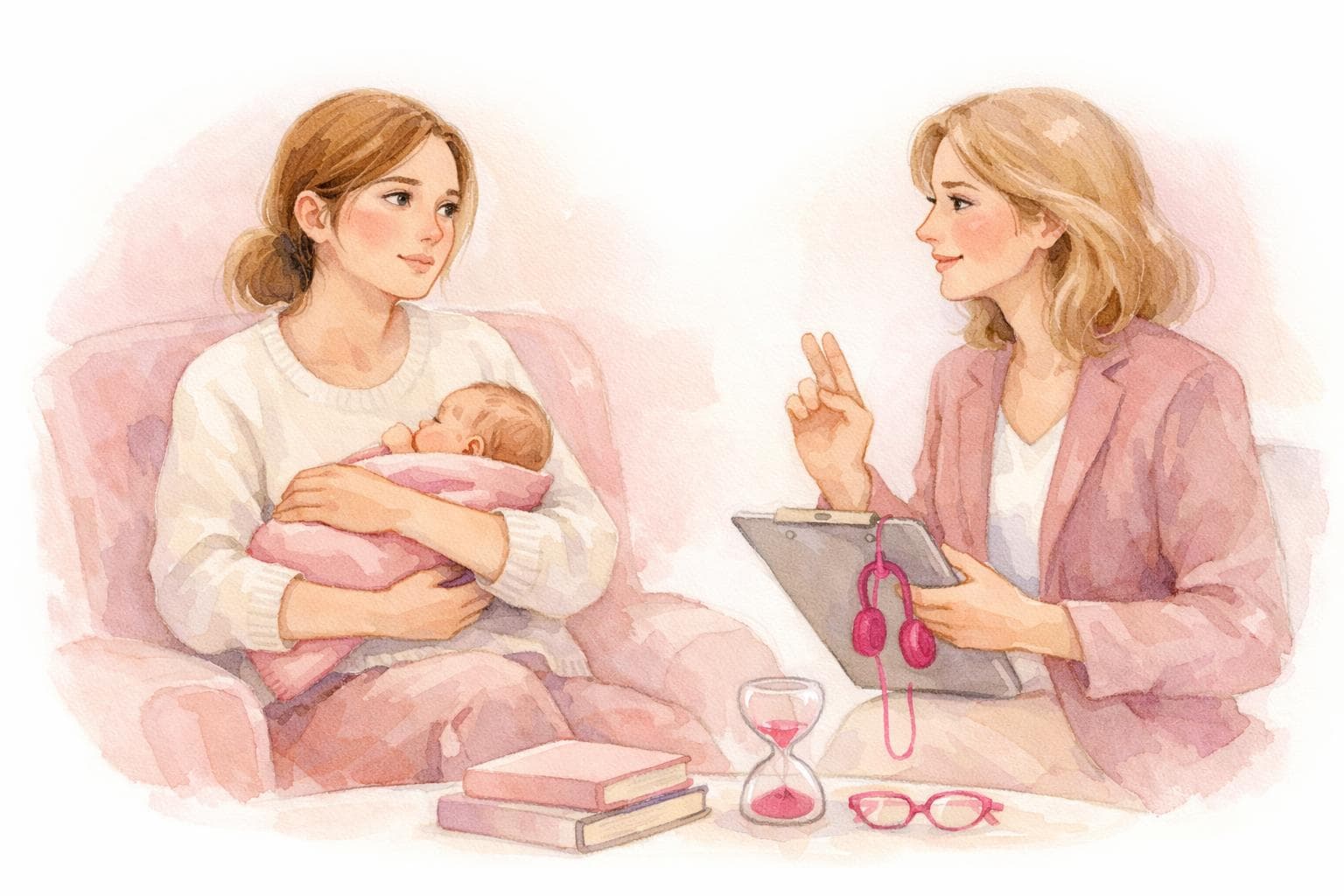

You filled in the questionnaire. You scored 7. Your health visitor said everything looked fine. But nothing feels fine. Your chest tightens when the baby sleeps too long. You check the monitor seventeen times before midnight. You cannot leave the house without running through every possible disaster in your head.
The test said you were okay. Your body is telling you otherwise.
Here is the problem: the EPDS was built to catch depression. It was never designed to detect anxiety on its own. And postpartum anxiety is at least as common as postpartum depression, often more distressing and almost always under-screened.
How common is postpartum anxiety?
Approximately 24% of pregnant women experience at least one anxiety disorder, with 8.5% meeting criteria specifically for generalised anxiety disorder. In the postpartum period, anxiety symptoms are reported in up to 31% of women, according to a quality improvement study at Cedars-Sinai (2025) that screened using both the EPDS and specific anxiety items.
A 2023 study at a US academic medical centre found that 23% of postpartum women screened positive for anxiety symptoms on the GAD-7, compared to 25.4% for depression on the PHQ-9. The overlap was substantial but not complete: many women had anxiety without depression. Those women would pass a depression-only screen and leave without support.
"Despite the acknowledged importance of addressing postpartum anxiety alongside postpartum depression, standardized screening tools specifically developed for this purpose remain limited." - PMC (2025)
What the EPDS catches and what it misses
The EPDS contains 10 items. Only three of them touch on anxiety (items 3, 4 and 5), forming what researchers call the EPDS-3A subscale. These three questions ask about feeling anxious or worried for no reason, feeling scared or panicky and things getting on top of you.
A 2024 validation study in Malta tested the EPDS-3A as a standalone anxiety screen and concluded that it is inadequate when used in isolation. The subscale's sensitivity was too low to reliably detect anxiety disorders on its own.
A Japanese validation study (2025) found that expanding the subscale to four items (EPDS-4A) improved accuracy, achieving 79% sensitivity and 71% specificity for state anxiety. But even the improved version was designed as a research tool, not a replacement for a dedicated anxiety screen.
Tool | What it screens for | Items | Developed for perinatal use? |
|---|---|---|---|
EPDS (full) | Depression primarily, some anxiety | 10 | Yes |
EPDS-3A | Anxiety subscale only | 3 | Extracted, not standalone |
GAD-7 | Generalised anxiety disorder | 7 | No, but validated in perinatal populations |
PSAS | Postpartum-specific anxiety | 51 (full) or 12 (short) | Yes |
PASS | Perinatal anxiety across subtypes | 31 | Yes |
The GAD-7: the most commonly used alternative
The Generalised Anxiety Disorder 7-item scale is the tool most often recommended alongside the EPDS. NICE guidelines in the UK endorse the combined use of both instruments in the perinatal pathway.
A study comparing the GAD-7 and EPDS for detecting generalised anxiety disorder in perinatal women found that the GAD-7 displayed greater accuracy and specificity across a wider range of cutoff scores. It was also better at identifying anxiety in women who had co-occurring depression, a common pattern that a single instrument can miss.
The GAD-7 is short, free and already widely used in primary care. Adding it to existing postnatal check-ups would take approximately two minutes.
The PSAS: built specifically for postpartum anxiety
The Postpartum Specific Anxiety Scale was developed by researchers who recognised that general anxiety tools miss the particular worries of new mothers: fears about the baby's health, concerns about competence as a parent, anxiety about infant feeding, and fear of being judged.
A 2023 comparative study found that the PSAS detected more participants with anxiety or depression (26.8%) than the general anxiety instrument STAI combined with the EPDS (23.9%). More importantly, PSAS scores increased from one to eight weeks postpartum, while general anxiety scores decreased, suggesting that postpartum-specific anxiety follows its own trajectory.
The PSAS captures what generic tools cannot: the difference between "I feel anxious" and "I am terrified something will happen to my baby and I cannot stop checking."
The PASS: screening across anxiety subtypes
The Perinatal Anxiety Screening Scale was developed in Western Australia to capture a broader range of anxiety presentations, including generalised worry, social anxiety, acute anxiety, specific fears and trauma-related symptoms.
The MGH Center for Women's Mental Health at Harvard describes the PASS as a tool that measures severity on a continuum rather than using a single cutoff, which better reflects the way anxiety actually behaves during the perinatal period. Symptoms fluctuate. A tool that captures degrees of distress is more clinically useful than one that produces a binary yes or no.
What should change
The science is clear. Screening for depression alone misses a significant proportion of postpartum mental health conditions. A 2025 stepped care model published in the World Journal of Psychiatry recommended integrated screening that addresses both depression and anxiety at each assessment point.
What should happen at your postnatal check:
- EPDS for depression (as currently standard)
- GAD-7 or PASS for anxiety (added alongside, not instead of)
- A question about intrusive thoughts (to screen for perinatal OCD)
- A question about the birth experience (to screen for postpartum PTSD)
PSI's 2026 clinical standards recommend routine dual screening at 6 weeks and 4 months postpartum. Some services already do this. Many do not.
What you can do right now
If you scored low on the EPDS but still feel something is wrong, here is what to try:
- Name the symptoms. Is it sadness, or is it worry? Dread? Hypervigilance? Physical tension? Panic? These distinctions matter when describing your experience to a clinician.
- Ask your GP to screen for anxiety specifically. You can request a GAD-7 assessment. Most GPs have access to it. You may simply need to ask.
- Do not accept "your EPDS is fine" as the end of the conversation. A low EPDS with high anxiety is not fine. It is a gap in screening, not a sign that you are overreacting.
- Read about what postpartum anxiety actually looks like. Our earlier EPDS guide covers what the test misses, and the action plan after your score gives you next steps for every range.
If you have already been told you are "fine" but your body and mind are telling a different story, trust yourself. You know your experience better than any questionnaire does.
Anxiety is not a lesser version of depression
Postpartum anxiety is its own condition. It has its own symptoms, its own trajectory and its own treatment pathway. It is not depression-lite. It is not "just worrying." It is a clinical presentation that deserves its own screen, its own diagnosis and its own care.
If emotional exhaustion is part of the picture, that matters too. And if you are unsure who to see, our guide to choosing the right mental health provider can help you find someone who understands the difference between depression and anxiety in the postpartum context.
You are not overreacting. You are under-screened. And that is the system's problem, not yours.
Sources and further reading
- PMC. (2025). Psychometric evaluation of the EPDS for screening postpartum anxiety. pmc.ncbi.nlm.nih.gov
- Buhagiar, R. et al. (2024). Validation of the EPDS, EPDS-3A, and GAD-7 for screening postpartum depression and anxiety in Malta. Midwifery. sciencedirect.com
- PMC. (2014). Comparative efficacy of the GAD-7 and EPDS as screening tools for generalised anxiety disorder in perinatal women. pmc.ncbi.nlm.nih.gov
- Hoberg, M.G. et al. (2023). Descriptive exploratory study to understand postpartum anxiety using multiple measures. JOGNN / PMC. pmc.ncbi.nlm.nih.gov
- MGH Center for Women's Mental Health. (2025). Screening for perinatal anxiety using PASS. womensmentalhealth.org
- Phoenix Health. (2026). 2026 perinatal screening guide: EPDS, GAD-7 and PHQ-9 clinical thresholds. joinphoenixhealth.com
- PMC. (2025). Epidemiology, pathophysiology, and interventions for postpartum depression: systematic review. World Journal of Psychiatry. pmc.ncbi.nlm.nih.gov