
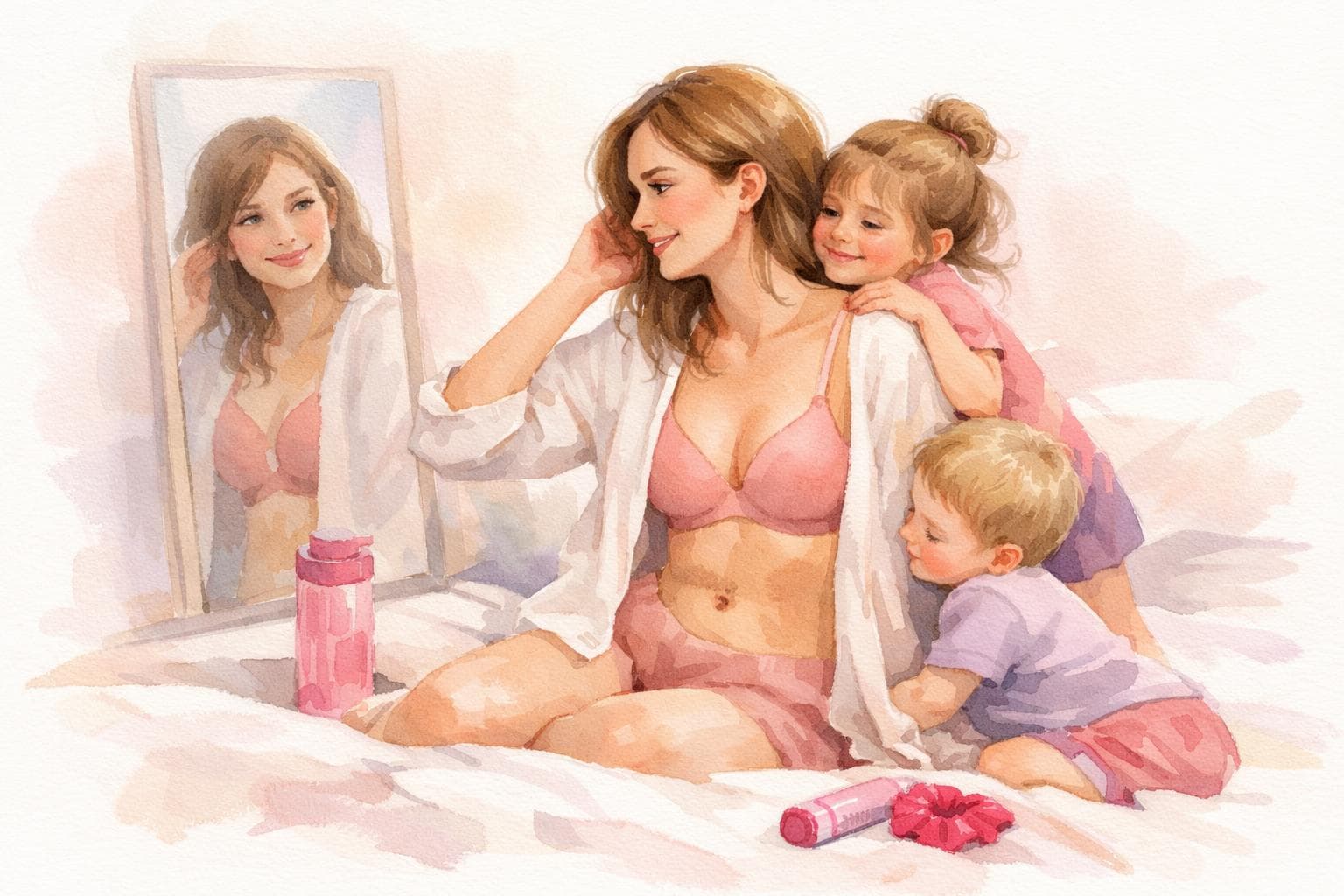
The postpartum body gets a strange reception. During pregnancy, it was celebrated — strangers smiled at your bump, people held doors open, the whole thing felt acknowledged. Then the baby arrived, and suddenly the narrative shifted: now the body was something to fix, to shrink back down, to get "under control" again.
It's a whiplash that many mothers feel but few people name out loud.
The truth is, feeling comfortable in your postpartum body isn't about willpower or workout plans. It's about understanding what's actually happened — physically, hormonally, psychologically — and building a more honest relationship with yourself from there.
What the Research Actually Says
The numbers on postpartum body image are sobering, but also clarifying. Between 30 and 70% of women experience lower self-esteem after giving birth — a remarkably wide range that reflects just how varied and individual this experience is (Frontiers in Global Women's Health, 2022).
A 2022 study of 234 mothers found a clear and significant link: mothers with higher body dissatisfaction showed lower wellbeing, lower self-esteem, and lower confidence in their own parenting. The reverse was equally true — mothers with better mental wellbeing reported more positive relationships with their bodies (Journal of Reproductive and Infant Psychology, 2022).
This matters because it reframes the whole conversation. Body confidence after having kids isn't a vanity issue. It's directly connected to how you feel as a mother, as a person, and as someone navigating one of the most demanding seasons of her life.
The "Bounce Back" Myth and the Damage It Does
Social media's obsession with postpartum "snap back" bodies has real consequences. A 2023 systematic review in the Journal of Reproductive and Infant Psychology — drawing on 55 international studies — found that the pressure on postpartum women to return to pre-pregnancy size and shape is one of the primary drivers of body dissatisfaction, reduced self-esteem, and low mood in early motherhood (Lee, Bolton, Madsen & Burke, 2023).
A more recent experiment added sharp detail to this: mothers who viewed fitspiration-style social media videos reported more upward social comparisons, increased anxiety, and lower body satisfaction than those who didn't — while mothers who consumed body-positive content fared measurably better (Health Communication, 2025).
Here's what bounce-back culture gets wrong:
- It treats recovery from childbirth as an inconvenient delay rather than a genuine physical process
- It uses celebrities and influencers as benchmarks for "normal" — a population with personal trainers, stylists, and nutritionists on speed dial
- It frames your postpartum body as a "before" picture, stripping away what it actually achieved
- It creates shame in women whose bodies — quite reasonably — don't snap back quickly, or at all
"A body that has carried, birthed, and nourished a child is strong and remarkable. Reducing it to a 'before' picture strips away the significance of what it has achieved." — Psychology Today, 2025
Body Neutrality: A More Liveable Alternative
Body positivity — the idea of actively loving your body at all times — can feel like another pressure in disguise for many new mothers. Something else to perform. Something else to fail at.
Body neutrality offers a different frame: not love, not hate, but acknowledgement. Your body is doing a lot. It doesn't need your approval or your criticism to keep doing it.
Research supports this shift in perspective. Studies on maternal body appreciation — which focuses on what the body can do rather than how it looks — consistently show it's associated with more intuitive eating, more adaptive exercise behaviours, and better psychological wellbeing (ScienceDirect, 2023). It's also protective against disordered eating — and crucially, mothers who model a positive relationship with their own bodies have been shown to be more likely to raise daughters with healthier body image too.
Body DissatisfactionBody Neutrality / Appreciation
Focuses on appearance and comparison
Focuses on function and capability
Tied to lower self-esteem and wellbeing
Associated with higher confidence and mood
Drives restrictive eating and punishing exercise
Supports intuitive eating and joyful movement
Worsened by "bounce back" content
Reinforced by authentic, diverse representation
Often passes intergenerational shame to daughters
Builds daughters' body resilience
Practical Ways to Rebuild Confidence
Audit what you're consuming. The social media feeds you scroll at 11pm matter. Accounts that show only one kind of postpartum body aren't showing you reality — they're showing you a curated slice of it. The practical step is simple: unfollow what makes you feel worse. Follow what makes you feel seen.
Move for how it feels, not for what it changes. Research on postpartum exercise and body image found a clear pattern: mothers who exercised to manage body dissatisfaction were more likely to experience negative outcomes, while those who exercised for enjoyment or how it made them feel had more adaptive relationships with both movement and their bodies (ScienceDirect, 2020). The goal of movement, for now, might simply be feeling a bit more like yourself.
Name what your body has done recently. Not in a forced, affirmation-poster way — but concretely. It grew a human. It recovered from labour. It is producing milk, or has. It is picking up a small child many dozens of times a day. Sitting with these facts, rather than with comparisons to your pre-baby weight, tends to shift things — quietly, but genuinely.
Be honest about what you're actually struggling with. Body image after having kids is sometimes about the body — and sometimes about the identity shift that motherhood brings, or the exhaustion that has nothing to do with how you look. Separating these threads is useful. If the feelings are persistent and go beyond body image, postpartum anxiety or depression might be part of the picture.
Dress the body you have right now. Clothes that fit your current body — not aspirational clothes that belong to a different season of your life — make a meaningful difference to how you move through the day. This is not giving up. It is a small, practical act of care.
A Different Question
Instead of asking when will I get my body back, it might be worth asking: what would it look like to make peace with this body, right now, as it is?
Not because the feelings aren't real, or because the changes aren't significant. But because the body you have — the one that did all of this — deserves a slightly more generous narrator than the one diet culture has been providing.
You're allowed to still be figuring this out. Most mothers are. And understanding why motherhood feels this hard — in all its forms — is usually the first step toward feeling more like yourself again.
Further reading: Identity loss after becoming a mother — and how to find yourself again | Body image after motherhood