
Published: February 23, 2026 • Last updated: July 28, 2026
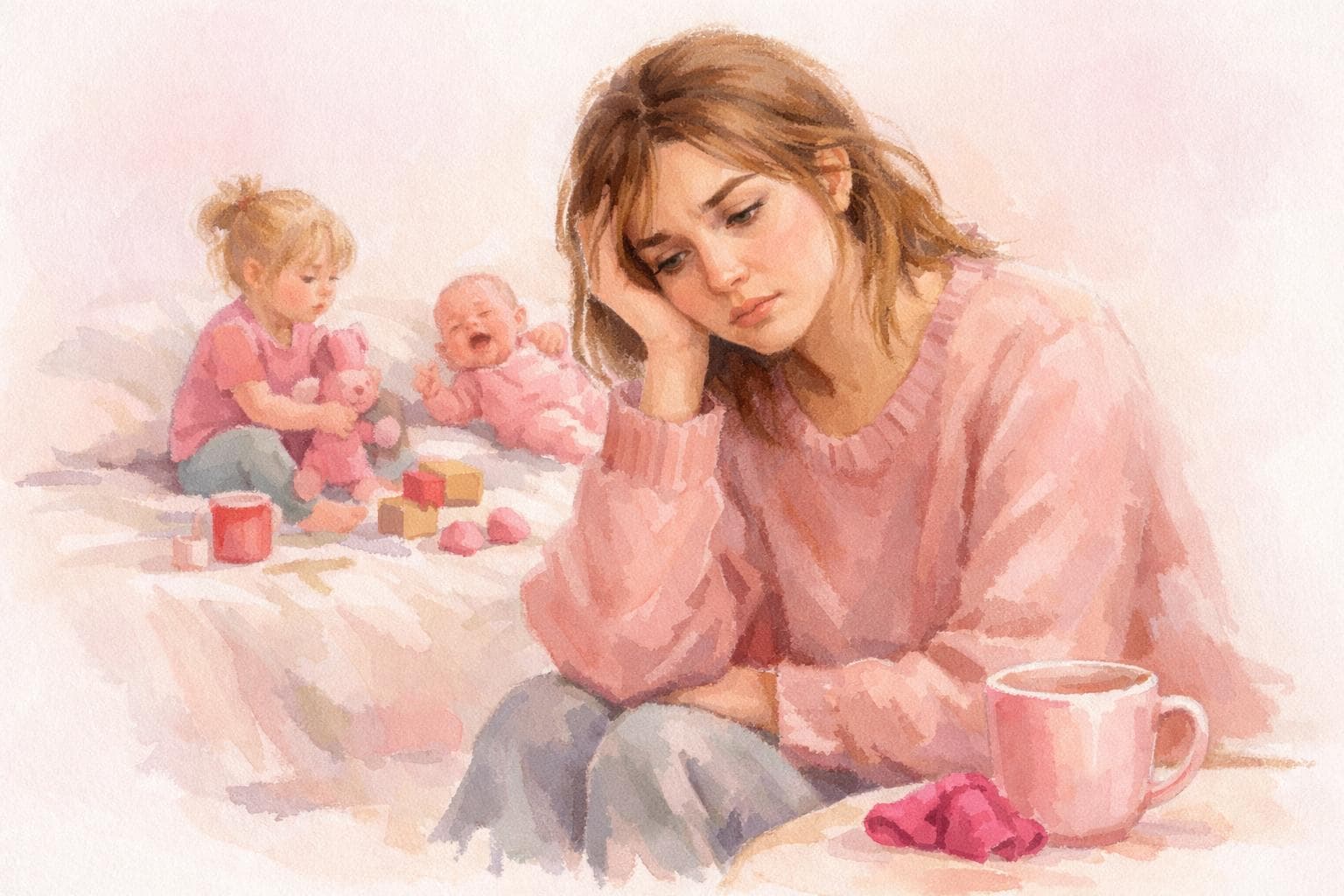
Motherhood comes with a kind of tired that sleep doesn't fix. It sits in your chest before your feet hit the floor. Someone asks how you are, and the honest answer would take longer than anyone has time for.
If that feeling has become your baseline, you might be dealing with more than regular exhaustion. You might be experiencing mom burnout, and it's far more common than most people realize.
Mom burnout is a state of chronic stress specific to the parenting role, marked by emotional and physical exhaustion, detachment from your children, and a growing sense that nothing you do really matters, distinct from ordinary tiredness because rest no longer restores you. The Motherhood Index 2026, a survey of over 4,000 mothers across the US and UK published by Peanut and Nuna, found that 93% of mothers report experiencing burnout, with 58% saying it happens often or almost always. That same research found 70% of mothers get fewer than five hours of unbroken sleep a night, and 36% get fewer than four. This is not a fringe experience. It is close to the statistical norm, which is exactly why naming it accurately matters.
What mom burnout actually looks like
Burnout isn't just being tired. Researchers define it as chronic stress that leads to physical and emotional exhaustion, detachment, and a growing sense that nothing you do really matters. When applied to motherhood the picture gets painfully specific.
Parental burnout was formally studied by researchers Moïra Mikolajczak and Isabelle Roskam at UCLouvain in Belgium, who found that burned-out parents experienced overwhelming exhaustion tied to their role, emotional distancing from their children, and a sharp gap between who they were and who they wanted to be as a parent. Their work published in Clinical Psychological Science also revealed that parental burnout strongly increases escape ideation, neglectful behaviours, and even parental violence, making it a condition with serious consequences.
That last part stings the most, because the mothers who burn out hardest are often the ones who care the most.
Common signs of mom burnout include:
- inability to rest even when you have the chance
- emotional numbness or frequent irritability
- loss of interest in things you used to enjoy
- constant guilt about your parenting
- feeling disconnected from your children
- physical symptoms like headaches, insomnia, or jaw clenching
That last point matters more than most mothers realize. Burnout doesn't stay in your head, it shows up in your body.
Burnout vs. regular exhaustion: how to tell the difference
It can be hard to know when normal tiredness crosses into something more serious.
Regular exhaustion | Mom burnout | |
|---|---|---|
Rest | Helps you recover | Doesn't feel restorative |
Good moments | You still enjoy them | You feel numb during moments that should be sweet |
Frustration | Passes quickly | Constant and disproportionate |
Anticipation | You look forward to things | You've stopped wanting anything for yourself |
Connection | Tired but connected | Detached from your kids or partner |
Daily pattern | Bad days are occasional | Every day feels the same shade of grey |
If the right-hand column feels more familiar, it's worth taking seriously.
Your body can't rest even when it should
One of the earliest signs of mom burnout is the inability to rest even when you finally get the chance. Your child is napping, the house is quiet, and instead of closing your eyes you're staring at your phone in a fog, unable to relax or do anything productive.
Chronic stress keeps cortisol elevated, which makes genuine rest feel almost impossible. Research on the physiological effects of parenting stress has found that mothers with lower parental self-efficacy show heightened cortisol responses, meaning the less confident you feel as a parent, the harder it is for your body to calm down. If downtime no longer feels restorative, that's a signal worth paying attention to. Our guide to a 48-hour DIY reset weekend covers how to actually build recovery back into a day, rather than just hoping quiet time on its own will do the work.
Everything feels like a demand
There's a tipping point where even small interactions feel like burdens. Your child asks for a snack and it registers like a five-page to-do list. Your partner mentions plans and irritation hits before logic does.
This is emotional exhaustion, when your capacity has been so depleted that your nervous system treats everything as a threat. If you flinch at the sound of "Mom?" or dread routines you once enjoyed, your reserves are telling you something important. Our guide to emotional exhaustion in motherhood covers this specific pattern in more depth, and if irritability has started tipping into something closer to anger, our piece on postpartum rage and anxiety explains why that shift happens.
You've lost touch with who you were
Before kids maybe you painted, ran, or spent mornings at the farmer's market. When burnout takes hold, those things don't just leave your schedule, they leave your radar entirely. You stop wanting them.
This identity erosion is one of the most quietly devastating parts of maternal burnout. And the painful irony is that society often celebrates this disappearing act. The mother who gives up everything is praised. But complete self-erasure isn't noble. It's unsustainable.
Burnout doesn't mean you've failed as a mother. It means you've been strong for too long without enough support.
Our guide to identity beyond mom explores this specific loss directly, and our list of reclaiming hobbies after motherhood is a practical starting point if you genuinely cannot remember what you used to enjoy.
The guilt never stops
Mom guilt in burnout becomes a constant hum. Guilty for being impatient. Guilty for wanting time alone. Guilty for not savouring a phase that "goes by so fast." And then there's the meta-guilt: feeling guilty about feeling burned out at all.
A 2023 Pew Research Center survey found that 62% of parents said parenting has been harder than expected, with mothers significantly more likely than fathers to report feeling judged, stressed, and stretched thin. More recent data confirms the trend has not eased: Motherly's 2025 State of Motherhood Survey found that 54% of mothers describe childcare as barely or not at all affordable, and one in five feel lonely every single day, two pressures that compound the guilt burnout already produces. Somewhere along the way, you internalized the message that a good mother should handle this effortlessly. That message was never true.
You're emotionally disconnecting from your kids
This is the sign that scares mothers the most. Going through caregiving motions without feeling connected, numbness during moments that should feel sweet, fantasizing about just disappearing for a while.
Researcher Moïra Mikolajczak found that emotional distancing in parental burnout is actually a psychological defense mechanism. When demands exceed your resources for too long, your brain turns down the emotional volume. A longitudinal study published in Frontiers in Psychology confirmed that this distancing follows exhaustion as a predictable second phase, not a character flaw, but a system in survival mode. It's not that you don't love your children. It's that your nervous system has been overwhelmed for too long.
The mental load has become unbearable
You know who needs a dentist appointment, which kid is outgrowing shoes, and when the permission slip is due. The invisible work of tracking, planning, and anticipating every family detail falls disproportionately on mothers, even in dual-income households.
According to Pew Research Center data, 78% of mothers in opposite-sex couples say they do more than their partner when it comes to managing children's schedules and activities. More recent research from the Fair Play Institute puts the figure at closer to 73% of overall cognitive labour, and our deeper look at mental load and relationship resentment covers exactly how this imbalance corrodes a relationship over time if it goes unaddressed. This cognitive labour rarely gets acknowledged, let alone shared equally.
What the mental load actually includes:
- scheduling and remembering appointments
- tracking clothing sizes, school needs, medications
- anticipating what the family will need before anyone asks
- managing emotional dynamics between family members
- planning meals, groceries, and household supplies
No single task breaks you. It's the accumulation. The fact that your brain never fully turns off. If you are ready to actually change this dynamic rather than just naming it, our guide to redistributing the mental load with scripts for your partner gives you the exact language to start that conversation, and our review of the Fair Play method covers whether a more structured system is worth trying.
You don't have to earn the right to rest. You don't have to justify needing help. You are allowed to struggle and still be a wonderful mother.
What you can actually do about it
Naming burnout isn't admitting defeat, it's refusing to keep suffering in silence. Research consistently shows that parental burnout occurs when demands outweigh resources, and the solution involves restoring that balance.
Talk to someone who gets it. A therapist specializing in maternal mental health, a support group, or even an honest conversation with a friend can crack open the isolation. Dr. Kristin Neff's research on self-compassion shows that treating yourself with the kindness you'd offer a friend is one of the most effective tools against shame. If you are not sure how to find the right kind of support, our guide to vetting a therapist for postpartum anxiety applies just as well beyond the postpartum period.
Lower the bar. Perfectionism and burnout are close companions. Research by Meeussen and Van Laar (2018) found that pressure to be a perfect parent was directly correlated with parental burnout. If dinner is cereal tonight, your children will survive.
Redistribute the load. Be specific with your partner. Not "I need help" but "I need you to fully own school communication." This distinction, full ownership versus a single delegated task, is the difference between a conversation that actually reduces your load and one that only sounds like it did.
Protect sleep, movement, and time alone. These aren't luxuries. They're minimum maintenance. If a full retreat is out of reach, our guide to a 48-hour DIY reset weekend shows how to build the same recovery mechanism at home for close to nothing.
Quick self-check: where are you right now?
How you're feeling | What it might mean |
|---|---|
Tired but still enjoying moments with your kids | Normal parenting fatigue, prioritize rest |
Irritable and running on autopilot most days | Early burnout, time to ask for help |
Emotionally numb, disconnected, or fantasizing about escape | Advanced burnout, professional support recommended |
There's no shame in landing anywhere on this spectrum. The only thing that matters is that you're honest with yourself about it.
You're allowed to struggle and still be a good mom
You can love your children fiercely and still reach a point where you've given more than you have. Mom burnout isn't a character flaw, it's what happens when a caring person meets impossible expectations without enough support.
The fact that you're here looking for answers says everything about the kind of mother you are.
Key takeaways
- 93% of mothers report experiencing burnout, with 58% saying it happens often or almost always, according to the 2026 Motherhood Index survey of over 4,000 mothers.
- Burnout is distinguishable from ordinary exhaustion by whether rest actually restores you. If downtime no longer feels restorative and irritability has become constant, that is the signal to take seriously.
- The mental load, not any single task, is often what tips exhaustion into burnout. Mothers report carrying roughly 73% of household cognitive labour, according to Fair Play Institute research.
- Naming burnout is not admitting failure. It is the first step toward restoring the balance between demands and resources that the underlying research consistently identifies as the actual fix.
- Small, protected recovery, sleep, movement, time alone and a redistributed mental load, moves the needle more reliably than waiting for a single big fix.
Frequently asked questions
What does mom burnout mean?
Mom burnout is a form of chronic stress tied to the parenting role that causes physical and emotional exhaustion, emotional distancing, and a sense that nothing you do matters. It's more than tiredness and often involves a mismatch between who you are and who you want to be as a parent.
How is mom burnout different from normal exhaustion?
Unlike ordinary tiredness that improves with sleep, mom burnout is persistent and linked to chronic stress, so rest often doesn't feel restorative. It also includes emotional detachment and feeling overwhelmed by routine parenting tasks.
What early signs should I watch for?
Early signs include inability to relax during downtime, feeling foggy or unable to rest, persistent irritability where small requests feel like big demands, and growing emotional distance from your children. These signals often reflect chronically elevated stress hormones and depleted coping capacity.
How can mom burnout affect my relationships with my children and partner?
Burnout can cause emotional distancing from your children, less patience, and a widening gap between your parenting ideals and daily reality, which strains attachment and communication. It can also increase irritability and conflict with a partner as your capacity to cope declines, and unaddressed mental load imbalance specifically has been linked to relationship resentment over time.
What should I do if I think I'm experiencing mom burnout?
Start by acknowledging it and talking to a trusted person, partner, friend, or clinician, and set small boundaries to protect rest and reduce demands. If symptoms persist, seek help from a healthcare provider or therapist who can assess stress, sleep, and mental health and suggest targeted strategies.
Sources and further reading
- Mikolajczak, M. & Roskam, I. (2018). Parental burnout: what is it, and why does it matter? Clinical Psychological Science. journals.sagepub.com
- Peanut & Nuna. (2026). Motherhood Index 2026. prnewswire.com
- Pew Research Center. (2023). Parenting in America today. pewresearch.org
- Pew Research Center. (2023). Facts about U.S. mothers. pewresearch.org
- Meeussen, L. & Van Laar, C. (2018). Feeling pressure to be a perfect parent correlates with parental burnout and career ambition. British Journal of Social Psychology.
- Neff, K. (2021). Fierce Self-Compassion: How Women Can Harness Kindness to Speak Up, Claim Their Power, and Thrive. Harper Wave.