
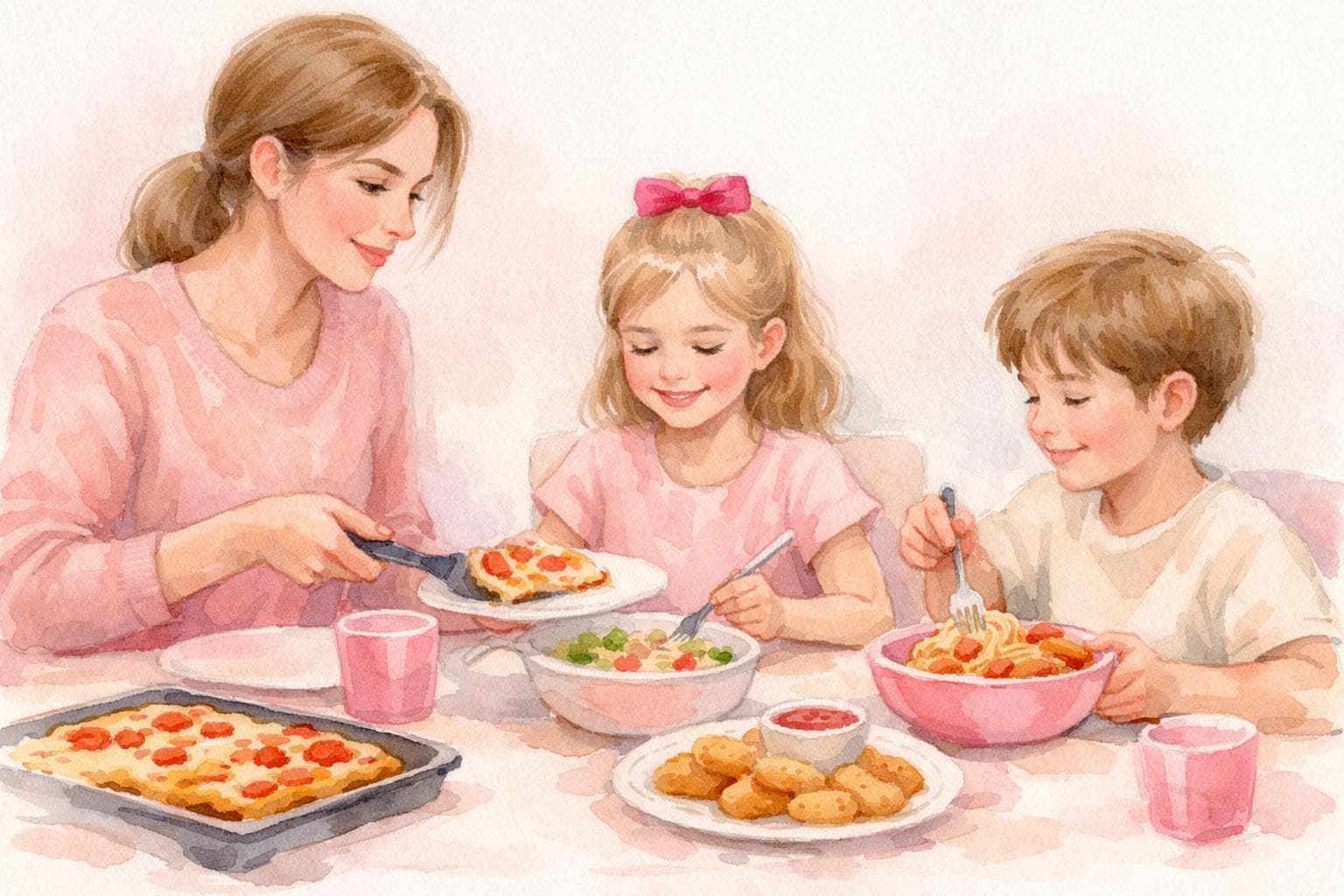
Every parent has a list of meals that work. You know what yours are. The ones you can make with your eyes closed, that get eaten without complaint and that do not result in anyone crying before 7pm.
But even the best rotation gets stale. And when it does, the alternative, trying something new on a random Tuesday, risks ending with a plate pushed away, a standoff over two peas and a meal that nobody ate.
This list is built to solve that problem. Thirty meals that tend to get eaten, are genuinely achievable on busy weeknights and do not require specialist ingredients or advanced cooking skills.
Why kids refuse food and why it's not about the food
Before the list, a piece of context that makes the cooking feel less personal.
Child food refusal is one of the most studied areas in developmental nutrition. Research by Dr Lucy Cooke at University College London found that food refusal in children is largely driven by neophobia (fear of new foods), sensory sensitivity and learned behaviour rather than hunger or taste preference.
More importantly, her research found that repeated neutral exposure to a food, offering it without pressure seven to fifteen times, was significantly more effective at increasing acceptance than hiding foods, forcing eating or offering alternatives. The single best thing parents can do is keep offering, without drama, without comment and without making any meal a battleground.
Which is partly why "meals that work" matter so much. When the base of the week is reliable, there is room to introduce something new without the stakes being too high.
The 30 meals
Listed roughly from most to least universally accepted. Your family's version of this list will look different.
- Pasta with tomato sauce and parmesan
- Spaghetti bolognese
- Mac and cheese (homemade or packet, both count)
- Cheese pizza (homemade or shop-bought base)
- Fish fingers with peas and potato wedges
- Jacket potato with beans and cheese
- Chicken nuggets (oven) with sweet potato fries
- Cheese quesadillas with sweetcorn
- Buttered noodles with a sprinkle of soy sauce
- Pesto pasta with cherry tomatoes
- Sausages with mash and peas
- Chicken and rice (one pot, minimal washing up)
- Scrambled eggs on toast
- Pancakes with fruit (yes, for dinner, yes it's fine)
- Beans on toast with grated cheese
- Chicken stir-fry with egg noodles
- Homemade fish and chips from the oven
- Toad in the hole
- Chicken tikka masala with rice (jar sauce is allowed)
- Pasta bake with cheese on top
- Mini homemade burgers with oven chips
- Soup with a big bread roll
- Soft tacos with chicken and cheese
- Egg fried rice with frozen peas and carrot
- Tortellini with butter and sage
- Baked potato bar (let children choose their own toppings)
- Mild vegetable curry with rice
- Cauliflower cheese with crusty bread
- Sausage pasta with peppers and tomato
- Simple chicken with roasted veg and new potatoes
Making them work on difficult evenings
The meals that get cooked are the ones with the lowest barrier. Here is how to reduce the friction on the hardest days.
Strategy | What it looks like |
|---|---|
Decide the week's meals on Sunday | Choose five meals and write them on the fridge |
Keep a batch of pasta sauce in the freezer | One cooking session creates multiple meals |
Use good shortcuts | Rotisserie chicken, jar sauce, frozen veg: these are tools, not failures |
Have a no-cook fallback | Bread, cheese, fruit and crackers is a meal |
Involve the children in choosing | A meal they picked is a meal more likely to be eaten |
The last point matters more than it sounds. Research published in Appetite (2016) found that children who were involved in choosing or preparing food were significantly more likely to eat it, even foods they had previously refused.
On the drama
Food battles are exhausting. They are also, according to paediatric feeding research, usually counterproductive.
Ellyn Satter's Division of Responsibility model, which is one of the most evidence-based frameworks in childhood feeding, proposes a simple split: the parent decides what food is offered, when it is offered and where. The child decides whether to eat it and how much.
Following this model tends to reduce mealtime conflict significantly, because it removes the power struggle. The parent is not trying to get the child to eat. The parent is offering food and getting out of the way.
"The goal is a child who is competent around food, not a child who eats what you want them to eat." - Ellyn Satter
If mealtimes in your house feel like a battleground more often than not, the problem is rarely the food. It is usually the dynamic around the food. How to stop yelling at your kids (without pretending to be perfect) addresses some of the same pressure points that tend to make difficult moments escalate. And if the cognitive load of planning and making dinner on top of everything else is the real issue, meal planning for moms who are too tired to think about food has a simpler framework that actually works on the hardest days.
The one rule that helps more than any recipe
Serve something you know they like alongside something new. Keep it small. Say nothing about the new thing. Offer it again next week.
Repeat until it is no longer new.
That is, according to the research, how children learn to eat a wider range of food. Not through reasoning or reward or making it fun. Through low-pressure, repeated exposure over time.
Further reading: Ellyn Satter, Child of mine: feeding with love and good sense (2000). Annabel Karmel, New complete baby and toddler meal planner (2018). NHS: fussy eaters.