Most self-care advice for stay-at-home moms includes the phrase "get out of the house."
Go for a coffee. Meet a friend. Take a walk. Which is good advice, genuinely. But it also assumes that leaving is straightforward, that childcare is available or that the logistics of a solo exit do not sometimes cost more energy than the outing restores.
On the days when leaving is not the answer, there still has to be something. Because the alternative, powering through without any kind of care for yourself, is one of the fastest routes to the particular kind of burnout that stay-at-home parenting produces.
These 28 ideas are for the days you are staying in.
Why SAHMs are at particular risk of neglecting self-care
Stay-at-home moms face a specific challenge that employed parents do not.
There is no commute that provides a natural transition between roles. No lunch break where you briefly become a person rather than a caregiver. No colleague interactions that remind you that you are competent in a professional context. The caregiving is full-time and the recovery spaces that employed parents take for granted tend not to exist.
A 2020 Gallup study found that stay-at-home mothers reported higher rates of depression, worry and sadness than their employed counterparts, alongside higher rates of reported meaning and purpose. Both things were true simultaneously. The role is meaningful and the conditions are depleting.
Research by Kristin Neff at the University of Texas, whose work on self-compassion is foundational in the field, found that mothers who practised small, consistent acts of self-care showed lower rates of burnout and more positive emotional interactions with their children. The self-care was not separate from the parenting. It made the parenting possible.
28 ideas that work at home
These are grouped by type. Most take between five and thirty minutes.
When you have five minutes
- Make a proper cup of tea or coffee and drink it while it is hot
- Step outside the back door for five minutes, no phone
- Sit in a room alone with no noise for five minutes
- Splash cold water on your face and change into something you feel comfortable in
- Write one sentence about how you feel today
When you have fifteen minutes
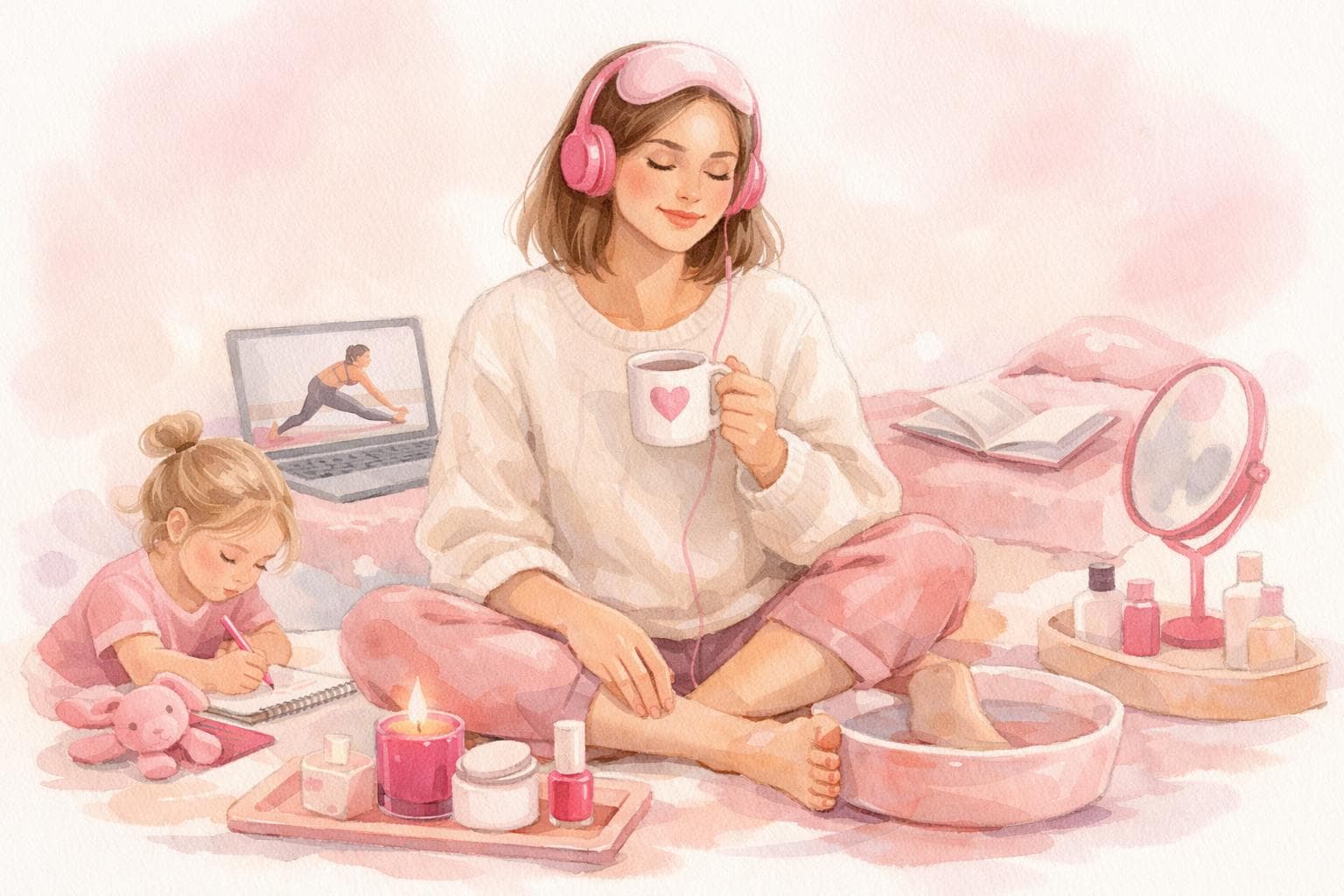
- Follow a short yoga or stretch video (YouTube has hundreds that are genuinely 10 to 15 minutes)
- Listen to a podcast episode that has nothing to do with parenting
- Read a chapter of a book, in a room with the door closed
- Paint your nails, do your eyebrows or do whatever small thing makes you feel like yourself
- Watch something funny that you would not watch with the children
- Call a friend without a plan for how long to talk
- Write out everything that is in your head with no filter or purpose
- Do a face mask or skin routine you enjoy
When you have thirty minutes
- Take a proper bath, not a quick shower, with something in the water that smells good
- Watch an episode of something you have chosen
- Do a light workout at home, even just dancing to a playlist you love
- Make something creative, a drawing, a card, anything that is yours
- Reorganise one corner of the house in a way that gives you genuine satisfaction
- Cook something just for yourself, something you want that the children would not eat
- Read something long and absorbing that takes your whole attention
- Do a gentle walk in the garden or around the block while children play or sleep
When you have an hour
- Try a new recipe for yourself, something indulgent or interesting
- Start a project, a journal, a craft, a course, anything you are genuinely curious about
- Have a proper phone call with someone who knew you before children
- Clean and organise your bedroom so it feels like somewhere to rest
- Watch a film in the middle of the day while a partner or another adult is present
- Do absolutely nothing structured for sixty minutes and let that be enough
- Have an honest conversation with your partner about how you are actually doing
A note on the guilt
Most stay-at-home moms find self-care harder to justify than employed parents do. The implicit logic is: you are already at home, what do you need to recover from?
The answer is everything. The sustained attention, emotional availability and physical labour of full-time caregiving is demanding in ways that are invisible precisely because they do not take place in a professional context.
Research from the Journal of Family Psychology found that maternal wellbeing was significantly lower in households where the mother perceived her caregiving as undervalued and her own needs as less legitimate than other household members' needs. The perception mattered. Feeling like your needs count is not separate from wellbeing. It is constitutive of it.
Type of self-care | What it restores |
|---|---|
Physical (bath, rest, movement) | Energy and body regulation |
Cognitive (reading, learning, creating) | Sense of self beyond the caregiving role |
Emotional (journalling, connection, honest conversation) | Processing and internal clarity |
Sensory (things that smell, sound or feel good) | Nervous system regulation |
"You cannot pour from an empty vessel." - Eleanor Brownn
If the guilt about taking time for yourself is significant, how to prioritise yourself without guilt addresses the internal pattern that makes this so difficult for so many mothers. And if the SAHM identity question is part of what is making the depletion harder to address, stay-at-home mom identity crisis: when the role isn't enough approaches that dimension directly.
You do not have to leave the house to take care of yourself. You just have to start.
Further reading: Kristin Neff, Self-compassion: the proven power of being kind to yourself (2011). Emily and Amelia Nagoski, Burnout: the secret to unlocking the stress cycle (2019). Brené Brown, The gifts of imperfection (2010).