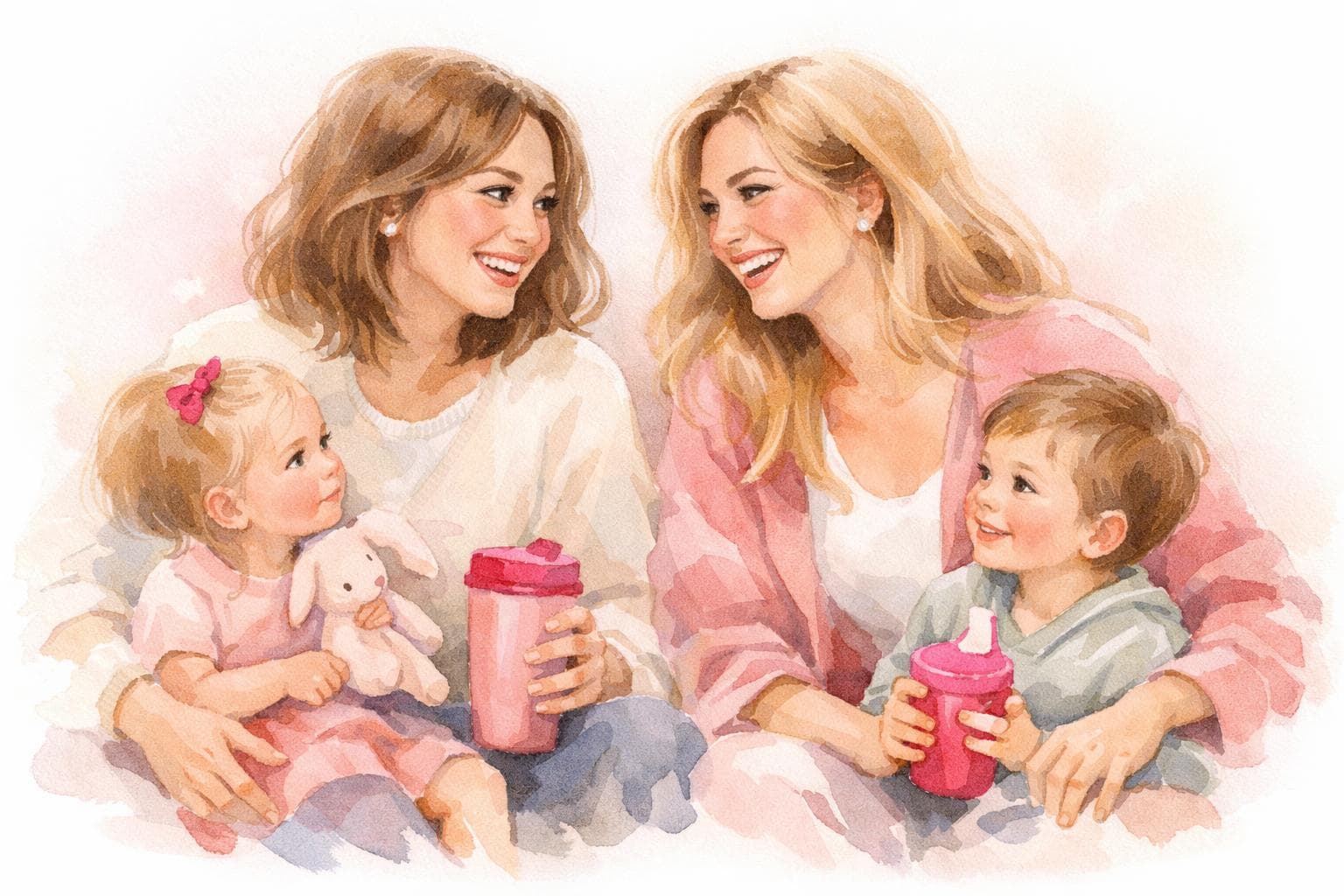
There is a specific kind of friend that most mothers quietly want and rarely talk about wanting.
Not just a coffee contact or a school-gate acquaintance. Not someone you exchange WhatsApp messages with about logistics. The one who texts you at 11pm because she knew today was hard. The one who already knows the whole picture and does not need the context explained. The one who makes you feel like yourself, not just like a mother.
This is the mom best friend. And for many women, finding one in adulthood, with children, on a limited schedule, feels surprisingly out of reach.
Why the mom best friend is different from other friendships
The friendships that sustain mothers through the most demanding years of parenting are not just pleasant. They are, according to the research, genuinely protective.
A 2018 study published in Maternal and Child Health Journal found that mothers with at least one close, genuinely intimate friendship showed significantly lower rates of postpartum depression and anxiety than those without. The effect was independent of relationship status and income. The friendship itself was the variable.
Psychologist Shelley Taylor at UCLA developed the concept of "tend and befriend" to describe how women, in particular, respond to stress by seeking social connection rather than withdrawing. Her research found that female social bonds specifically activate oxytocin-mediated stress reduction in ways that other forms of social support do not. Close female friendship, in short, works on the nervous system in a specific and measurable way.
The mom best friend is not a nice-to-have. She is a health resource.
Why finding her is so hard
The conditions that produced best friendships in your twenties, proximity, unplanned time, the freedom to be spontaneous, no longer exist in the same way.
The school gate offers mothers, which is a starting point. It does not offer chemistry, compatibility or the willingness to be honest before you are comfortable doing so. Two people can stand in the same playground for years and never get past surface conversation, not because either person is unfriendly, but because nobody took the risk of going deeper first.
There is also the time problem. University of Kansas research found that forming a genuine close friendship requires approximately 200 hours of shared time. For mothers managing school, work and household demands, accumulating that with any single person outside the family is a significant undertaking. The hours have to be built deliberately and consistently.
And there is the vulnerability problem. The mom best friend relationship, at its most sustaining, involves honesty about the parts of motherhood that are not for public consumption: the hard days, the doubts, the identity confusion, the resentment that shows up sometimes. Getting there requires someone to say the real thing first. Most people wait for someone else to go first.
How to find her
Stop waiting to feel ready. The comfortable moment to deepen a friendship rarely arrives on its own. "I've been wanting to get to know you properly" is something you can say before you feel entirely at ease saying it.
Follow your genuine interest. The mom best friend tends not to emerge from the largest available pool of mothers. She tends to emerge from smaller, more specific contexts, a shared interest, a class, an online community organised around something you genuinely care about. Common ground beyond parenting is often what moves a connection from pleasant to real.
Prioritise one person at a time. Distributed effort across many potential friendships tends to produce many acquaintances. Focused investment in one person at a time, consistently showing up, being honest, making plans that actually happen, is what produces the thing you are actually looking for.
Make the first move more than once. A single invitation is easy to decline or defer. Three genuine attempts, with enough space between them, signals real interest rather than politeness. Most people respond to being genuinely pursued.
Be honest about what you are looking for. This sounds strange but tends to work. "I've been finding it hard to connect with people since having children and I'd love to find someone to actually be friends with" is a more effective friendship-opener than most small talk. It creates immediate recognition in anyone who feels the same.
What the relationship needs to become real
Stage | What it looks like |
|---|---|
Acquaintance | Regular contact in a shared context, pleasant but surface |
Developing friendship | One-to-one plans, some honest conversation, mutual effort |
Close friendship | Knowing the real picture, being honest without editing, showing up when it matters |
Mom best friend | The person you call first, who already understands, who is yours in the specific way of this season |
The gap between the first row and the last is crossed by honesty and consistency over time. There is no shortcut. But it is faster when someone stops waiting and starts doing.
The thing most mothers do not say out loud
Finding a mom best friend feels embarrassing to want at 35. There is a cultural expectation that friendships should arrive naturally, that needing to look for one is somehow undignified.
It is not. Wanting a genuine close friendship is one of the most human things a person can want. Adults who actively maintain and build social connections show better cognitive outcomes, lower rates of anxiety and depression and longer lifespans than those who do not.
"Friendship is unnecessary, like philosophy, like art. It has no survival value; rather it is one of those things which give value to survival." - C.S. Lewis, The four loves
If loneliness is part of what is driving the search, loneliness in motherhood: why it happens and how to find connection addresses the structural context with more depth. And for practical starting points on meeting people, how to make mom friends (when it feels harder than it should) has more specific suggestions for the first moves.
She exists. She is probably also looking. One of you has to go first.
Further reading: Vivek Murthy, Together: the healing power of human connection in a sometimes lonely world (2020). Robin Dunbar, Friends: understanding the power of our most important relationships (2021). C.S. Lewis, The four loves (1960).