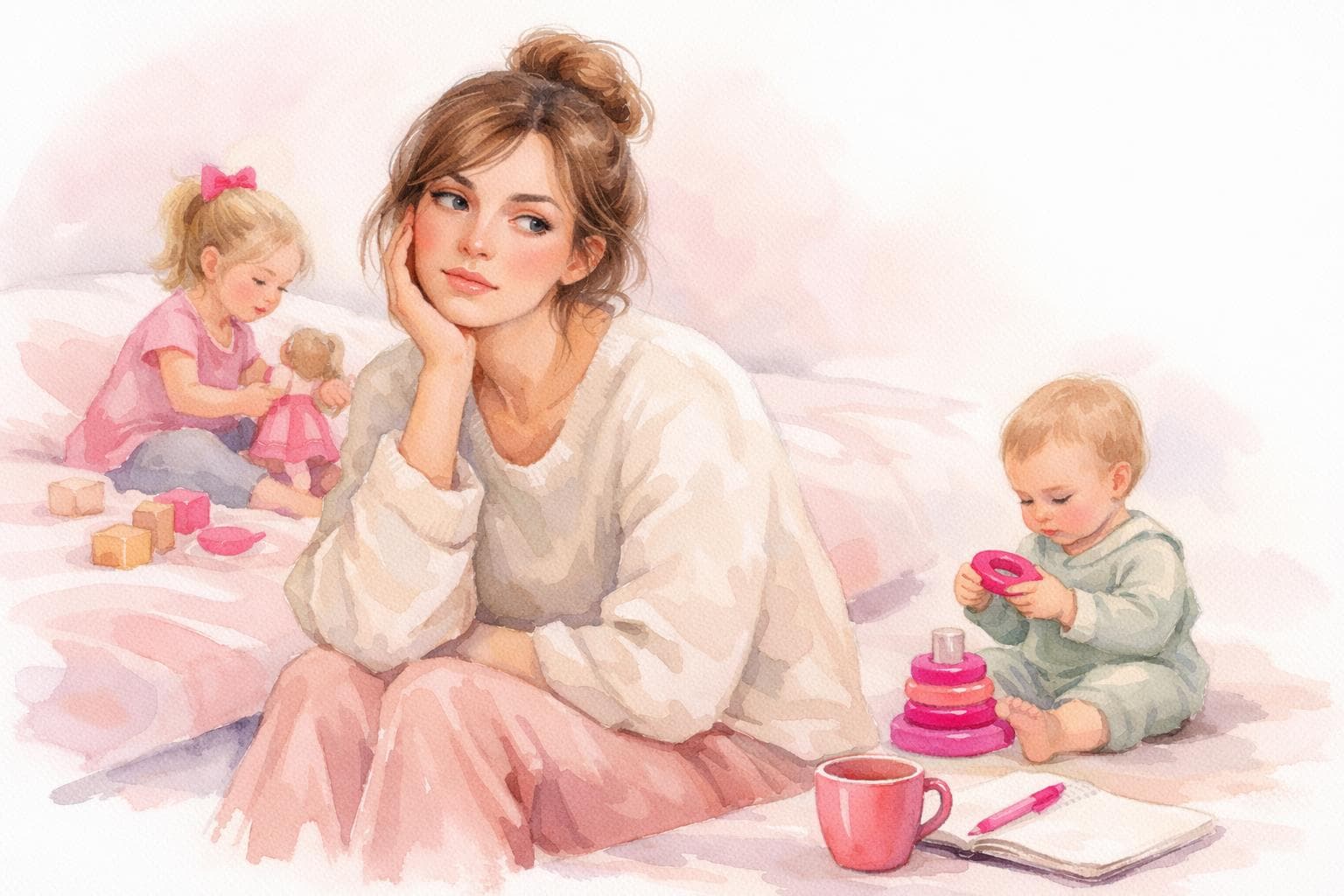
Nobody says it at the playgroup. But it's in the room.
The slight pause before answering "what do you do?" at a party. The strange flatness that arrives mid-afternoon, when the children are finally occupied and you have a moment to yourself and it feels not like rest but like something vaguely uncomfortable you can't name. The awareness, growing quietly over months, that you love your children completely and that something else is missing, and that those two things are not supposed to be in conflict but keep feeling like they are.
The stay-at-home mom identity crisis is one of the most common and least publicly acknowledged experiences in contemporary motherhood. It doesn't arrive in dramatic form. It arrives in ordinary moments, in the small persistent sense that the person you were before is still in there somewhere, not quite finding enough room.
Why staying home can produce this crisis
Choosing to stay home with children is a legitimate and valuable choice. It is also a choice that, depending on the person making it, can involve a significant loss of the structures that previously organised identity.
Before children, most people's sense of self is anchored in multiple domains simultaneously: work, friendships, physical pursuits, creative interests, the specific competence and recognition that a professional role provides. Staying home contracts many of those anchors at once. What remains is a role that is enormously demanding, largely invisible and almost entirely unrecognised in the currency that the adult world uses to measure value.
Sociologist Sharon Hays, whose research on what she termed "intensive mothering" identified the cultural expectation that good mothers be completely devoted, child-centred and self-sacrificing, described this as a contradiction at the heart of modern motherhood: women are told that staying home is the most important thing they can do and are simultaneously treated as though they are doing nothing.
A 2018 survey by the UK-based charity Mumsnet found that 68% of stay-at-home mothers reported feeling undervalued or invisible as a result of their role. A 2020 Gallup study in the US found that stay-at-home mothers reported higher rates of depression, worry and sadness than employed mothers, alongside higher rates of reported meaning and purpose. Both things were true simultaneously, which is precisely the paradox that makes this difficult to articulate.
The specific dimensions of the identity loss
It is useful to name exactly what tends to get lost, because the solutions depend on understanding what is missing.
Professional identity. For women who had careers they found meaningful, the loss of a job title, professional recognition and the daily experience of being competent in a domain that others value can be significant. This is not vanity. It is the loss of a specific kind of feedback loop that human beings need.
Intellectual engagement. The work of caring for young children is cognitively demanding in specific ways and intellectually unstimulating in others. The absence of problem-solving that uses the full range of a person's capacity is a real loss, and it tends to be felt most acutely by women who had intellectually stimulating careers before children.
Social identity. Your social world contracts when you stay home. The spontaneous professional relationships, the daily contact with a range of different people, the sense of belonging to a wider community: all of this narrows considerably. What replaces it, the playgroup, the school gate, the parent-and-baby class, is meaningful but not always a sufficient substitute for what was there before.
The simple experience of being seen. In a professional context, your contributions are visible. Someone notices when you do something well. At home, the meals get eaten and the laundry gets done and the children are safe and cared for, and none of it leaves any trace by the following morning.
What this does not mean
It does not mean you made the wrong choice. It does not mean you don't love your children. It does not mean that staying home is a lesser path or that you should feel ashamed of finding it insufficient in certain ways.
It means you are a person with needs that extend beyond the caregiving role, and that those needs are not being met adequately by the role alone. That is not a crisis of character. It is information about what you need to build alongside the role.
What the identity crisis is not. / What it usually is
Evidence that you regret your choice / A signal that the role needs supplementing
Ingratitude for what you have / A legitimate need for more dimensions of self
A sign you should return to work immediately / An invitation to examine what specifically is missing
A reflection on the worth of what you're doing / A reflection on the narrowness of the identity container
What tends to help
None of these require returning to full-time employment, though that may be the right answer for some women at some points.
Finding one thing outside the role that is yours. Not a hobby performed for the children's benefit, not something that exists as an extension of the caregiving role. Something that exists because you are interested in it and that has nothing to do with motherhood. Even small. Even irregular. Even imperfect.
Reconnecting with your professional or creative self in some form. Voluntary work, freelance projects, a course, a community role that uses the skills you developed before children. The specific form is less important than the experience of being competent in a domain that extends beyond the household.
Talking about it honestly. This is harder than it sounds because the cultural script around staying home doesn't leave much room for ambivalence. Finding other stay-at-home mothers who will say the real thing, rather than performing contentment, changes something.
Resisting the frame that says you must earn your complexity. You are allowed to have a rich interior life, professional ambitions, intellectual interests and a persistent sense of self that extends beyond the role you are currently in. None of that needs to wait until the children start school.
"The privilege of a lifetime is being who you are." - Joseph Campbell
If the identity question has become something more acute than occasional flatness, How to feel like yourself again after kids addresses the retrieval of self with more depth. And if building something professionally alongside the caregiving role is something you're considering, How to start a business as a stay-at-home mom takes that conversation somewhere practical.
The role is not enough. That is allowed to be true. And it is also true that you are the one who gets to decide what else gets built around it.
Further reading: Sharon Hays, The cultural contradictions of motherhood (1996). Susan Douglas & Meredith Michaels, The mommy myth: the idealisation of motherhood and how it has undermined all women (2004). Naomi Wolf, Misconceptions: truth, lies and the unexpected on the journey to motherhood (2001).