The first twelve weeks after having a baby are unlike anything else.
Nothing fully prepares you for the level of physical demand, emotional intensity and identity shift that arrives alongside a newborn. Your body is recovering. Your sleep is fragmented. Your sense of who you are has been reorganised in ways you did not expect. And somewhere in the middle of all that, most mothers are also told to take care of themselves.
The problem is that most self-care advice was written for people whose bodies are not recovering from birth, whose sleep is unbroken and whose days have some predictable structure. For new moms in the first twelve weeks, even the smallest act of care can feel like a significant achievement. That is the right standard to use.
Why self-care matters in the fourth trimester
The term "fourth trimester" was coined by paediatrician Harvey Karp to describe the first three months after birth as a continuation of the gestational period rather than a separate event. For the baby, it is a period of adjustment. For the mother, it is a period of significant physiological and psychological change that rarely receives adequate attention.
Research published in Maternal and Child Nutrition found that maternal self-care behaviours in the early postpartum period, including adequate nutrition, rest and social connection, were significantly associated with reduced rates of postpartum depression and better maternal-infant bonding outcomes.
A 2019 study in the Journal of Midwifery and Women's Health found that mothers who received explicit guidance on self-care in the first twelve weeks reported better physical recovery, lower anxiety and higher confidence in caring for their baby than those who did not.
Self-care in the fourth trimester is not a luxury. It is part of recovery.
30 ideas for the first 12 weeks
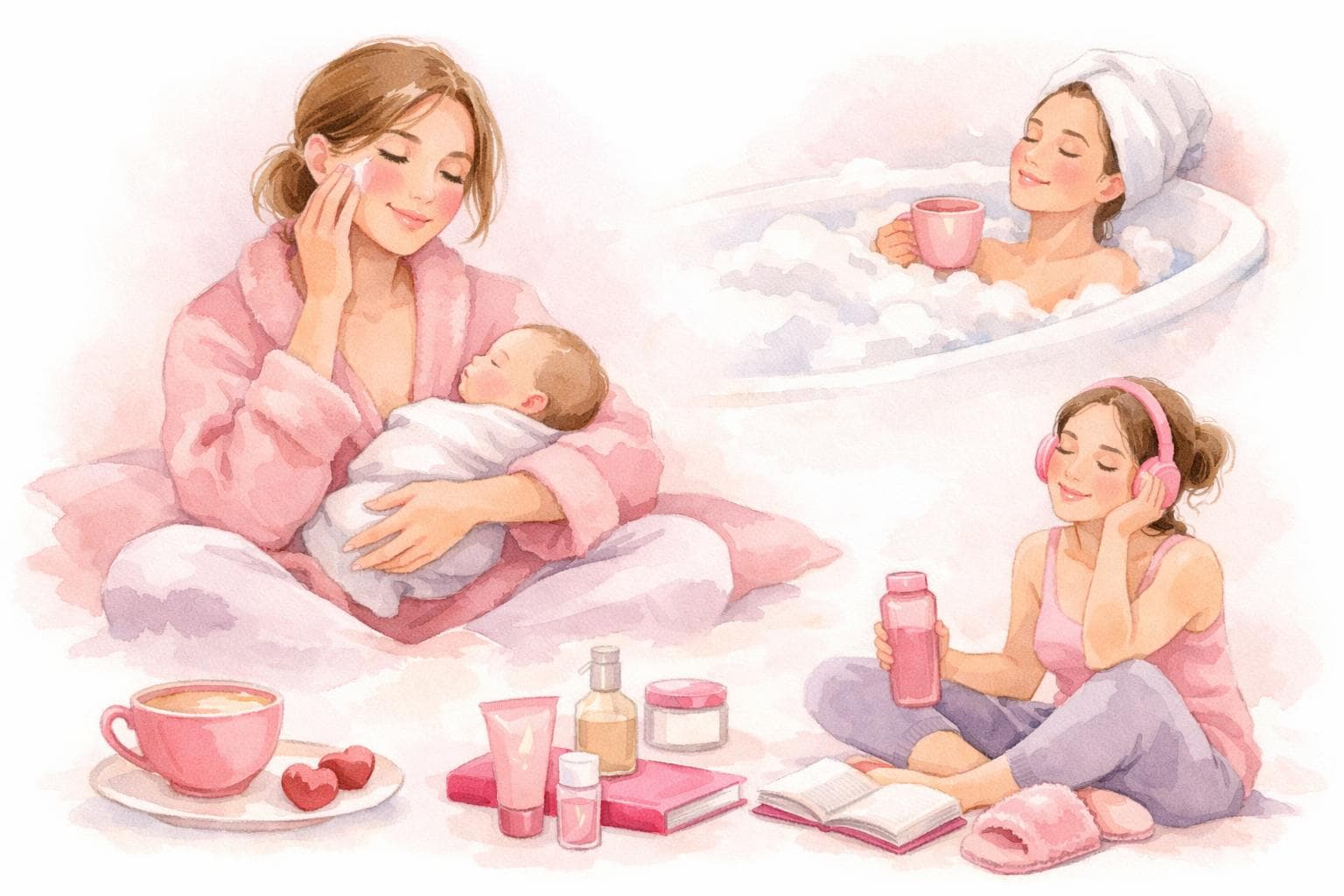
These are categorised by type, not by difficulty. All are achievable. None require childcare, significant money or energy you do not have.
For your body
- Drink a large glass of water every time you feed
- Eat something substantial before the morning chaos begins
- Take a shower before midday, even briefly
- Accept every offer of food that arrives
- Walk outside for ten minutes when you can
- Sleep when someone else is with the baby, not just when the baby sleeps
- Ask your GP or midwife about pelvic floor exercises at your six-week check
- Put on clothes that fit your current body, not clothes you hope to fit into
For your mind
- Write three sentences about how you feel at the end of each day
- Read something that has nothing to do with babies, even one page
- Watch one episode of something you enjoy, without also doing laundry
- Give yourself permission to not know what you're doing
- Say "I'm finding this hard" to one person who will hear it without panic
- Stop reading parenting content that makes you feel inadequate
- Let something be undone today that does not truly need doing
For connection
- Text one friend something real rather than "we're fine, just busy"
- Accept company even when the house is not tidy
- Tell your partner one specific thing you need, not a general "more support"
- Join one local or online group of mothers in the same phase
- Let someone hold the baby while you do absolutely nothing for 20 minutes
- Have one conversation per day that is not about the baby
For rest and recovery
- Stop apologising for how you look or how the house looks
- Nap without guilt when someone else is present with the baby
- Go to bed at the same time as the baby at least twice a week
- Ask specifically for a block of uninterrupted sleep at night, even once a week
- Say no to one visit or obligation that you do not have the energy for
Small things that help more than they should
- Put something that smells good in your bedroom
- Make your bed in the morning, even if nothing else gets done
- Sit outside for five minutes without your phone
- Ask "what do I need right now?" once a day, and try to answer it honestly
What makes these work
None of these require a full hour or a spare afternoon. Most take between two and twenty minutes. The principle behind all of them is the same: you are a person who has physical, emotional and social needs, and meeting those needs in small, consistent ways is what makes sustained caregiving possible.
Kristin Neff's research on self-compassion at the University of Texas found that treating yourself with the same warmth you would extend to a friend in the same situation, particularly during difficult periods, produced measurably lower anxiety and depression rates than self-criticism or neglect. The fourth trimester qualifies as a difficult period.
Category | What it does |
|---|---|
Body care | Supports physical recovery and energy |
Mind care | Reduces rumination and maintains sense of self |
Connection | Prevents isolation and provides perspective |
Rest | Supports hormonal regulation and emotional stability |
Small acts | Creates a felt sense of being a person, not only a function |
On asking for help
Most of these ideas work better if someone else is helping. That requires asking.
The barrier to asking is real. Research from Social Science and Medicine found that new mothers were significantly less likely to ask for specific help than to hope it would be offered, and significantly more likely to recover well when specific support was provided.
"Can you take the baby for an hour this afternoon?" is more useful than waiting to see if someone offers. You are allowed to ask.
"Caring for myself is not self-indulgence. It is self-preservation." - Audre Lorde
For support with the guilt that tends to come with prioritising yourself in this period, how to prioritise yourself without guilt is worth reading. And if the exhaustion goes further than the early weeks and still has not lifted, always tired even after resting: what it means for moms addresses what might be underneath it.
You are doing something very hard. Small acts of care are not indulgent. They are essential.
Further reading: Harvey Karp, The happiest baby on the block (2002). Kristin Neff, Self-compassion: the proven power of being kind to yourself (2011). PANDAS Foundation UK: pandasfoundation.org.uk.