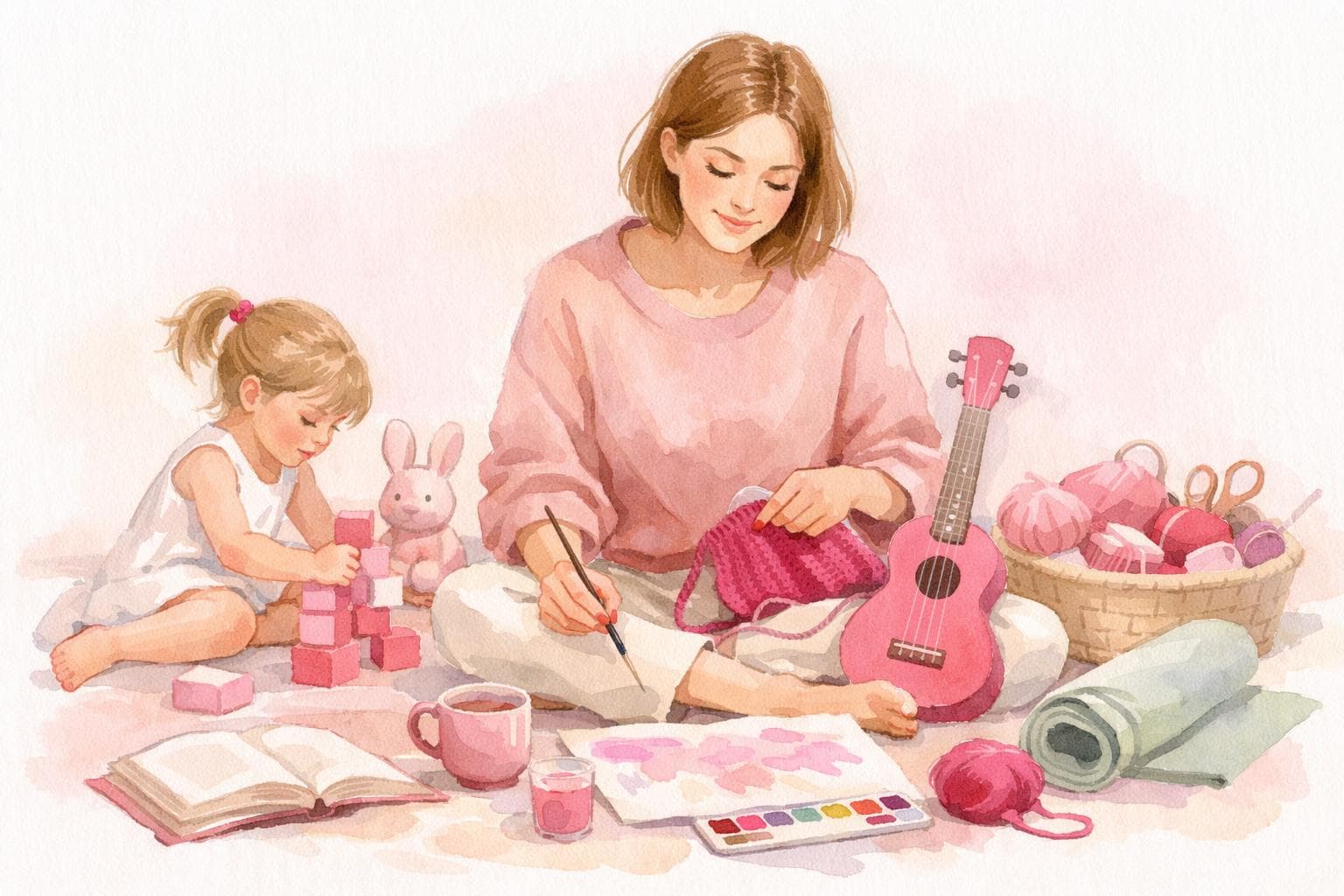
You used to paint. Or read whole books in a weekend. Or run without a pram. Or bake something that was not shaped like a dinosaur. Somewhere between the first contraction and the four hundredth nappy, those things disappeared. Not dramatically. Quietly. One skipped week became a skipped month became a version of yourself you barely recognise.
The most common advice is "make time for yourself." But that phrase assumes time is just sitting there, waiting to be claimed. It is not. Time in motherhood is borrowed, interrupted and shared. What you need are hobbies that fit the life you actually have, not the life you had before.
Why hobbies matter more than you think
A qualitative study published in PMC (2023) explored how mothers experience self-care and found that even when mothers do get leisure time, it tends to be interrupted by home and family obligations. The researchers noted that self-care goes beyond grooming and exercise: emotional self-care, creative expression and genuine enjoyment of activities were strongly tied to stress reduction and wellbeing.
A 2025 study in Midwifery found that postpartum mothers are less active than other women their age, less active than their partners and less active than other parents with older children. Women who returned to pre-pregnancy activity levels reported higher subjective wellbeing than those who did not.
This is not about productivity or self-improvement. It is about remaining a person with interests, curiosity and something to look forward to that has nothing to do with keeping a small human alive.
"Even when mothers get to experience true leisure, it tends to be interrupted by home and family obligations. Engagement in self-care behaviors is associated with benefits not only for well-being outcomes such as stress reduction and health promotion, but also for work-related outcomes." — PMC (2023)
The myth of the 3-hour block
Most hobby advice assumes you need a studio, a gym membership or a free afternoon. That is why most mothers give up before they start. The bar is too high.
But research on flow states, the psychological experience of being fully absorbed in an activity, shows that even brief engagement in a meaningful task can shift your mood and reduce stress. You do not need three hours. You need fifteen minutes of something that is yours.
27 hobbies that fit around motherhood
Creative (5 to 20 minutes)
# | Hobby | Why it works for moms |
|---|---|---|
1 | Sketch in a small notebook while the kettle boils | No setup, no cleanup, portable |
2 | Write three lines of poetry or a micro journal entry | Creative expression in under two minutes |
3 | Hand-letter a single quote or phrase | Focused, meditative, produces something tangible |
4 | Knit or crochet ten rows during nap time | Repetitive motion calms the nervous system |
5 | Photograph one thing a day on your phone | Rebuilds your habit of noticing beauty |
6 | Arrange a small vase of flowers or foraged branches | Micro-creativity with immediate visual reward |
7 | Watercolour a single postcard-sized painting | Small surface = small commitment |
Physical (10 to 30 minutes)
# | Hobby | Why it works for moms |
|---|---|---|
8 | Yoga from a 15-minute YouTube video after bedtime | No travel, no babysitter, no equipment |
9 | Walk one loop of your neighbourhood without the pram | Movement as solitude, not exercise |
10 | Dance to three songs in the kitchen | Releases endorphins, requires zero planning |
11 | Stretch on the floor while your child plays beside you | Counts as both presence and self-care |
12 | Swim during a weekend partner shift | Full-body reset with no phone access |
13 | Garden for ten minutes while the child digs beside you | Parallel play works for adults too |
Learning (10 to 20 minutes)
# | Hobby | Why it works for moms |
|---|---|---|
14 | Listen to one episode of a podcast during chores | Turns mundane tasks into something enriching |
15 | Read five pages of a book before sleep | Not a chapter. Five pages. Lower the bar. |
16 | Learn a language with a 10-minute app session | Duolingo streaks are surprisingly motivating |
17 | Watch one short documentary after bedtime | Stimulates curiosity without a time commitment |
18 | Take an online course one module at a time | Progress at your own pace, no deadlines |
Social and connective (15 to 45 minutes)
# | Hobby | Why it works for moms |
|---|---|---|
19 | Join a book club that meets monthly | Social connection with a low time cost |
20 | Text a friend a voice note instead of typing | Feels more personal, takes less effort |
21 | Attend a community craft group or stitch circle | Hobby plus peer support in one session |
22 | Cook one recipe from a different cuisine each week | Creative, functional, shareable with the family |
Quiet and restorative (5 to 15 minutes)
# | Hobby | Why it works for moms |
|---|---|---|
23 | Sit outside with tea and no phone for ten minutes | Silence as a hobby, not a luxury |
24 | Do a jigsaw puzzle in an ongoing corner of the house | Pick it up and put it down across days |
25 | Listen to a full album from start to finish | Reclaims music as an experience, not background noise |
26 | Take a bath with the door locked and no agenda | Not for the children. Not for cleaning. For you. |
27 | Write a list of things you enjoyed before motherhood | Reconnecting with your pre-baby self is a hobby in itself |
How to actually start
The biggest obstacle is not time. It is the belief that you do not deserve to spend it on yourself.
A 2020 study in Women and Health found that mother guilt actively suppresses health-promoting behaviours, while self-compassion increases them. If you feel guilty every time you sit down with a sketchbook instead of folding laundry, the guilt is the barrier, not the laundry.
Three principles that help:
- Lower the bar radically. You are not training for an exhibition or a marathon. You are keeping a part of yourself alive. Five minutes counts.
- Attach it to something you already do. Listen to a podcast during the school run. Sketch while the pasta boils. Read during the bath. Habit stacking works because it does not require new time.
- Tell someone what you are doing. Accountability makes hobbies stick. Tell a friend, post it in a group, write it down. Making it visible makes it real.
Hobbies and identity after motherhood
Losing your hobbies is not just about losing activities. It is about losing a piece of who you were. The process of matrescence reshapes your identity at a neurological level, and reclaiming old interests, or discovering new ones, is one of the most practical ways to rebuild your sense of self.
If you are also navigating emotional exhaustion, a hobby might feel like the last thing you have energy for. But the research suggests it works in the opposite direction: engaging in something enjoyable replenishes energy rather than draining it. It is an input, not an expense.
And if you need help carving out the space, our list of 30 ways to find alone time with no help gives you practical strategies to create the window. The morning routine for exhausted moms can also help you anchor a small creative or restorative habit into the start of your day.
You are allowed to want things that are just for you
Motherhood asks you to give everything. Hobbies are how you keep something back. Not selfishly. Strategically. Because a mother with interests, energy and curiosity has more to give, not less.
Pick one thing from the list. Try it this week. Do not wait for the perfect moment. The perfect moment left when the baby arrived. What you have now is ten minutes and a choice. That is enough.
Sources and further reading
- PMC. (2023). "More than just a manicure": qualitative experiences of maternal self-care during COVID-19. pmc.ncbi.nlm.nih.gov
- Pindek, S. et al. (2025). Self-care in early motherhood: a qualitative exploration of sleep, exercise, and making time for oneself. Midwifery. sciencedirect.com
- Miller, C.L. & Strachan, S.M. (2020). Understanding the role of mother guilt and self-compassion in health behaviors in mothers with young children. Women and Health, 60(7), 763-775.
- Bean, C. & Lesser, I. (2024). Increasing health equity for postpartum women through physical activity. Journal of Physical Activity and Health, 21(5), 417. humankinetics.com
- Csikszentmihalyi, M. (1990). Flow: The Psychology of Optimal Experience. Harper Perennial.
- Nagoski, E. & Nagoski, A. (2019). Burnout: The Secret to Unlocking the Stress Cycle. Ballantine Books.