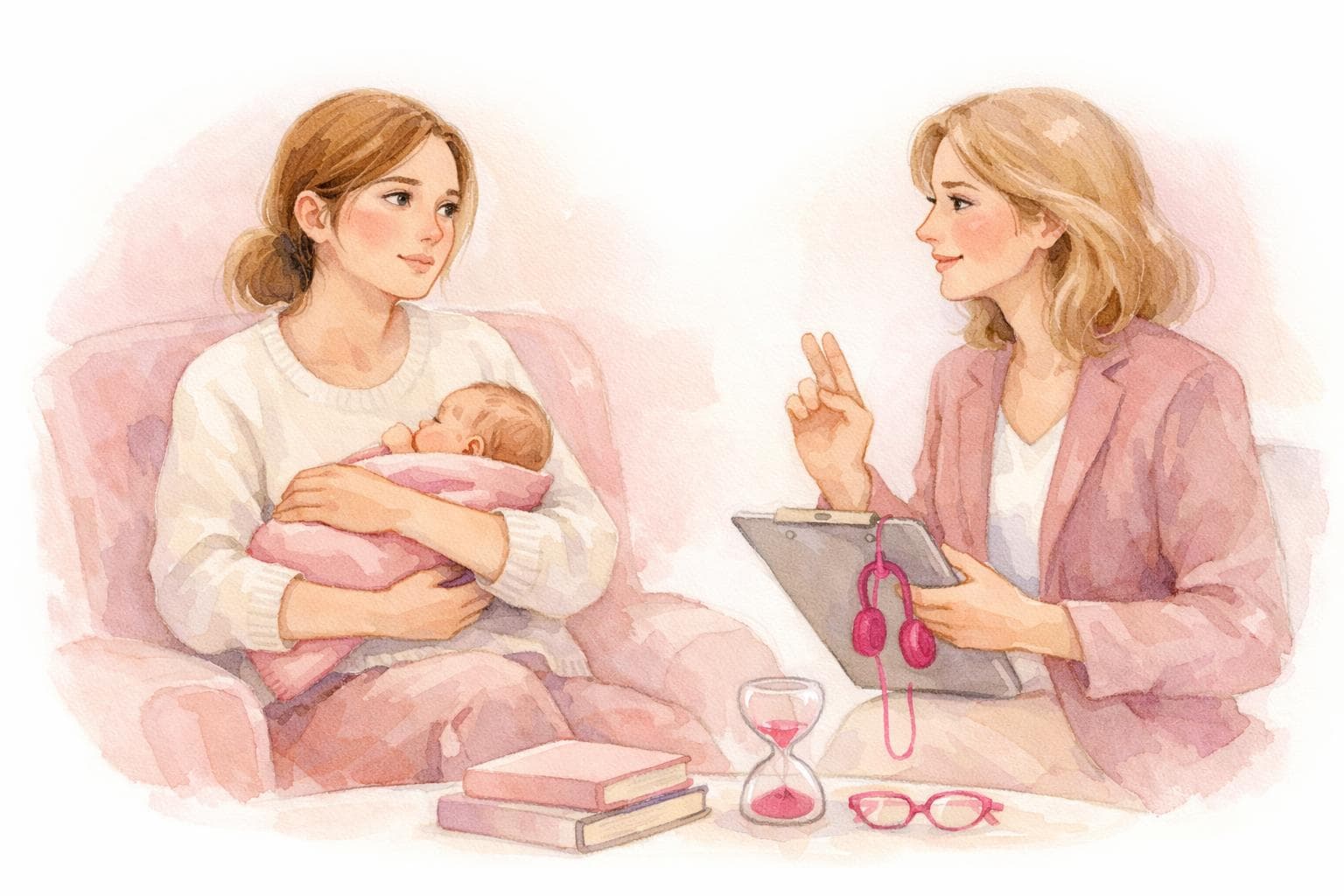

Your doctor mentioned "PMADs" during your six-week check and moved on before you could ask what it meant. A friend used the phrase "intrusive thoughts" like it was obvious, and you nodded along while quietly panicking about whether what you were experiencing counted. Nobody hands new mothers a dictionary for this, and the vocabulary gap itself becomes one more thing to feel behind on.
A postpartum mental health glossary is a reference guide to the clinical and everyday terms used to describe the emotional and psychological experiences mothers face after childbirth, ranging from normal, temporary adjustment to conditions requiring medical treatment. Perinatal Mood and Anxiety Disorders, the umbrella term clinicians now use, affect up to 1 in 5 mothers during pregnancy or the first year postpartum, according to Postpartum Support International, making this collection of terms relevant to a genuinely large share of new mothers, not a small edge case. This guide defines the terms you are most likely to encounter, from the mildest to the most clinically serious, so you can recognise what you are actually dealing with and ask for the right kind of help.
The core terms, defined
Baby blues. A short-lived period of mood swings, tearfulness and mild anxiety affecting up to 80% of new mothers, typically beginning within a few days of birth and resolving on its own within two weeks. Baby blues does not require treatment, though support and rest help.
PMADs, Perinatal Mood and Anxiety Disorders. The clinical umbrella term covering the full range of mental health conditions that can occur during pregnancy or within the first year postpartum, including depression, anxiety, OCD, PTSD and psychosis. Using this term instead of just postpartum depression reflects how varied these conditions actually are.
PPD, Postpartum Depression. Persistent sadness, hopelessness, loss of interest and difficulty functioning that lasts beyond two weeks and does not resolve on its own. Our guide to what postpartum depression actually is covers the full clinical picture, including symptoms, causes and treatment options in depth.
PPA, Postpartum Anxiety. Excessive, persistent worry, racing thoughts, physical tension and sometimes panic attacks centred on the baby's safety or your ability to cope. PPA is estimated to affect roughly as many mothers as PPD, though it receives far less public attention.
Postpartum OCD. Intrusive, unwanted thoughts about harm coming to the baby, paired with compulsive behaviours, excessive checking, avoidance, aimed at preventing that harm. These intrusive thoughts are ego-dystonic, meaning they horrify the person experiencing them rather than reflecting any actual desire to act on them, a distinction that matters enormously for accurate diagnosis.
Postpartum PTSD. A trauma response that can develop after a frightening, painful or medically complicated birth, involving flashbacks, hypervigilance and avoidance of birth-related reminders. It can occur regardless of how medically successful the delivery was, since the trauma is about the subjective experience, not just the outcome.
Postpartum psychosis. A rare but serious psychiatric emergency, affecting roughly 1 to 2 in every 1,000 births, involving delusions, hallucinations or severe confusion, typically emerging within the first two weeks postpartum. This condition requires immediate medical attention and is distinct from, and far more serious than, the intrusive thoughts described under postpartum OCD.
Matrescence. The developmental transition into motherhood, coined by anthropologist Dana Raphael in the 1970s and popularised more recently through research on the neurological and identity changes pregnancy and early motherhood produce. Our guide to what matrescence actually means covers this concept in full.
EPDS, Edinburgh Postnatal Depression Scale. The ten-question screening tool most commonly used by healthcare providers to identify possible postpartum depression or anxiety. A high score signals the need for further clinical evaluation, not a diagnosis on its own.
Intrusive thoughts. Sudden, unwanted, often disturbing thoughts that pop into a person's mind involuntarily. Common and normal in isolation for most new parents; they become clinically significant when paired with compulsive behaviours or severe distress, as in postpartum OCD specifically.
How the conditions compare
Condition | Typical onset | Duration without treatment | Core feature |
|---|---|---|---|
Baby blues | Days 3 to 5 postpartum | Resolves within 2 weeks | Mood swings, tearfulness |
PPD | Weeks to months postpartum | Persists, often worsens | Persistent sadness, hopelessness |
PPA | Weeks to months postpartum | Persists without intervention | Excessive worry, physical tension |
Postpartum OCD | Weeks postpartum | Persists without treatment | Intrusive thoughts plus compulsions |
Postpartum PTSD | Following a traumatic birth | Can persist for months to years | Flashbacks, avoidance, hypervigilance |
Postpartum psychosis | First 2 weeks postpartum | Requires immediate treatment | Delusions, hallucinations, severe confusion |
Why the vocabulary itself matters
Precise language changes outcomes. A 2023 review in the Journal of Clinical Psychiatry found that mothers who could accurately name their symptoms were more likely to seek appropriate care sooner, rather than dismissing serious symptoms as normal exhaustion or, conversely, catastrophising manageable anxiety as something more severe than it was.
"Perinatal mental health disorders are the most common complication of pregnancy and childbirth, yet they remain among the most underdiagnosed." - Postpartum Support International
If you recognise yourself in several of these definitions, our guide to postpartum depression: CBT vs medication, a mom's decision guide covers the treatment pathways in detail once you have a clearer sense of what you are naming.
A note on intrusive thoughts and safety
If intrusive thoughts about harming yourself or your baby feel persistent, distressing or hard to interrupt, this is a sensitive topic worth addressing directly with a healthcare provider, not something to manage alone. If you are having thoughts of harming yourself or your baby, call or text 988 to reach the Suicide and Crisis Lifeline, available 24/7, or text HOME to 741741 to reach the Crisis Text Line.
Key takeaways
- PMADs affect up to 1 in 5 mothers during pregnancy or the first postpartum year, making this vocabulary relevant to a significant share of new mothers, not a rare exception.
- Baby blues resolves within two weeks without treatment; PPD, PPA and postpartum OCD persist and typically worsen without intervention, a distinction that determines whether waiting it out is reasonable.
- Intrusive thoughts alone are common and normal; paired with compulsions and severe distress, they may indicate postpartum OCD specifically, a treatable but frequently misunderstood condition.
- Postpartum psychosis is rare, affecting 1 to 2 in 1,000 births, but constitutes a genuine psychiatric emergency requiring immediate medical attention, distinct from milder intrusive thoughts.
- Naming your symptoms accurately is linked to seeking appropriate care sooner, making a working vocabulary a practical tool, not just clinical trivia.
Sources and further reading
- Postpartum Support International. (2026). Perinatal mood and anxiety disorders. postpartum.net
- American College of Obstetricians and Gynecologists. (2025). Postpartum depression. acog.org
- Journal of Clinical Psychiatry. (2023). Symptom recognition and help-seeking behaviour in perinatal mental health.
- MGH Center for Women's Mental Health. (2026). Postpartum psychosis: symptoms and treatment. womensmentalhealth.org
- Raphael, D. (1973). The Tender Gift: Breastfeeding. Schocken Books.
- National Institute of Mental Health. (2026). Perinatal depression. nimh.nih.gov