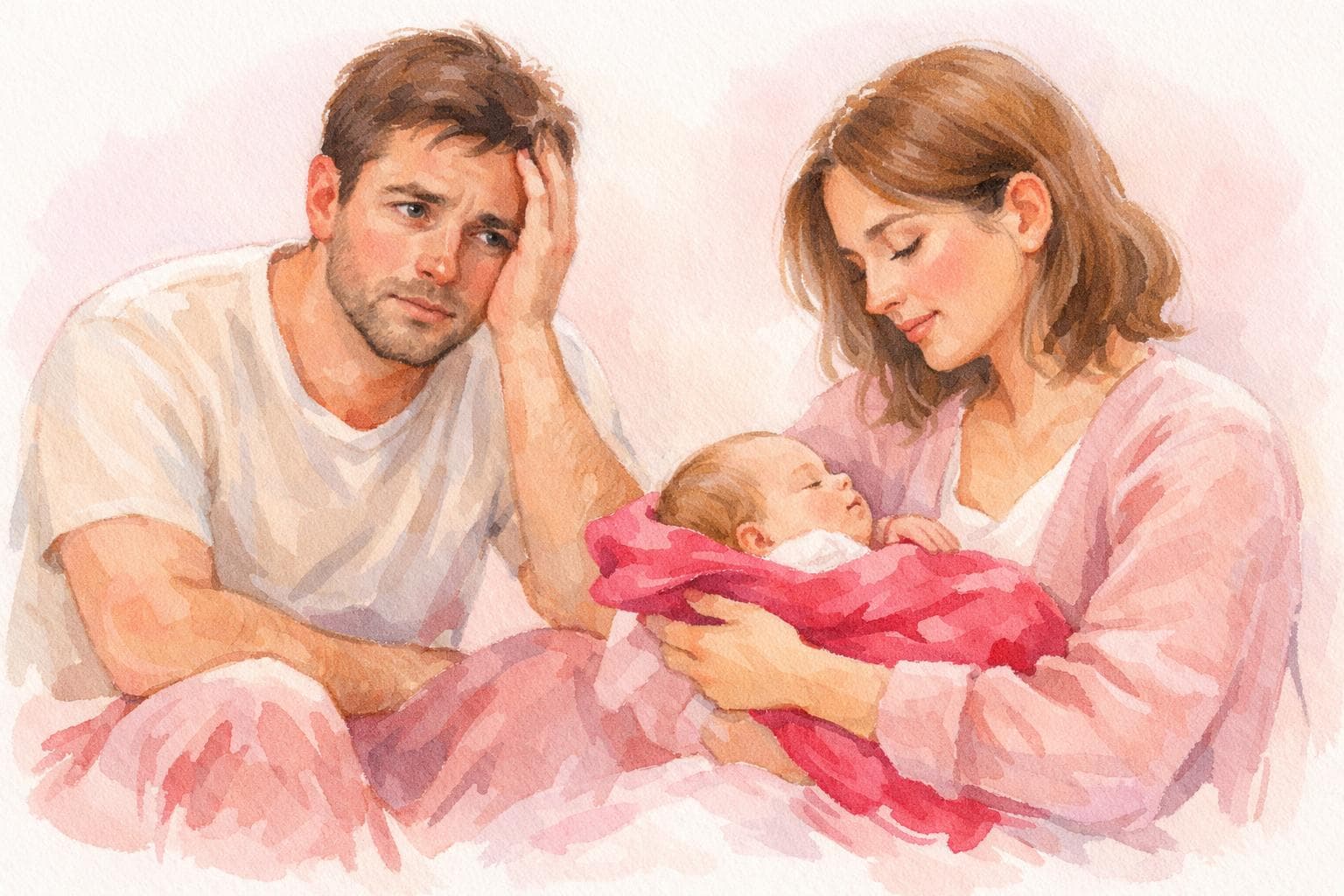
Everyone asked how she was doing. Nobody asked him. He nodded through the sleepless weeks, went to work, came home, held the baby, and somewhere underneath the exhaustion, something else was building. Racing thoughts at 3am about money, about whether he was doing this right, about a future that suddenly felt precarious in a way it never had before. He did not have a name for it. He just knew something was wrong, and no one had ever suggested it might be him who needed checking on.
Postpartum anxiety in fathers and partners is real, common and almost entirely absent from the conversation.
Postpartum anxiety in fathers and partners refers to excessive, persistent worry, restlessness or dread occurring during the perinatal period in a non-birthing parent, which can present alongside or independently of paternal postpartum depression and frequently goes undetected because screening protocols are built almost exclusively around the birthing mother. A 2024 nationwide Canadian cohort study of 3,217 fathers found that 22.4% experienced comorbid depression and anxiety symptoms at some point during the first year postpartum, rising to 8.9% at the six-month mark specifically. A separate meta-analysis of 47 studies found paternal depression prevalence of 9.7% prenatally and 8.75% postpartum, and clinical guidance from Kansas's Department of Health notes that up to 18% of fathers develop a clinically significant anxiety disorder, including generalised anxiety, OCD or PTSD, at some point during the perinatal period. This is not a rare complication. It is a systematically overlooked one.
Why this gets missed so consistently
Every structural element of perinatal mental health care is built around the birthing parent. The EPDS is administered to mothers. Postnatal check-ups are scheduled for mothers. Even Postpartum Support International's own 2020 screening recommendations acknowledge that partner mental health is rarely incorporated into routine perinatal care pathways.
A 2024 Health Affairs article on father inclusion in perinatal mental health describes fathers as occupying a dual role: partner and parent. As partners, their support directly affects maternal mental health outcomes. As parents, they are independently vulnerable to their own perinatal mood and anxiety disorders. Both roles are documented in the research. Only one is typically addressed in clinical practice.
Maternal vs paternal postpartum anxiety: how they compare
The symptoms overlap substantially, but the presentation and detection differ in important ways.
Maternal postpartum anxiety | Paternal/partner postpartum anxiety | |
|---|---|---|
Prevalence | Up to 20% of postpartum women | 8.75% to 18%, depending on the study and whether comorbid depression is present |
Screening | Routine, via EPDS and increasingly GAD-7 | Rarely screened; no routine clinical pathway in most US healthcare settings |
Common presentation | Worry, restlessness, physical tension, difficulty relaxing | Similar core symptoms, but often expressed through withdrawal, irritability or overworking rather than open worry |
Risk factor, partner's mental health | Partner depression or anxiety is a known risk factor | Maternal anxiety specifically predicts partner anxiety, according to a 2023 BMC study |
Cultural permission to disclose | Increasing, though still limited by stigma | Very limited; fathers report significant reluctance to disclose symptoms |
Impact on child development | Well documented | Increasingly documented; paternal mental health independently affects child outcomes |
A 2023 study published in BMC Pregnancy and Childbirth examined psychosocial predictors of early postpartum symptoms in both mothers and their partners and found that maternal anxiety specifically predicted partner anxiety, while maternal relationship satisfaction predicted partner depression. The two parents' mental health are not separate stories. They are intertwined, and treating one without attention to the other misses part of the picture.
Risk factors specific to fathers and partners
A 2022 study published in Cambridge Prisms: Global Mental Health, examining paternal stress, anxiety and depression in the early postnatal period, identified several consistent predictors:
- A personal history of depression or anxiety before the birth
- Pregnancy or birth-related stress and anxiety experienced during the pregnancy itself
- Lower income and lower educational attainment
- Younger paternal age
- Poor relationship quality with the birthing partner
- The birthing partner's own mental health, particularly anxiety
None of these differ dramatically from maternal risk factors, which is precisely the point: the underlying vulnerability is comparable, but the detection system is not.
What paternal postpartum anxiety often looks like
Because fathers and partners are rarely asked directly, the symptoms often present in less recognisable forms:
- Persistent worry about finances, safety or the future that feels disproportionate to actual circumstances
- Difficulty sleeping even when the opportunity to sleep is available
- Increased irritability or a shorter temper than usual
- Withdrawal from the relationship or from the baby, sometimes mistaken for disinterest
- Overworking or throwing himself into tasks as a way of avoiding the emotional weight of the transition
- Physical symptoms: racing heart, muscle tension, restlessness
- Reluctance to discuss any of the above, often due to a sense that his experience is secondary to his partner's recovery
A qualitative study exploring fathers' experiences of paternal postpartum depression on Reddit, published in Global Qualitative Nursing Research (2025), found that many fathers described their struggles as something whispered on only the darkest corners of the internet, reflecting how isolated and undiscussed this experience remains even among men actively seeking connection about it.
Why this matters beyond the individual father
Paternal perinatal mental health is not a side issue. Health Affairs (2024) reports that paternal mental health independently affects child emotional and behavioural development, separate from maternal mental health outcomes. A father's anxiety does not stay contained to him; it shapes the emotional climate of the household and the developmental environment of the child.
"Fathers themselves are vulnerable to perinatal mood and anxiety disorder. Up to half of men whose partners experience postpartum depression will experience postpartum depression themselves." - Health Affairs (2024)
If you are the mother in this dynamic and recognise these patterns in your partner, that recognition matters. Our guide to postpartum depression in dads covers the depression side of paternal perinatal mental health in more depth, and much of the same stigma and detection gap applies directly to anxiety.
What actually helps
Ask directly, even without a formal screening tool. "How are you actually doing with all of this?" is a question most fathers are never asked. It does not require a clinical instrument to be meaningful.
Normalise the numbers. Knowing that 8.75% to 22% of fathers experience clinically significant symptoms removes some of the isolation that keeps men from disclosing what they are feeling.
Seek couples-inclusive care where available. Since maternal and partner mental health are documented to influence each other, addressing both together, rather than treating the mother's mental health in isolation, reflects what the research actually shows about how these dynamics work.
Therapy remains effective regardless of gender. CBT and other evidence-based approaches that help with maternal postpartum anxiety apply equally to paternal presentations. Our guide to why every new mom should consider therapy makes an argument that holds just as well for partners, even though the framing rarely includes them.
Key takeaways
- 22.4% of fathers experienced comorbid depression and anxiety symptoms at some point in the first year postpartum, according to a 2024 nationwide Canadian cohort study of over 3,200 fathers.
- Up to 18% of fathers develop a clinically significant anxiety disorder during the perinatal period, yet almost no routine screening pathway exists for partners in standard US perinatal care.
- Maternal anxiety specifically predicts partner anxiety, according to a 2023 BMC Pregnancy and Childbirth study, meaning the two parents' mental health outcomes are directly linked, not separate.
- Paternal postpartum anxiety often presents differently than in mothers: through withdrawal, irritability, overworking or reluctance to disclose, rather than openly expressed worry.
- Paternal mental health independently affects child development, separate from maternal outcomes, making this a family health issue rather than an individual one.
Sources and further reading
- Kansas Department of Health and Environment. (2025). Paternal perinatal mental health. kdhe.ks.gov
- Nationwide Canadian cohort study. (2021). Paternal prevalence and risk factors for comorbid depression and anxiety across the first 2 years postpartum. PubMed. pubmed.ncbi.nlm.nih.gov
- Health Affairs. (2024). Perinatal mental health: father inclusion at the local, state, and national levels. healthaffairs.org
- Philpott, L.F. et al. (2022). Prevalence and associated factors of paternal stress, anxiety, and depression symptoms in the early postnatal period. Cambridge Prisms: Global Mental Health. ncbi.nlm.nih.gov
- BMC Pregnancy and Childbirth. (2023). Psychosocial predictors of early postpartum depressive and anxious symptoms in primiparous women and their partners. link.springer.com
- Global Qualitative Nursing Research. (2025). "Whispered on only the darkest corners of the internet": fathers' experiences with paternal postpartum depression on Reddit.