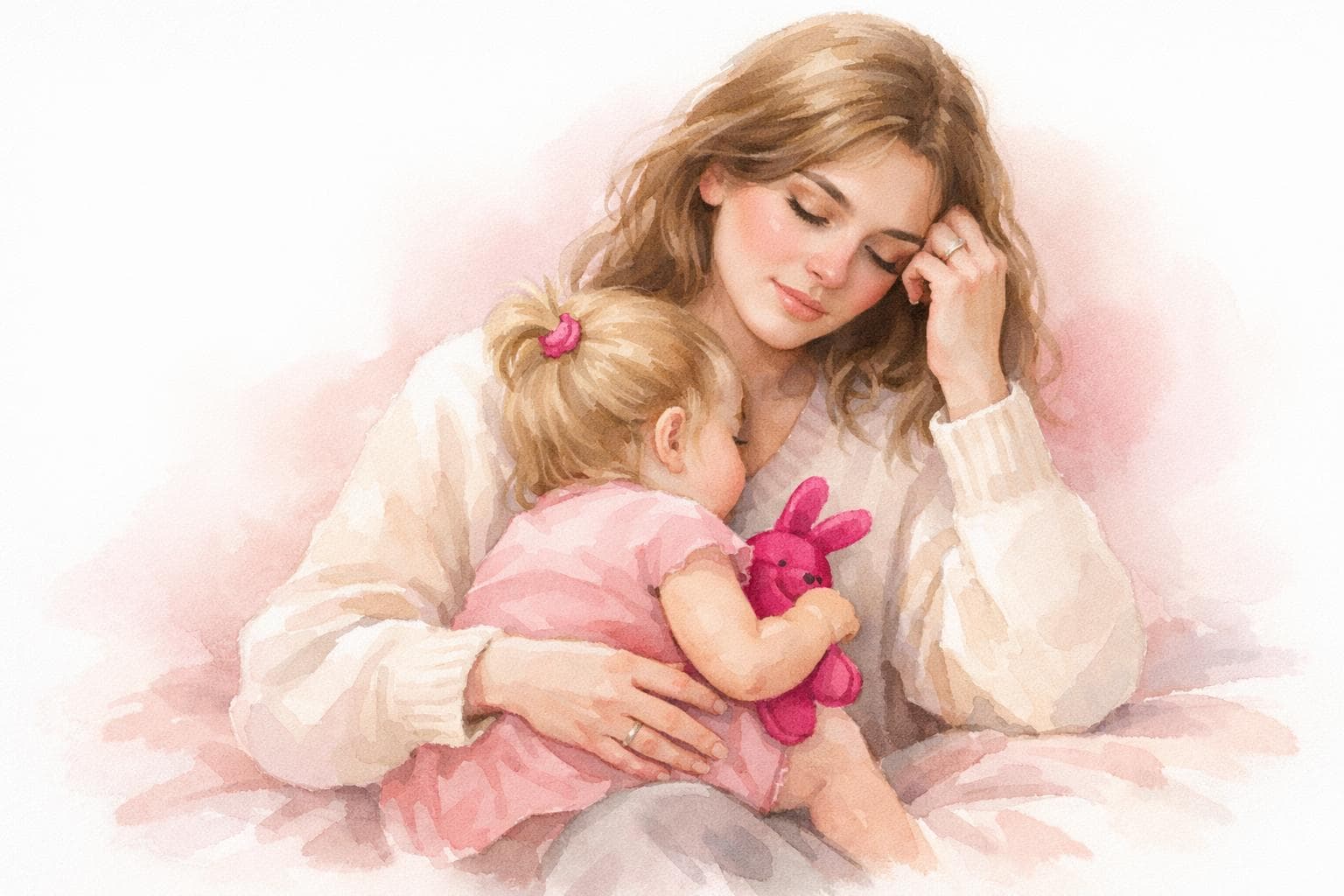
Nobody tells you how strange it is to hold a living child and grieve another one simultaneously.
You expected grief to be its own separate territory, something you could enter and move through before you got to the other side. But grief doesn't work like that. It doesn't wait for a convenient moment. It shows up in the middle of bath time, in the particular quiet of a child's afternoon nap, in a due date that passes unmarked by everyone except you.
Parenting after a miscarriage or through multiple losses, is one of the most emotionally complex experiences a mother can live inside. You are grateful and gutted, present and somewhere else, loving the child in front of you and mourning the one who isn't there. Both things are true at the same time and neither cancels the other out.
How common this is and why we don't talk about it
Miscarriage affects approximately one in four known pregnancies. In the UK, around 250,000 miscarriages are recorded each year, though the actual figure is likely higher due to very early losses that go unrecognised or unreported. The Tommy's charity estimates that in the US, up to one million pregnancies are lost annually.
These numbers mean that the experience of parenting alongside grief, or of becoming a mother after one or more losses, is far more common than the collective silence around it suggests. Most women who have miscarried will eventually have a living child. Many of them will parent that child while carrying a grief that has no official name and no clear endpoint.
Psychologist Pauline Boss, whose work on ambiguous loss has shaped how researchers understand unresolved grief, describes miscarriage as a form of ambiguous loss precisely because it involves mourning someone who existed but left no social trace. There is no funeral. Often there is no acknowledged relationship. The loss happens, the world continues as usual and the mother is left with a grief she is not always sure she is allowed to have.
What parenting inside grief actually feels like
It doesn't feel like one thing. That's part of what makes it so hard to describe, and so hard for the people around you to understand.
There is the anniversary grief: the due date that should have been, the month the other child would have turned two, the season in which everything happened. These dates come quietly and land hard.
There is the comparative grief: watching your living child reach milestones and wondering, involuntarily, what the other one would have been like at the same age. It's not a failure of love for the child in front of you. It's the mind completing a loop it can't quite close.
There is survivor guilt, which is not a rational feeling but arrives anyway: the sense that your joy in your living child is somehow a betrayal of the one you lost, or that you don't deserve to feel happy while grief is still present.
And there is, for many women, a specific kind of anxiety that attaches to parenting after loss: a hypervigilance, a difficulty trusting that good things will stay good, a reflex to prepare for the worst because the worst has already happened once.
The grief that doesn't have a clear endpoint
One of the most difficult aspects of grief after miscarriage is that it doesn't follow the arc that people expect grief to follow. There is no stage at which you are officially done, no moment at which having a healthy child resolves or replaces what was lost.
Research published in Obstetrics and Gynecology found that a significant proportion of women who experienced miscarriage still reported symptoms of grief, anxiety and depression at nine months post-loss, even those who had subsequently had a successful pregnancy. A 2021 study in BMC Pregnancy and Childbirth found that the birth of a subsequent child did not eliminate grief but changed its texture, adding gratitude and complexity to feelings that were already complex.
What this tells us is that grief after pregnancy loss is not a problem to be solved by a subsequent healthy baby. The child who arrives is not a replacement. The loss remains a loss, and it is allowed to remain one.
What people around you may assume | What is often closer to the truth |
|---|---|
Having a healthy baby means the grief is over | Grief and gratitude coexist for a long time |
You should be feeling better by now | There is no timeline for this kind of loss |
Talking about it is morbid or unhelpful | Being able to name the loss is usually what helps |
The miscarriage was early so it was less significant | Gestational age does not determine the significance of a loss |
Moving forward means leaving it behind | Moving forward usually means carrying it differently |
How to hold both at the same time
There is no formula for this. But there are things that tend to help and things that tend to make it harder.
It helps to name the loss, even privately. To acknowledge the child who didn't arrive as someone who existed, even briefly, and whose absence has a shape. Some parents find it useful to mark anniversaries in small private ways. Others find those days easier if they are acknowledged rather than pushed through. There is no correct approach.
It helps to say, without apology, that both things are true. That you love your living child completely and that you still grieve the one you lost. You do not have to choose between those feelings or explain how they coexist. They just do.
It helps to find people who can hold both things with you, because not everyone can. A therapist who has experience with pregnancy loss, or a community of women who have been through the same thing, can offer a kind of witnessing that is hard to find in ordinary social life.
"Grief is just love with nowhere to go." - Jamie Anderson
If you are parenting through the kind of depletion that goes deeper than ordinary tiredness, Emotional exhaustion in motherhood: what it really means speaks to what it feels like when the emotional weight becomes physical. And if the anxiety that attaches to parenting after loss has become something that significantly affects your daily life, Postpartum anxiety: how to recognise it and cope is a useful companion.
The thing worth saying directly
You are allowed to grieve and to parent at the same time. You are allowed to love your living child and still be sad about the one you lost. You are allowed to talk about the baby who didn't come, even years later, even in the middle of an ordinary day.
The grief is not a problem with your parenting. It is not a sign that you love the child in front of you any less. It is proof that love existed, and that it doesn't simply stop because the person it was directed at is no longer here.
That is worth acknowledging. Even if nobody else does.
Further reading: Pauline Boss, Ambiguous loss: learning to live with unresolved grief (1999). Zoe Clark-Coates, Beyond the storm: a guide to help you through grief after pregnancy loss, stillbirth or neonatal death (2021). Tommy's: www.tommys.org.
If you are struggling after pregnancy loss, the Miscarriage Association offers support at www.miscarriageassociation.org.uk. In the US, Share Pregnancy and Infant Loss Support is available at www.nationalshare.org.