There is something about putting it in writing that changes things.
You can tell your son a hundred times that you love him, that you are proud of him, that you believe in him. And those words matter, genuinely. But a letter is different. It is something he can hold. Something he can return to at twenty-three, or thirty-five, or the morning before something important, when your voice is not immediately available and the words still need to be there.
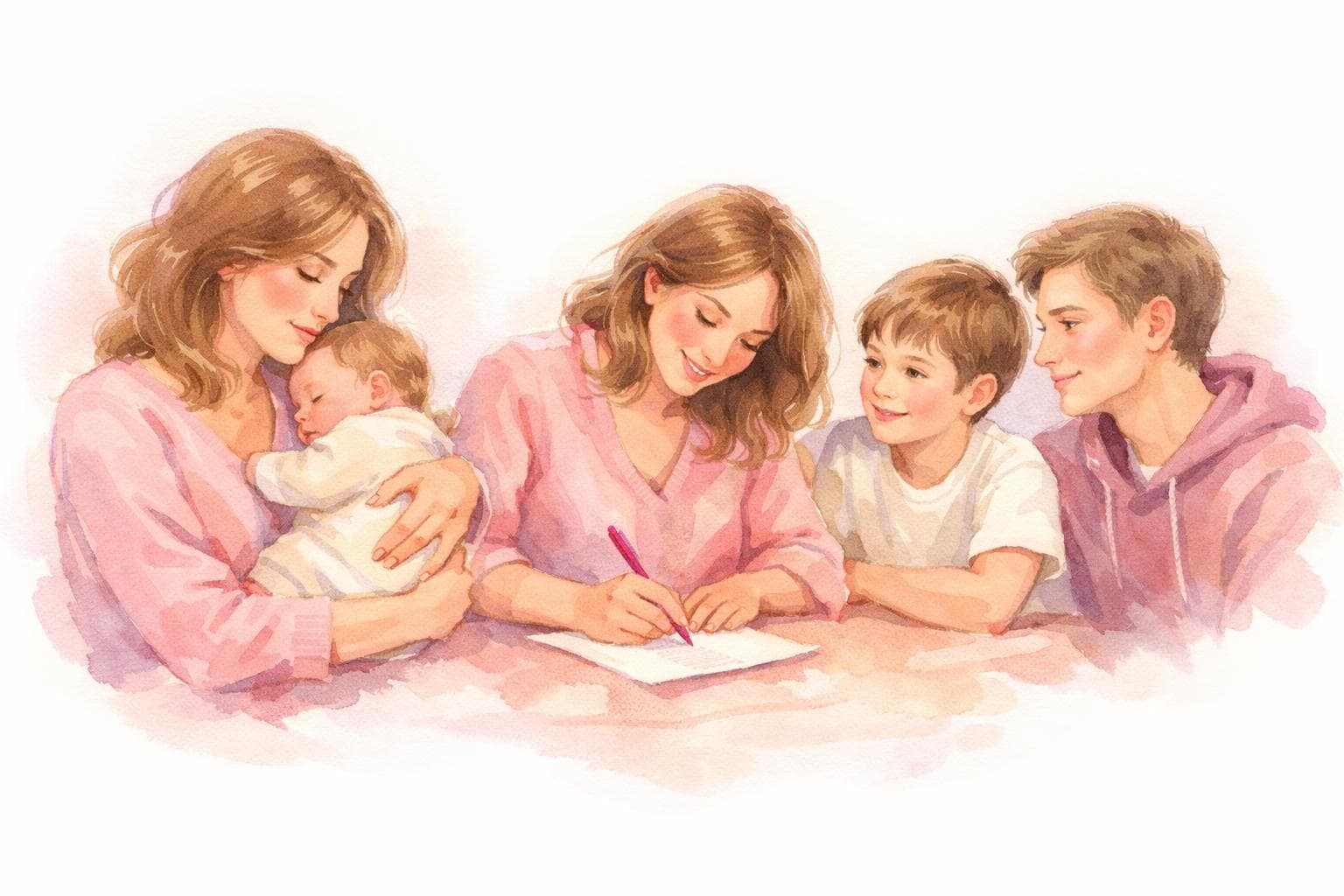
Writing letters to your son at different stages of his life is one of the most lasting things a mother can do. Not because the letters are literary masterpieces, but because they exist. Because someone thought he was worth the time and the care of writing it down.
Why letters matter more than you think
The evidence for the impact of written parental communication on children is more robust than most people expect.
Research by psychologist Marshall Duke at Emory University, whose work on family narratives has been influential in developmental psychology, found that children who had a strong sense of their family story, who they come from and who their parents are as people, showed greater resilience, higher self-esteem and better emotional regulation. Letters are a direct way of building that narrative.
A 2018 study published in Developmental Psychology found that children who received explicit written expressions of parental belief in their ability showed measurably higher academic persistence and self-efficacy than those who did not. The written form, specifically, was more durable in its effect than verbal expressions alone.
Letters also protect against something that most parents do not anticipate: the gaps. The years when a teenage son is not particularly interested in talking. The transition to adulthood when he is figuring out who he is. The moments when he needs to know someone believed in him but cannot ask. A letter in a drawer answers that.
What to write at each stage
You do not need to write fifty letters or write them perfectly. You need to write something, at the moments that matter, in words that are honestly yours.
At birth or in the early days What you felt when you first knew he existed. What you hoped for him. What you noticed about him in those first days that you do not want to forget. This letter is as much for you as for him.
Starting nursery or school What this transition feels like. What you want him to know about the world he is entering. What you already see in him that you hope he holds onto.
The primary school years Something specific about who he is at this age: what makes him laugh, what he cares about, how he moves through the world. These letters become a record of him becoming himself.
Starting secondary school This transition is significant. What you want him to know about belonging, about friendship, about not losing himself in the effort to fit in. What you believe about him even when he is not sure he believes it about himself.
The teenage years This is when letters matter most and when writing them feels hardest. Not a lecture. Not a list of expectations. Something more honest: what you are noticing, what you are proud of, what you want him to know even when he appears not to need telling.
Before a significant moment An exam. A match. A performance. A difficult conversation he has to have. A small letter that says: I see you working at this. I am already proud of you regardless of the outcome.
When things are hard When something has gone wrong, when he is struggling, when he has made a mistake he feels terrible about. A letter that does not fix it but does not abandon him in it either.
As he becomes an adult What you have learnt from being his mother. What you wish for his life. What you want him to carry with him.
How to actually write one
The blank page is the hardest part. These prompts help.
Stage | Starting prompt |
|---|---|
Birth | "The first thing I noticed about you was..." |
Starting school | "I want you to know that you are already..." |
Teenage years | "I see you navigating something hard, and I want you to know..." |
Before something difficult | "Whatever happens today, I want you to remember that..." |
When things go wrong | "You don't have to be perfect for me to be proud of you." |
As an adult | "Here is what I have learned from being your mother..." |
You do not have to start with these. But sometimes having a first sentence removes the paralysis that makes the letter never get written.
A few things worth knowing before you start
Keep the letters. Whether he reads them now or in twenty years, they are worth keeping somewhere he can find them.
Do not wait for the perfect moment. The letter written on a Tuesday when nothing particular is happening is sometimes the most honest one.
Do not edit out the vulnerability. The letters where you say "I am not sure I always get this right" tend to mean more than the polished ones.
"A mother's love for her child is like nothing else in the world. It knows no law, no pity, it dares all things and crushes down remorselessly all that stands in its path." - Agatha Christie
If writing this kind of letter brings up things about your own relationship with your mother or your own childhood, how to break generational cycles and parent differently than you were raised addresses that layer honestly. And for mothers thinking about how to talk to their children about harder topics, how to talk to your kids about your mental health is a useful companion.
The letter you write today will mean more to him than you know. That is worth starting.
Further reading: Rachel Macy Stafford, Hands free mama (2013). Erin Loechner, Chasing slow (2017). Marshall Duke, family narrative research, Emory University (ongoing).