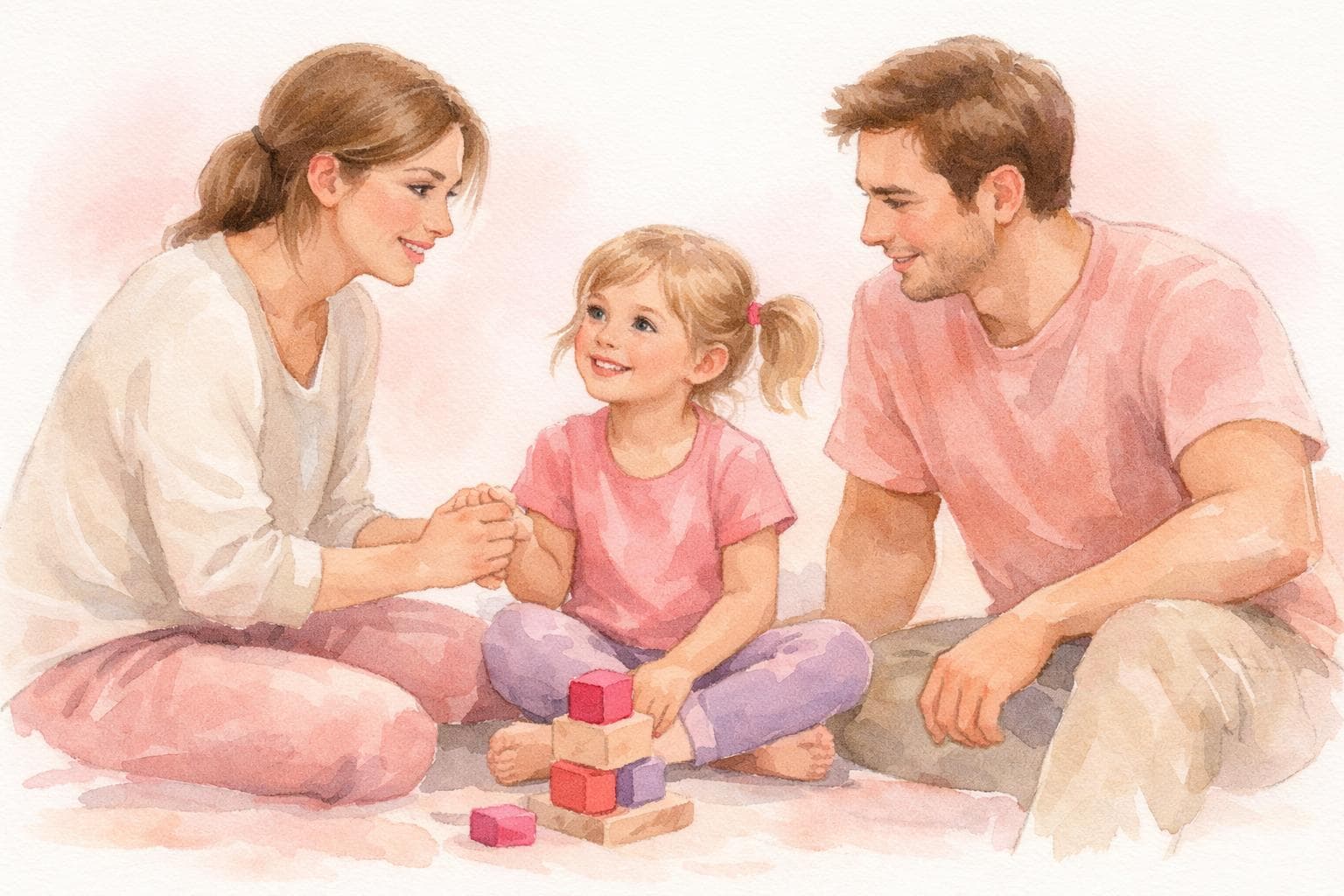
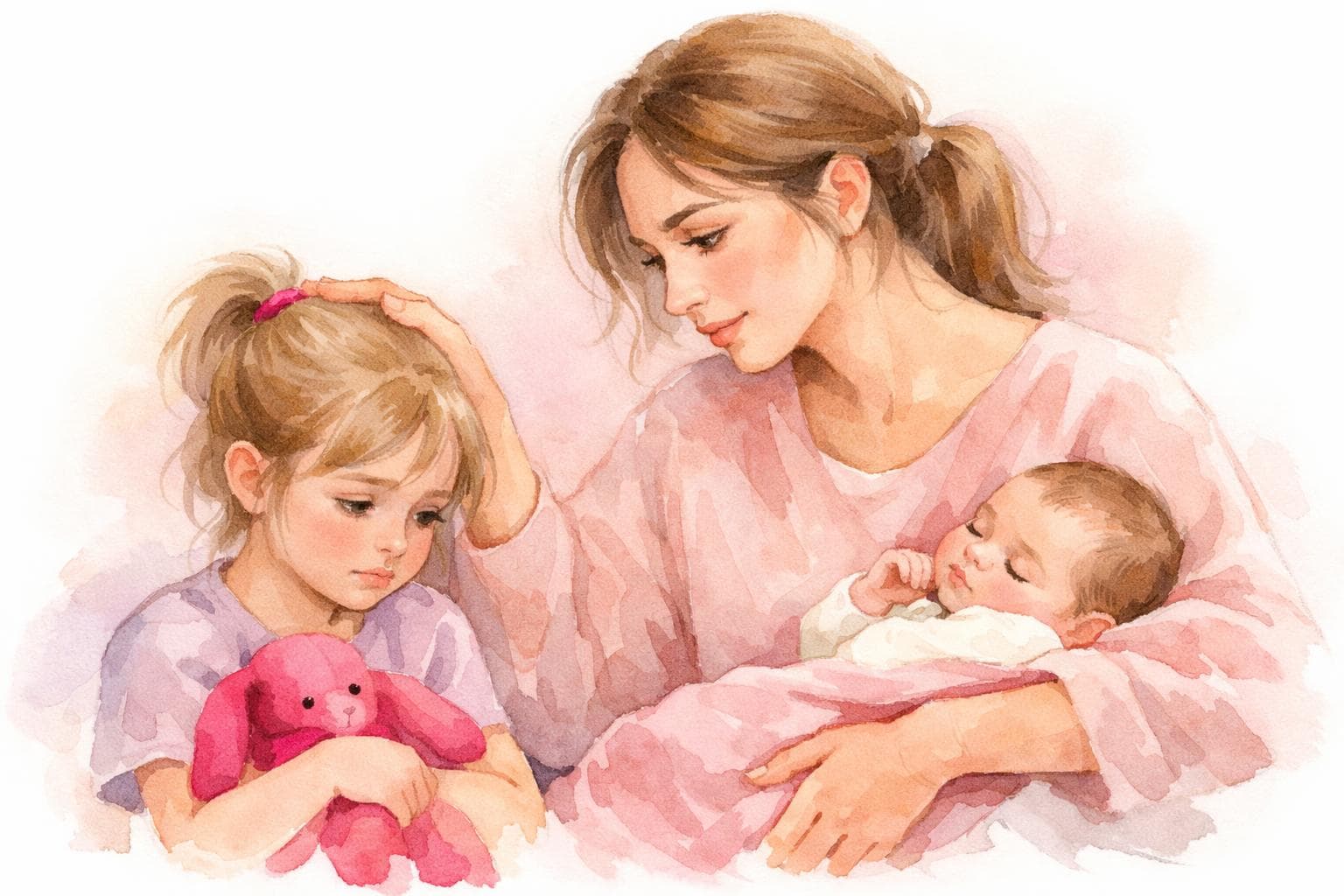
The baby is two weeks old. Your toddler is standing at the door holding a book, waiting. You want to read it with her but the newborn needs feeding again. So you say, "In a minute, sweetheart." And that minute never comes.
Later, in the dark, you cry. Not because something went wrong. Because something shifted. The person who made you a mother is now sharing you, and the guilt of that is heavier than anyone warned you about.
This is second child guilt. It is not dramatic. It is not rare. And it is not a sign that you are doing something wrong.
What is second child guilt?
Second child guilt is the persistent feeling that by having another baby, you are somehow betraying or shortchanging your firstborn. It can start during pregnancy and grow louder after the new baby arrives.
Research on families transitioning to siblinghood has shown that second-time mothers often carry a specific set of worries: whether they can love two children equally, how the relationship with the firstborn will change and guilt about disrupting that child's world.
Nearly 80% of families in the US have two or more children, which means the transition to siblinghood is one of the most common family events in early childhood. Yet it is frequently overlooked. Many assume that because you have done this once before, you know what you are doing. The truth is, having a second child introduces an entirely different emotional landscape.
Why it hits so hard
Guilt is already woven into motherhood. A 2023 survey found that 91% of mothers experience mom guilt, with 61% identifying themselves as the primary source of that pressure. When a second baby enters the picture, the guilt tends to sharpen around one specific person: your first child.
Here is what the guilt often sounds like:
- "She did not ask for this. I changed her whole world."
- "He is acting out because I am not giving him enough."
- "I feel like I have already failed her and it has only been a month."
- "I love the baby but I miss my time with just him."
None of these thoughts mean something is broken. They mean you care deeply. But sitting with that kind of guilt day after day is exhausting, and it deserves attention.
Common triggers of second child guilt
Trigger | What it feels like |
|---|---|
Firstborn's behaviour changes | Clinginess, tantrums, regression feel like proof that you have hurt them |
Less one-on-one time | You notice the gap between what you used to give and what you can give now |
Comparing milestones | You did not track the second baby's first smile the way you tracked the first one |
Physical exhaustion | Being too tired to be present for either child |
Firstborn crying at drop-off | Every goodbye feels like confirmation you are not enough |
What the research actually says
A comprehensive review published in Psychological Bulletin examined 30 studies on firstborn adjustment after the birth of a sibling. The results did not support a crisis model of the transition. While some children showed temporary decreases in affection toward their mothers, there was no consistent evidence that the transition is damaging for most children. In many cases, children showed developmental advances or no noticeable change at all.
That review also noted large individual differences, meaning some children struggle more and some adjust quickly. Both responses are normal.
A 2022 study published in International Journal of Environmental Research and Public Health found that the quality of the mother-firstborn relationship before the second baby's arrival was a strong predictor of maternal wellbeing. When that bond felt solid, mothers experienced less parenting burnout and fewer depressive symptoms during the transition.
In other words: the relationship matters more than the amount of time.
"Second-time mothers often have different concerns, generally focused on their relationship with the older child, how this relationship will change, whether they can love two children the same and feeling guilty about destroying the first child's life." - Mercer (1979), cited in Volling (2012), Psychological Bulletin
Things that actually help
Name the guilt instead of fighting it
Guilt thrives in silence. Saying "I feel guilty about not spending enough time with my older child" out loud, to a partner, a friend or a therapist, strips the thought of some of its power. You are not confessing a failure. You are describing a feeling.
Protect small, predictable rituals
You do not need hours of dedicated time. Ten minutes of undivided attention during a bedtime story or a morning walk to the letterbox together can carry more weight than a full afternoon split between two children. Predictability matters more than volume.
Let your firstborn be part of it
Children who feel included in the new family structure tend to adjust more smoothly. Letting your toddler "help" with nappy changes or choose the baby's outfit is not just cute. It is functional. It gives them a role.
Stop comparing chapters
Your firstborn had you entirely for a season. Your second child has a sibling from day one. These are different beginnings, not better or worse ones. The comparison trap is one of the biggest fuel sources for guilt, and stepping out of it is one of the most useful things you can do.
When the guilt becomes something bigger
Normal guilt ebbs and flows. It shows up, stings and passes. But if the guilt is constant, if it is affecting your sleep, your mood, your ability to enjoy time with either child or your sense of yourself as a parent, it may have tipped into something more.
Parenting burnout, described by researchers as an exhaustion disorder related to parenting, is now a well-documented phenomenon. It includes emotional exhaustion, emotional distancing from your children and a sense of ineffectiveness as a parent. If that sounds familiar, it is worth talking to a professional.
You might also find it helpful to read about emotional exhaustion in motherhood and how to ask for help as a mom without feeling like you are admitting defeat. And if you are navigating this transition alongside anxiety or low mood, this piece on how therapy can support moms who feel stuck might be a good next step.
You are not failing. You are adjusting.
Having a second child does not halve your love. It stretches your capacity, your time and your patience in ways no one fully prepares you for. But the guilt you feel is not evidence of failure. It is evidence that you care about both of your children deeply.
Your firstborn is not losing you. They are gaining a family that is bigger than before with a mother who is doing her best inside a season that will not last forever.
Sources and further reading
- Volling, B. L. (2012). Family transitions following the birth of a sibling: an empirical review of changes in the firstborn's adjustment. Psychological Bulletin. sites.lsa.umich.edu
- Zhuo, R., Shi, X. & Wu, Y. (2022). Association between parent-child relationship and second-time mother's prenatal depressive symptoms: the mediation role of parenting burnout. IJERPH. ncbi.nlm.nih.gov
- Mikolajczak, M. et al. (2023). 15 years of parental burnout research: systematic review and agenda. Current Directions in Psychological Science. journals.sagepub.com
- Pew Research Center. (2023). Parenting in America Today. pewresearch.org
- Ockwell-Smith, S. (2019). The Second Baby Book. Piatkus.