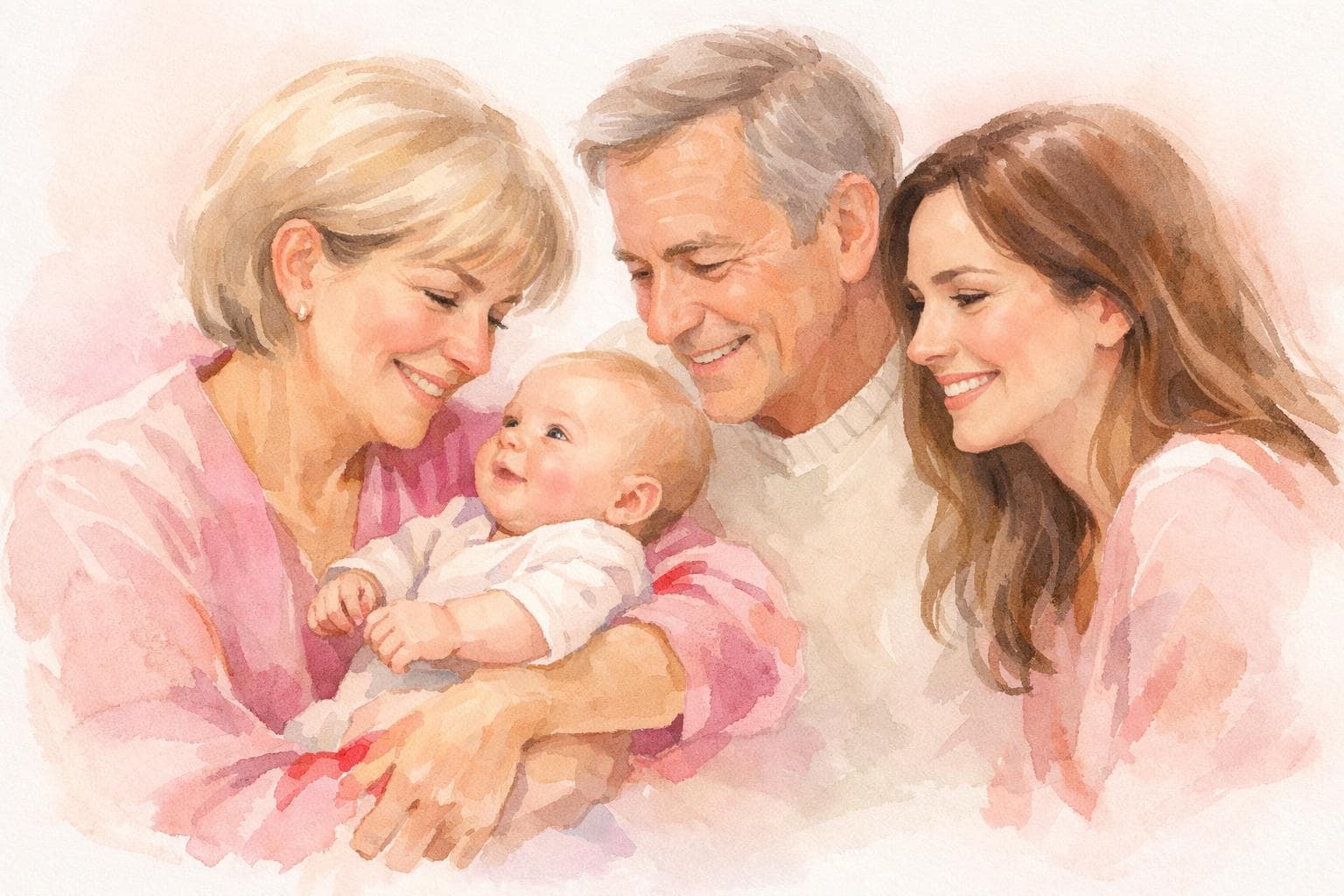
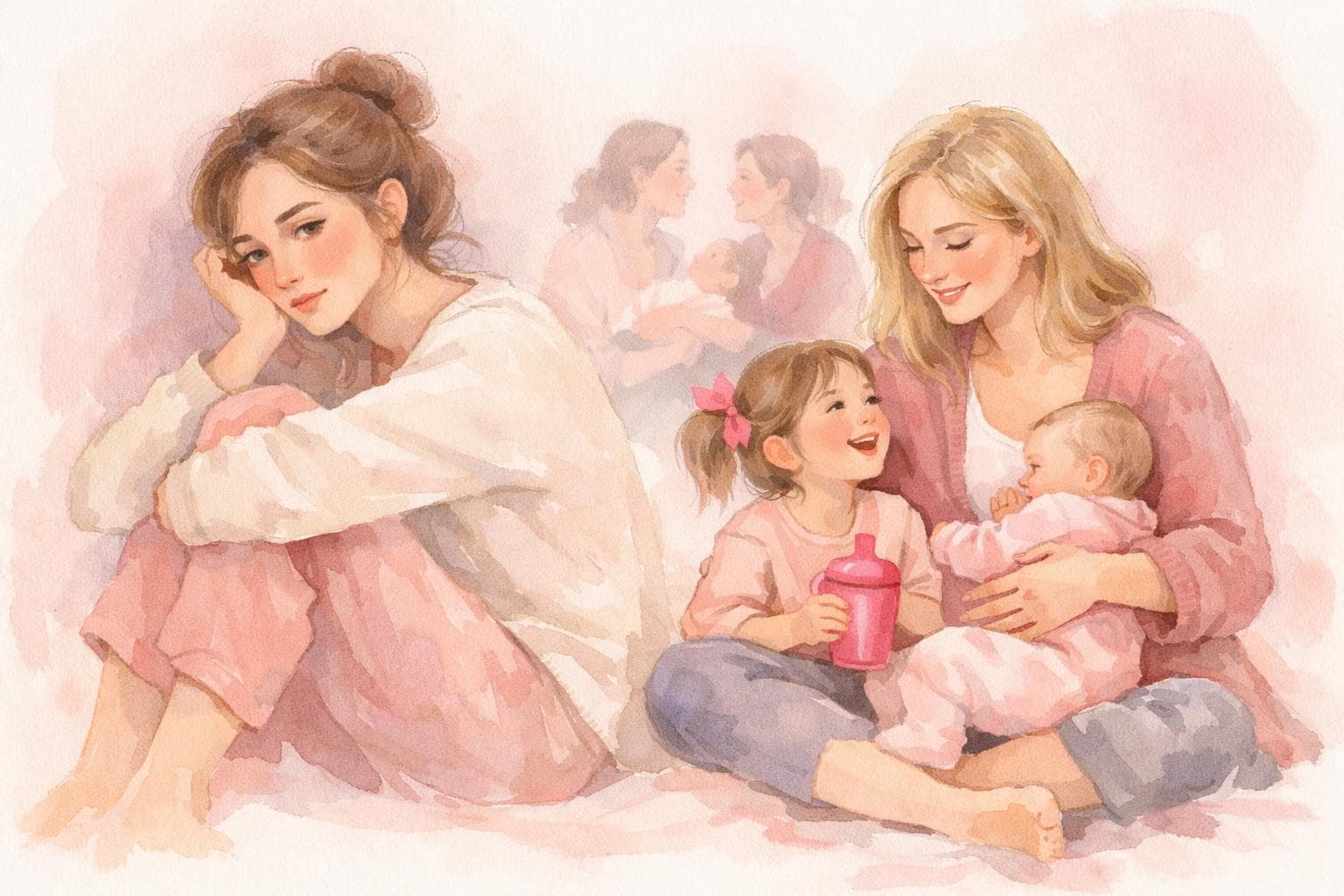
Your grandmother had a mother two streets over, a sister who dropped by unannounced, and neighbours who actually knew her children's names. You have a phone full of contacts and nobody to call at 2pm on a Tuesday. Something structural changed between her generation and yours, and it was not a personal failing on your part. It was the disappearance of the infrastructure that used to make motherhood less lonely by default.
Here is what the research actually shows changed and why naming the shift matters more than blaming yourself for feeling it.
The loneliness epidemic among mothers refers to the measurable rise in social isolation and subjective loneliness among women raising young children, driven primarily by structural changes in family size, household composition and geographic proximity to extended family over the past several decades, rather than any change in mothers' individual resilience or sociability. A Japanese cross-sectional study of 531 mothers raising children under three found that loneliness was significantly higher among socially isolated mothers, with fewer supportive behaviours from partners and fewer people available to consult about parenting as key predictors. Research from the Institute for Family Studies documented that Americans are increasingly likely to have been raised in smaller families, a shift long underway before the pandemic accelerated conversations about isolation further. This is not a story about mothers becoming less capable of connection. It is a story about the disappearance of the structures that used to make connection automatic.
What actually changed generation to generation
Factor | Previous generations | Now |
|---|---|---|
Extended family proximity | Often lived in the same town or neighbourhood | Frequently hours or states away, dispersed by education and career mobility |
Household size | Larger families, more siblings, multi-generational homes common | Shrinking family size across recent decades, per Institute for Family Studies research |
Neighbourhood familiarity | Neighbours often knew each other across years, sometimes generations | Higher residential turnover; less time to build the kind of familiarity that produces casual support |
Default social contact | Built into daily errands, shared porches, community routines | Requires deliberate scheduling; contact has to be initiated rather than assumed |
Community institutions | Churches, clubs and local associations with regular built-in attendance | Declining participation in many traditional community institutions over the same period |
Work structure | Often single-income households with one parent present during the day | Dual-income households now the statistical majority, reducing daytime overlap between mothers |
The mechanism according to the research
A Japanese study of 531 mothers with children under three found that loneliness was mediated specifically by social isolation, and that two community-level factors stood out: fewer people to consult about parenting, and low community commitment. Individual and family-level factors mattered too, including fewer supportive behaviours from a partner around household duties and childcare. The researchers concluded that referral to community-based support could help mitigate loneliness precisely because the missing ingredient was structural access to people, not a lack of desire for connection.
This mirrors a broader generational pattern. The Institute for Family Studies found that shrinking family size and changes in family structure over recent decades have measurably affected loneliness outcomes, independent of social media use or any single modern explanation. The instinct to blame smartphones or the pandemic misses a slower-moving, decades-long structural shift that predates both.
Why this specifically hits mothers of young children hardest
A separate study on migrant mothers in Montreal found that women described social isolation specifically as the loss of family support and familiar cultural networks, while loneliness was described as the feeling of aloneness that came from parenting in unfamiliar circumstances with limited support. Notably, 84% of families in that study identified social isolation and emotional fragility as their primary challenge, a figure that illustrates how central this issue is even in a population receiving structured perinatal support services.
The timing of early motherhood compounds the structural problem. A newborn or toddler requires near-constant supervision precisely during the years when a mother has the least flexibility to travel toward extended family, join community institutions, or maintain the friendships that require reciprocal, adult-paced contact.
Intergenerational transmission: loneliness can pass down too
A large multigenerational Finnish study found a robust association between mothers' loneliness and their offspring's experienced loneliness in adulthood, with an odds ratio of 1.64. This finding adds a layer most conversations about maternal loneliness miss entirely: addressing isolation now is not only about your own wellbeing in this specific season. It may also shape your child's relational patterns decades later.
What this means for how you respond
Naming the structural cause changes the response. If loneliness were purely a personal failing, the fix would be trying harder to be more sociable. If it is a structural gap, the fix is deliberately rebuilding the infrastructure that used to exist by default.
- Extended family proximity used to provide practical help automatically. Our guide to mom community without family nearby addresses building that support deliberately when geography has removed it.
- Casual, repeated contact with other mothers used to happen through neighbourhoods and shared daily routines. Our guide to how to make adult friends after having kids covers how to recreate that mechanism intentionally.
- Existing friendships used to be sustained through proximity rather than effort. Our piece on why moms ghost their old friends addresses what happens when that automatic maintenance disappears and how to repair it.
"Referral to a counseling organization to alleviate feelings of loneliness among mothers of young children should focus on strengthening individual, family, and community-level factors, with particular attention to reducing social isolation." - Study on loneliness in mothers raising children under 3, peer-reviewed journal publication
Key takeaways
- Maternal loneliness is driven primarily by structural changes, family size, geographic dispersion and declining community institution participation, not a decline in mothers' individual capacity for connection.
- A study of 531 mothers found loneliness was significantly higher among socially isolated mothers, with fewer people to consult about parenting and low community commitment as key predictors.
- 84% of families in one perinatal support study identified social isolation as their primary challenge, illustrating how central this issue remains even among mothers receiving structured support services.
- A large Finnish study found maternal loneliness is associated with offspring's loneliness in adulthood, odds ratio 1.64, suggesting the stakes of addressing isolation extend beyond the current season.
- Because the cause is structural, the solution requires deliberate rebuilding, not simply trying harder to be more sociable within a system that no longer produces connection automatically.
Sources and further reading
- Machida, M. et al. (2021). Individual, family, and community factors related to loneliness in mothers raising children less than 3 years of age: a cross-sectional study. ncbi.nlm.nih.gov
- Institute for Family Studies. (2022). Growing up lonely: Generation Z. ifstudies.org
- Kekäläinen, T. et al. (2024). Intergenerational continuity of loneliness and potential mechanisms: Young Finns Multigenerational Study. Scientific Reports / Nature. nature.com
- La Maison Bleue study. (2022). Social isolation, loneliness and health: experiences of migrant mothers with young children. ncbi.nlm.nih.gov
- What Works Wellbeing. (2024). Trends in social isolation. whatworkswellbeing.org
- U.S. Surgeon General. (2023). Our Epidemic of Loneliness and Isolation. Office of the Surgeon General.