Your toddler just emptied a box of raisins into the sofa cushions. Before that, they poured water onto the cat. Before that, they cried because you peeled their banana the wrong way. It is 9:15 in the morning.
Somewhere between the mess and the monotony, a thought surfaces: I used to do things. Things that were mine. Things that had nothing to do with snacks, naps or wiping surfaces. Where did those things go?
They went where all stay-at-home mom hobbies go. Into the gap between what you want and what the day allows. But that gap, it turns out, is not as narrow as it feels. Fifteen minutes is more than enough. You just need the right activity and the right expectations.
Why stay-at-home moms lose hobbies first
A cross-sectional study comparing stay-at-home mothers and working mothers found that SAHMs reported higher stress scores (7.16 vs 5.72) and lower social wellbeing than their employed counterparts. The researchers linked this partly to isolation and partly to the loss of identity that comes with a role that has no clear boundaries, no breaks and no performance review.
When your workplace is your home and your colleagues are under four years old, the line between "on duty" and "off duty" disappears entirely. Hobbies require that line. Without it, every spare moment gets absorbed by laundry, meal prep or the vague guilt of not doing something productive.
A 2023 qualitative study published in PMC confirmed that even when mothers access leisure time, it is typically interrupted by home and family obligations. The study also found that emotional self-care, which includes creative and enjoyable activities, was undervalued compared to physical self-care like exercise or grooming.
"Stay-at-home moms often feel as though their identities become solely defined by their caregiving role, leaving little room for personal growth, hobbies, or self-reflection." - TheraCorpClinic (2024)
Why 15 minutes is enough
You do not need a free afternoon. You need a pocket of time that your nervous system recognises as yours. Research on flow states shows that even brief engagement in a personally meaningful activity can reduce cortisol, improve mood and create a sense of autonomy.
Fifteen minutes is:
- One nap-time window before the chores start
- The length of one episode of a toddler TV show
- The gap between bedtime and when you fall asleep on the sofa
- Three songs danced to in the kitchen after lunch
It is short. But it is not nothing. And "not nothing" is how hobbies come back to life.
Hobbies you can do while the toddler is awake
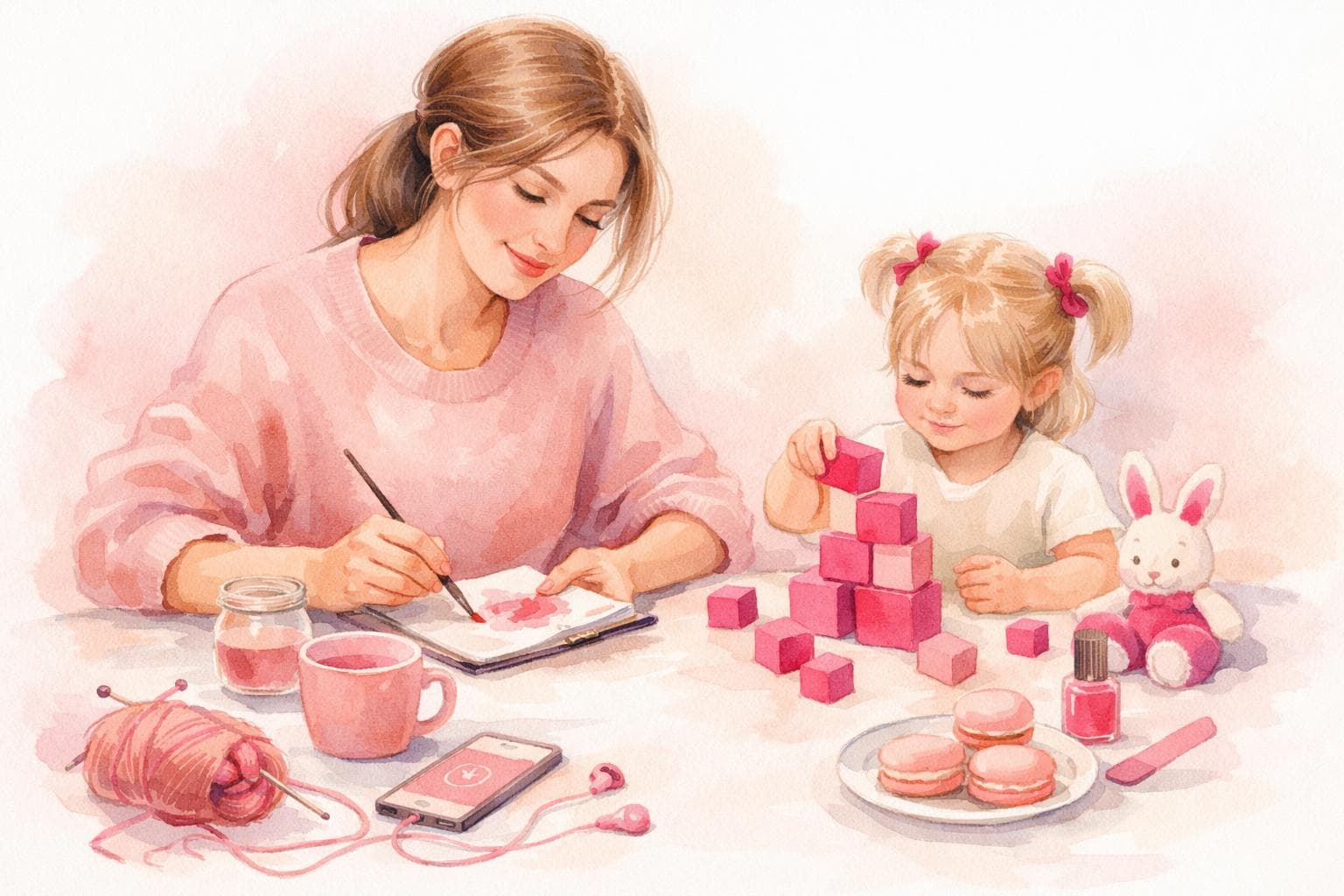
These are parallel activities: things you do alongside your child without needing their cooperation, silence or absence.
Hobby | How it works with a toddler nearby |
|---|---|
Sketch or doodle in a small notebook | Give them crayons and paper too; parallel play applies to adults |
Listen to a podcast with one earbud in | Stay present but feed your brain something beyond nursery rhymes |
Knit or crochet a few rows | Repetitive motion regulates your nervous system; toddlers can play with a ball of yarn |
Photograph one beautiful thing a day | Takes 30 seconds; rebuilds your habit of noticing beyond the mess |
Stretch on the floor | Your toddler will climb on you; that is fine; your body still benefits |
Garden while they dig beside you | Parallel play outdoors; soil is sensory play for them |
Hand-letter a quote on a sticky note | Two minutes of focused creative work between snack requests |
Hobbies for nap time or quiet time (15 minutes or less)
These are the ones that need a closed door or a sleeping child.
Hobby | Time needed | Why it works |
|---|---|---|
Read five pages of a novel | 5 to 7 minutes | Lowers the bar enough that you actually pick up the book |
Write three sentences in a journal | 3 minutes | Processes the day; creates a record you will value later |
Paint a single postcard-sized watercolour | 10 to 15 minutes | Small surface means small commitment; frame them and you have art |
Learn a language with an app | 10 minutes | Progress you can measure; surprisingly addictive |
Do one round of a jigsaw puzzle | 10 to 15 minutes | Leave it on a tray; return to it across the week |
Listen to a full song with your eyes closed | 4 minutes | Music as meditation; no app required |
Write a short poem or three-line haiku | 5 minutes | Creative expression in its most compressed form |
Hobbies for after bedtime
The temptation after bedtime is to collapse. And some nights, collapsing is the right choice. But on the nights when you have a small reservoir of energy left, these hobbies take 15 minutes or less and give you something back.
- Bake one small thing (mug cake, three biscuits, a single portion of banana bread)
- Watch one short documentary or essay video (not a full series; something complete in 15 minutes)
- Sew, embroider or mend something by hand
- Write a letter to a friend (pen and paper, not a text)
- Play one song on an instrument, badly, with joy
- Take a bath with no phone and no agenda
What hobbies do for SAHM mental health
This is not about filling time. It is about preserving identity.
The Social Identity Model of Identity Change (SIMIC) suggests that major life transitions, like becoming a stay-at-home parent, weaken existing social identities. The loss of contact with groups, activities and roles that defined you before motherhood leads to poorer wellbeing. Maintaining old interests or adopting new ones counteracts that loss.
A 2025 study of 514 mothers with children under three found that self-care behaviours, including engaging in enjoyable activities, were significantly associated with better physical and mental health. Hobbies are not extras. They are protective factors.
If you have been feeling like you have lost a piece of yourself since stepping into the SAHM role, reading about matrescence might help you understand what is happening at a deeper level. And if the flatness runs deeper than boredom, emotional exhaustion in motherhood describes the specific kind of depletion that SAHMs are most vulnerable to.
How to protect those 15 minutes
The hobby itself is the easy part. Protecting the time is where most mothers fail. Here is what helps:
- Treat it like a nap. You would not skip your toddler's nap because the kitchen needs cleaning. Apply the same logic to your 15 minutes.
- Anchor it to a trigger. After bedtime. During the first ten minutes of nap. While the pasta cooks. Attach the hobby to something that already happens so it does not require a decision.
- Keep supplies visible. A sketchbook on the counter. Knitting needles by the sofa. A book on the bedside table with a bookmark already in it. Friction kills habits. Reduce it.
- Let go of progress. You are not trying to become an artist, a runner or a published writer. You are trying to remember that you are a person who enjoys things. That is the whole goal.
If carving out any time at all feels impossible, our guide to 30 ways to find alone time with no help offers practical strategies. And the morning routine for exhausted moms shows how to build a small habit into the start of your day without waking at 5am.
You are still in there
The woman who used to read, paint, run, cook for pleasure, dance in the kitchen, write letters, learn languages: she is not gone. She is underneath. Covered in rice cakes and playdough, yes. But still there.
Fifteen minutes is enough to reach her. Start today.
Sources and further reading
- Nadri, Z. et al. (2024). A comparative analysis of stress, anxiety, and social well-being of working mothers and stay-at-home mothers. Journal of Education and Health Promotion. jehp.net
- PMC. (2023). "More than just a manicure": qualitative experiences of maternal self-care during COVID-19. pmc.ncbi.nlm.nih.gov
- El-Salahi, S. et al. (2024). The relationship between traumatic childbirth and first-time mothers' social identity and wellbeing. BMC Pregnancy and Childbirth. ncbi.nlm.nih.gov
- Bord, S. et al. (2025). Self-care in predicting physical and mental health among mothers of young children. Healthcare/PMC.
- Csikszentmihalyi, M. (1990). Flow: The Psychology of Optimal Experience. Harper Perennial.
- Nagoski, E. & Nagoski, A. (2019). Burnout: The Secret to Unlocking the Stress Cycle. Ballantine Books.