
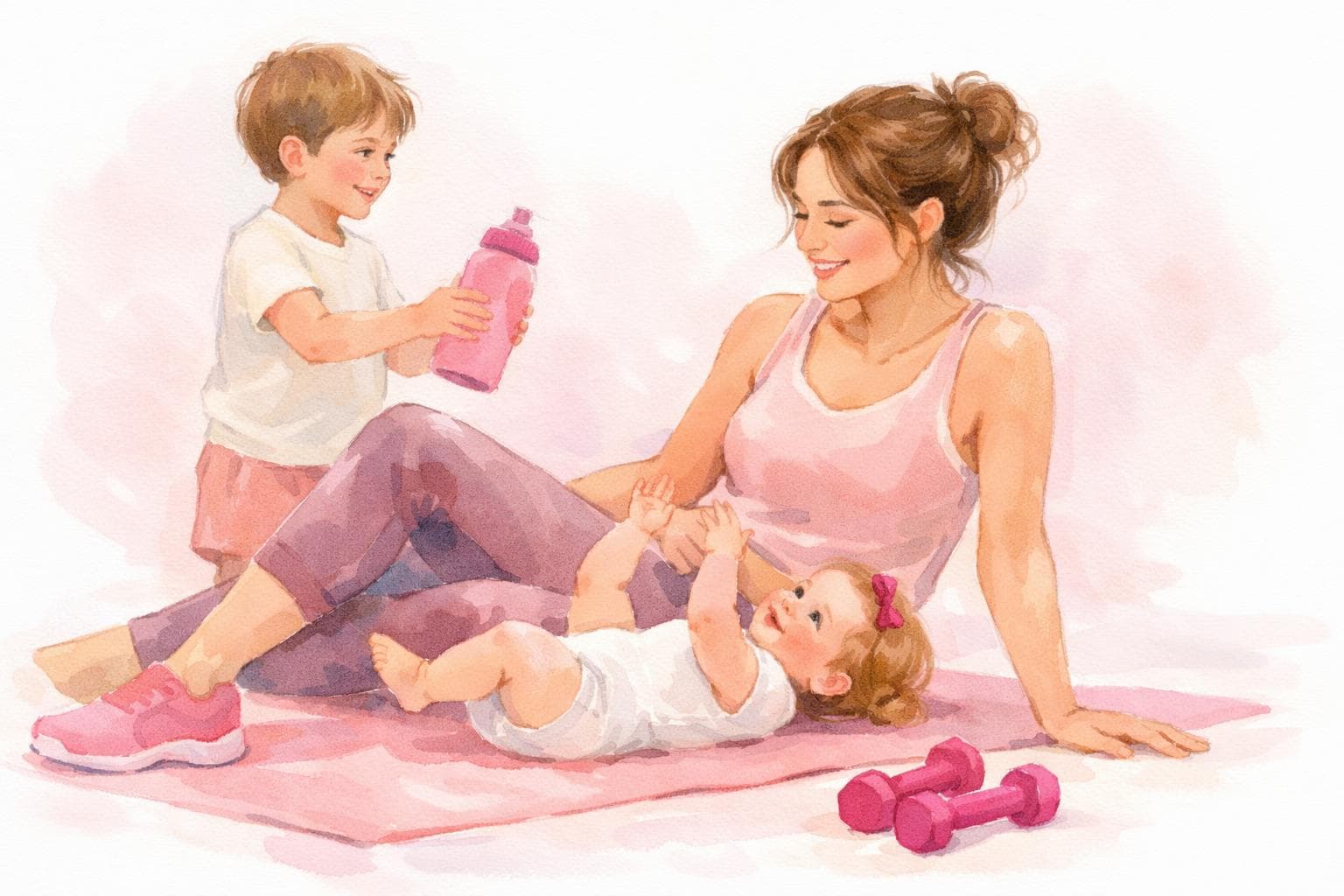
At some point in your first year of motherhood, the messaging finds you. It arrives via Instagram, in the form of a celebrity postpartum photo, or in the quiet subtext of a well-meaning question: "Are you back to exercising yet?" And suddenly movement — something that may once have felt good, even joyful — has become another thing you're either doing wrong or not doing enough of.
This article is not that. It's an attempt to reframe exercise for mothers in a way that's actually useful: grounded in what research says matters, honest about what the postpartum body needs, and entirely free of the idea that you owe anyone a "snap back."
What Movement Actually Does for Mothers
Let's start with the science, because it's genuinely encouraging — just not in the way fitness culture usually presents it.
A major dose-response meta-analysis that pooled data from 186,412 women found that just 90 minutes of physical activity per week was associated with a meaningful reduction in postpartum depression risk. Not daily HIIT. Not a transformation programme. Ninety minutes a week — across any format — was the threshold at which benefits to mental health became clearly measurable (Frontiers in Psychiatry, 2022).
A separate meta-analysis of 26 randomised controlled trials (2,867 participants), published in PLOS One (2023), confirmed that aerobic exercise significantly reduced postpartum depression symptoms compared to standard care — with 3–4 sessions per week of moderate intensity performing best overall.
A 2024 systematic review published in Frontiers in Psychology — examining the effect of exercise on maternal depression, anxiety, and fatigue — found that low to low-medium intensity exercise was the most effective approach for maternal anxiety and fatigue. High-intensity training, by contrast, was not consistently better, and in some cases added to stress rather than reducing it (Frontiers in Psychology, 2024).
The headline, read honestly: moving your body in gentle, consistent ways does measurable good for maternal mental health. The goal doesn't need to be performance or aesthetics. It can just be how you feel.
"Factors which have been shown to improve success in postpartum physical activity include a supportive, non-judgemental environment and programming which focuses on strength and function rather than appearance." — PMC, Moms on the Move study, 2023
The Pressure That Gets in the Way
Research with postpartum mothers consistently identifies a few specific barriers to movement — and interestingly, they're not mostly logistical:
- Low confidence in a changed body. New mothers frequently report reduced self-confidence about exercising, feeling disconnected from a body that looks and moves differently (PMC, 2023).
- Identity conflict. Researchers at the University of British Columbia found that new mothers often experience tension between their pre-baby athletic identity and their new maternal one — making even the idea of exercise feel complicated.
- Social media comparison. The research on this is unambiguous: viewing fitspiration content is associated with increased anxiety, social comparison, and lower body satisfaction in postpartum mothers. Body-positive content produces the opposite effect.
- The "snap back" narrative. Cultural pressure to return to a pre-pregnancy body quickly sets up an adversarial relationship with exercise — where movement becomes punishment rather than care.
All of this is worth naming explicitly, because body image after motherhood and fitness aren't separate topics. The reasons mothers avoid or approach movement with dread are often psychological, not physical.
What Actually Works: A Practical Frame
Rather than a programme, here's a way of thinking about movement that research supports and that's compatible with real motherhood:
Unhelpful fitness frameResearch-supported alternative
Exercise to "get your body back"
Move to reduce anxiety and improve sleep
High intensity = more benefit
Low-medium intensity most effective for maternal wellbeing
All-or-nothing approach
90 minutes across the week, any format, produces measurable benefit
Solo, structured workouts only
Group-based movement with social connection significantly boosts outcomes
Push through exhaustion
Exercise is not effective when it adds to depletion — rest is valid
Measure by weight loss
Measure by mood, energy, and how your body feels
Types of Movement That Work Well for New Mothers
The evidence points toward a few formats that tend to work well — not because they burn more calories, but because they're sustainable, accessible, and have specific mood benefits:
Walking — A meta-analysis cited in ScienceDirect (2023) specifically found that walking may help mothers manage postpartum depression symptoms. It's accessible, can be done with a pram, and requires no childcare or equipment. The social walking group model — whether with other mothers or a partner — adds the connection benefit.
Yoga — Multiple meta-analyses find yoga effective at reducing postpartum depression and anxiety. The breath-focused, non-competitive nature of most yoga classes makes it particularly compatible with a maternal body and a depleted nervous system.
Strength and function-based movement — Research consistently shows mothers respond better to exercise framed around what their body can do (getting stronger, recovering functional movement) than exercise framed around appearance. Rebuilding core strength and pelvic floor integrity — often overlooked postpartum — falls into this category.
Group-based movement — Studies specifically examining postpartum exercise programmes find that the social component is a significant predictor of outcomes. Connection with other mothers, in a non-judgmental environment, matters beyond the movement itself.
The Honest Answer to "How Much Is Enough?"
Ninety minutes per week is the evidence-based threshold for meaningful mental health benefit — but that 90 minutes doesn't have to look any particular way. It can be three 30-minute walks. It can be two yoga sessions and a swim. It can shift week to week depending on what's possible.
What matters most — and what the research on postpartum body image makes clear — is the intention behind the movement. Exercise done to punish, shrink, or perform tends to backfire. Exercise done because it makes you feel more like yourself tends to compound.
If burnout is part of what you're dealing with, or the exhaustion is so significant that movement feels impossible, that's information too. What self-care really means after kids sometimes looks like movement. And sometimes it looks like rest without guilt — which is, in its own way, exactly as valid.
Your body grew a person. It deserves movement that's kind, consistent, and on your terms.
Further reading: How to feel confident in your body after kids | Why self-care isn't selfish when you're a mother | Postpartum anxiety: how to recognise it and cope