
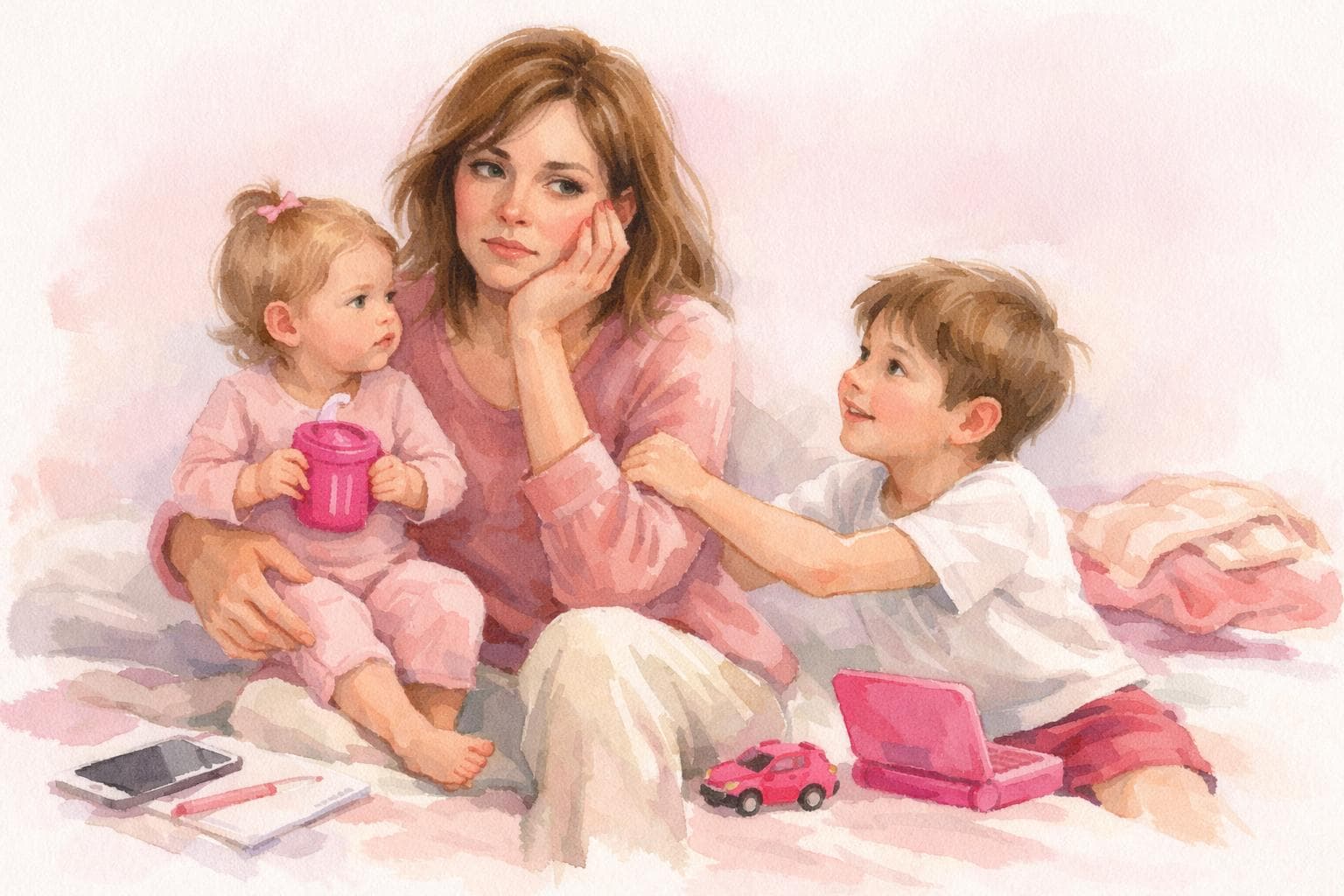
Your grandmother didn't Google whether the way she held her baby during feeding could affect their attachment style. She didn't have an algorithm curating her social media feed with images of mothers who appear to have simultaneously returned to their pre-pregnancy bodies, launched a business, and maintained an artfully organised nursery. And nobody expected her to be both a completely present, child-centred parent and a high-performing professional at the same time.
The pressure modern mothers feel is not imaginary, not a character weakness, and not simply the universal difficulty of raising children. It is historically specific. It has a name. And the research backing it up is substantial.
What Changed and When
In 1996, sociologist Sharon Hays identified something she called "intensive mothering" in her landmark book The Cultural Contradictions of Motherhood (Yale University Press). The ideology, she argued, had become the dominant standard for good mothering in Western societies holding that mothers (specifically mothers, not fathers or shared caregivers) should approach child-rearing as "child-centred, expert-guided, emotionally absorbing, labour-intensive, and financially expensive."
The cultural contradiction Hays named was this: at exactly the moment women were entering the workforce in record numbers, the standards for what good motherhood required were expanding, not contracting. Women were expected to compete and perform at work while simultaneously devoting more time, emotional energy, and resources to their children than any previous generation. Not one or the other both, simultaneously, indefinitely.
Nearly thirty years later, that contradiction hasn't resolved. It has intensified. Research published in 2022 (Sociological Quarterly) confirmed that intensive mothering attitudes are now cited as "the dominant ideology and modal way of mothering in many developed countries" more pervasive, more demanding, and more widely internalised than when Hays first described them.
The Three Pillars of Modern Pressure
1. The supermom standard and the impossible math it creates
Modern mothers are expected to be expert-guided parents who invest deeply in their children's development, and competitive, ambitious professionals, and attentive partners. Research published in Sex Roles (2016) found that even mothers who don't consciously subscribe to intensive mothering ideology still experience its effects reporting higher stress, lower self-efficacy, and more guilt than mothers who aren't exposed to these standards. The pressure doesn't require buy-in. It operates on you regardless.
A study published in Frontiers in Psychology (PMC, 2024) confirmed that intensive parenting attitudes — including the belief that a mother is the uniquely irreplaceable primary parent are directly associated with increased stress, anxiety, depression, and guilt. The standards themselves, independent of what mothers actually do, produce measurable harm.
"The idea that women should be 'naturally equipped and always ready and available to care for their children, no matter what the circumstances' creates an unrealistic and unattainable pressure for modern women who are often working, studying, and holding a myriad of other roles." - Sex Roles, PMC (2023)
2. Social media and the comparison machine
Previous generations compared themselves to the women they actually knew. Modern mothers compare themselves to a curated, algorithmically amplified selection of idealised portrayals 24 hours a day, from a device in their pocket.
In the past five years alone, there has been a 101.6% increase in mom-influencers on social media a vast, commercial enterprise in the business of projecting specific versions of motherhood. Research consistently shows this affects mothers' mental health. A study examining social comparison on social media found that mothers who engaged in more comparisons perceived more parental role overload, lower competence, and more depressive symptoms. A separate study found that following "InstaMom" accounts was linked to increased anxiety — particularly for mothers already prone to perfectionism (Journal of Social and Clinical Psychology, 2018).
The comparison isn't neutral. It's structured to make inadequacy feel inevitable.
3. The information age and its particular burden
More information about child development, nutrition, sleep, attachment theory, and neuroscience is now available to the average mother than at any previous point in history. This sounds like an advantage. In practice, it functions largely as an additional source of pressure: more potential to get it wrong, more areas in which you might be falling short, more expert voices telling you that what you're doing isn't optimal.
Here's how the pressures stack up:
Previous generations | Modern mothers |
|---|---|
Compared to women in their immediate social circle | Compared to algorithmically curated global idealised portrayals |
Child-rearing standards informed by family and community | Expert-guided, research-informed standards that shift and conflict |
Workforce participation largely separate from mother identity | Expected to excel professionally AND be fully present, intensive parents |
Social support from local community networks | Dispersed support; often parenting without nearby family |
Allowed to be a "good enough" mother | Exposed to messaging that good enough is never sufficient |
What This Is Actually Doing to Mothers
The research here is consistent and concerning. Subscribing to intensive mothering ideology or simply being exposed to its standards is associated with higher levels of parental burnout, depression, and anxiety. A JAMA Internal Medicine analysis (2025) confirmed that maternal mental health has meaningfully declined between 2016 and 2023 with mothers consistently reporting worse mental health than fathers at every measurement point.
The mental load that research consistently finds lands on mothers is partly a structural problem. But it is also a product of an ideology that positions mothers as uniquely responsible for managing every domain of family life and then provides an endless supply of expert content suggesting they're not managing it well enough.
The guilt that most mothers carry the kind explored in our piece on mom guilt and self-blame is not simply a personal failing. It is the logical emotional output of a cultural standard designed to be unachievable.
What Might Actually Help
Naming the ideology doesn't make it go away. But understanding that the pressure you feel is structural not a personality flaw, not evidence of inadequacy changes the relationship you can have with it.
Some things the research consistently supports:
- Auditing social media. The comparison machine runs on exposure. Less exposure produces measurably better outcomes for maternal mental health.
- Challenging the "irreplaceable mother" narrative. Children thrive with multiple caregivers. The idea that only you can meet your child's needs is an ideology, not a developmental fact.
- Distinguishing between "good enough" and "failing." Winnicott's concept of the good enough mother — explored in relation to body image and elsewhere has genuine developmental research behind it. Perfection is not what children need.
- Treating life balance as a structural problem, not a personal management challenge. The pressure is built into the system. Individual coping strategies help. But they aren't the full answer to a structural problem.
Modern mothers feel more pressure than ever because more pressure has been placed on them. That's not a comfort, exactly. But it is the truth and naming it clearly is where most change, personal and cultural, actually begins.
Further reading: What no one tells you about early motherhood | Identity loss after becoming a mother | Is it normal to miss your life before kids?