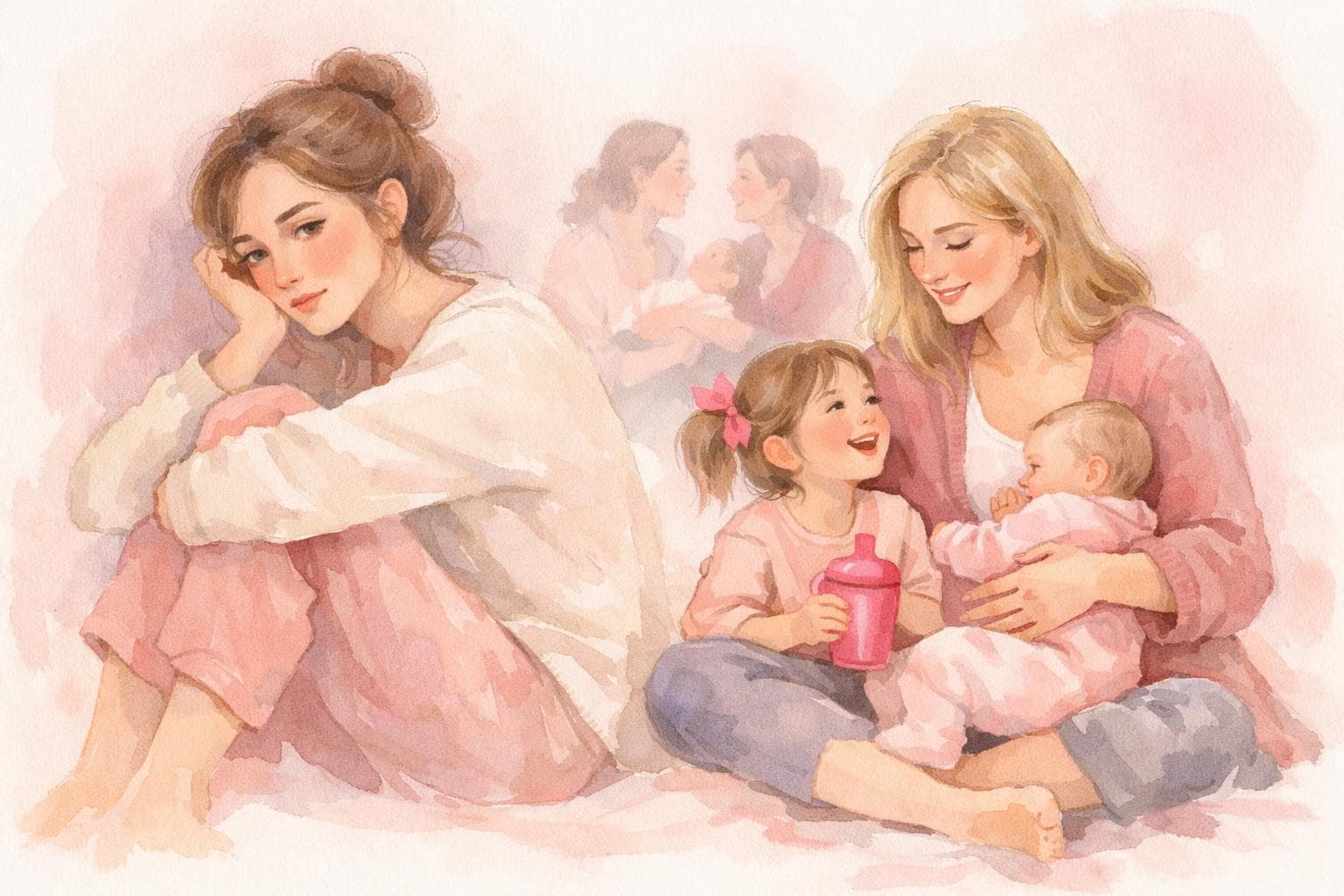
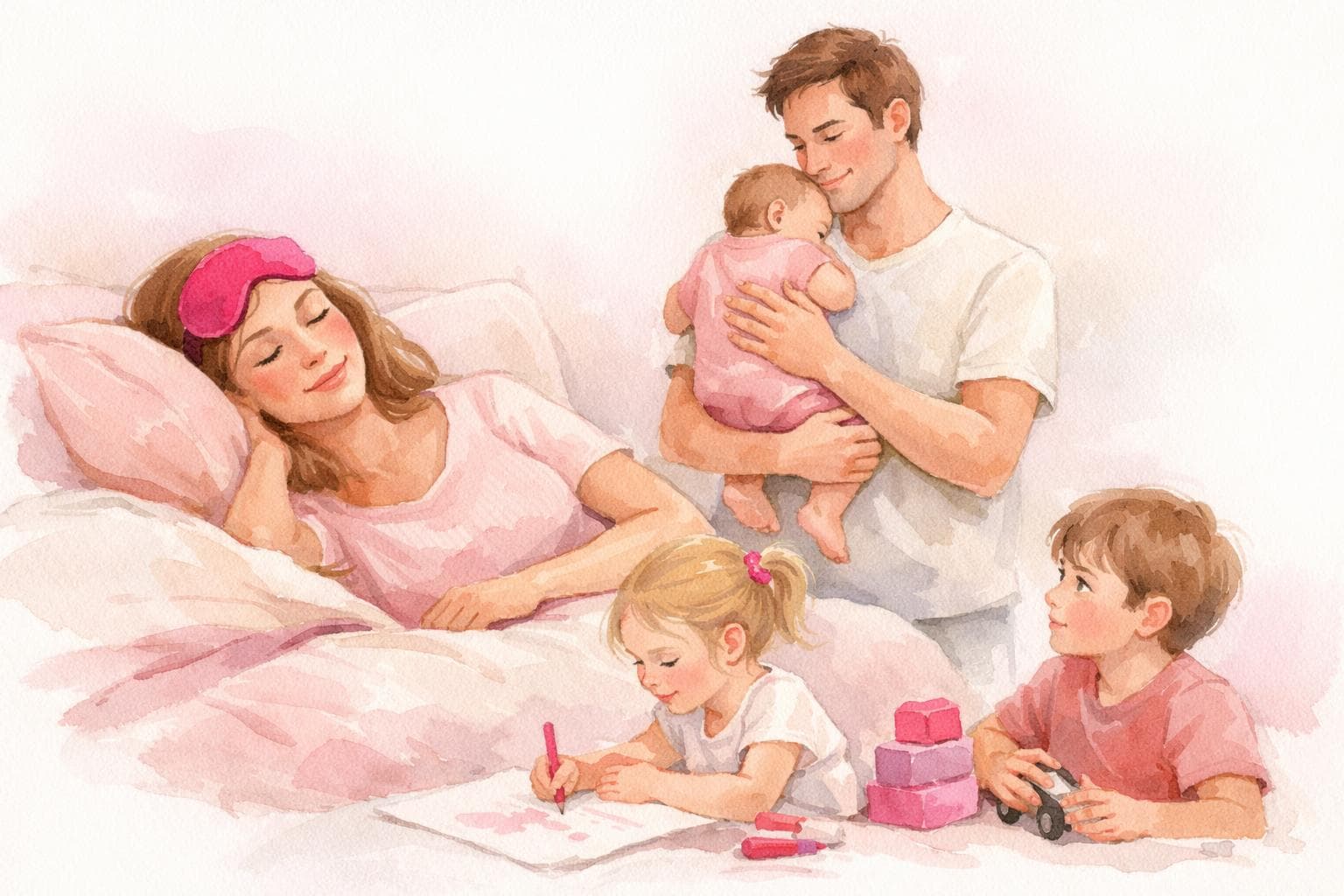
There is a question that most couples with children never ask out loud.
It lives in the gap between exhaustion and the particular arithmetic of a household where both people are tired, but one person's tiredness consistently seems to have more practical consequence than the other's. Where one person's need to stop is treated as a logistical problem to be solved, while the other's is treated as a given. Where rest is distributed not equally but according to an unspoken hierarchy that neither person formally agreed to and which, once named, most people find difficult to justify.
Who gets to rest in your household is not a trivial question. It is a question about whose needs are treated as legitimate, whose exhaustion is taken seriously and what the underlying structure of a partnership actually looks like when the resources get scarce.
Why this question matters and goes unasked
In most heterosexual partnerships with children, the research is consistent about what the hierarchy looks like. Mothers rest less, are interrupted more when they do and are more likely to experience their rest as conditional on everything else being managed first.
A 2019 study published in Sex Roles found that in dual-earner households with children, mothers reported an average of 17 fewer minutes of leisure time per day than fathers, with the gap increasing on weekends. More significantly, mothers were significantly more likely to describe their own rest as interrupted or compromised by the needs of children or household management, while fathers' leisure time was more likely to remain protected.
This is not usually the result of conscious decision-making. It tends to emerge from an accumulation of small defaults: the child who calls for Mum rather than Dad, the mental load that keeps a mother present to household needs even when she is technically off-duty, the pattern of the mother's needs being addressed after everyone else's without this ever being stated as policy.
What makes it invisible is that it rarely gets named. Naming it tends to produce defensiveness or guilt, neither of which is the actual goal. The goal is to understand what is happening and to decide, deliberately, whether it is what both people want.
The connection between rest and the mental load
The unequal distribution of rest is not separate from the unequal distribution of mental labour. They are two expressions of the same underlying dynamic.
Allison Daminger's research on cognitive labour in households, published in the American Sociological Review (2019), found that the invisible thinking work of managing a household, anticipating needs, making decisions and monitoring outcomes, was performed disproportionately by mothers. And because this work is invisible, the person doing it rarely appears to be working. They appear to be resting, or partially available, or sitting down. The work is happening in their mind rather than their body, which means it is neither acknowledged nor shared.
A mother lying on the sofa who is mentally tracking the child's temperature, planning tomorrow's packed lunches and remembering that the car insurance needs renewing is not resting. She is working in a format that her partner cannot see. And the assumption that she is available because she appears to be sitting still is one of the primary mechanisms through which the rest hierarchy maintains itself.
What this does to the person who rests less
The consequences accumulate in ways that compound over time.
Effect of chronic rest deficit | How it shows up |
|---|---|
Emotional dysregulation | Disproportionate reactions to small triggers, lower threshold for conflict |
Cognitive impairment | Difficulty concentrating, slower decision-making, memory issues |
Physical health effects | Increased cortisol, weakened immune function, chronic pain amplification |
Relationship resentment | Accumulated bitterness about the imbalance that goes unacknowledged |
Loss of self | The person who gets no unoccupied time gradually loses access to their own inner life |
The last row is not dramatic framing. Research on identity maintenance in mothers, including work by psychologist Dan McAdams on narrative identity, finds that access to unoccupied time, time that is neither productive nor caregiving, is necessary for the kind of reflective processing through which people maintain a coherent sense of self. A mother who has no such time is not simply tired. She is losing access to herself.
How to have the conversation
This is not a conversation about fault. It is a conversation about structure.
The most productive framing tends to start from data rather than feeling. Not "I never get any rest" but "I've noticed that when I try to stop, something always comes up, and I'd like us to figure out how to change that." This invites problem-solving rather than defence.
A few things worth establishing:
- What does protected rest actually look like for each person? A clear, uninterrupted block, not a vague permission to rest that evaporates when the children are loud.
- Who is on duty and who is off duty, at specific times, rather than both parents being perpetually available.
- What would need to change structurally for the current distribution to shift?
The last question is the hardest because it tends to require the person who has been benefiting from the current arrangement to actively change it, which does not happen automatically from good intentions alone.
On the permission to stop
Part of what keeps the hierarchy in place is the mother's own internalised sense that resting requires justification. That it needs to be earned, or deferred until everything is done, or offered by someone else rather than claimed by herself.
"Almost everything will work again if you unplug it for a few minutes. Including you." - Anne Lamott
If the resentment that has built around this particular imbalance has become significant, resentment in motherhood: where it comes from maps what accumulates when it goes unnamed. And for the broader picture of invisible labour in households, the invisible mental load moms carry every day addresses the structure that produces this particular hierarchy.
Rest is not something you earn. It is something your body and mind require. The fact that it has to be negotiated for in some households is the problem worth examining, not the need for it.
Further reading: Eve Rodsky, Fair play: a game-changing solution for when you have too much to do (2019). Arlie Hochschild, The second shift (1989). Emily and Amelia Nagoski, Burnout: the secret to unlocking the stress cycle (2019).