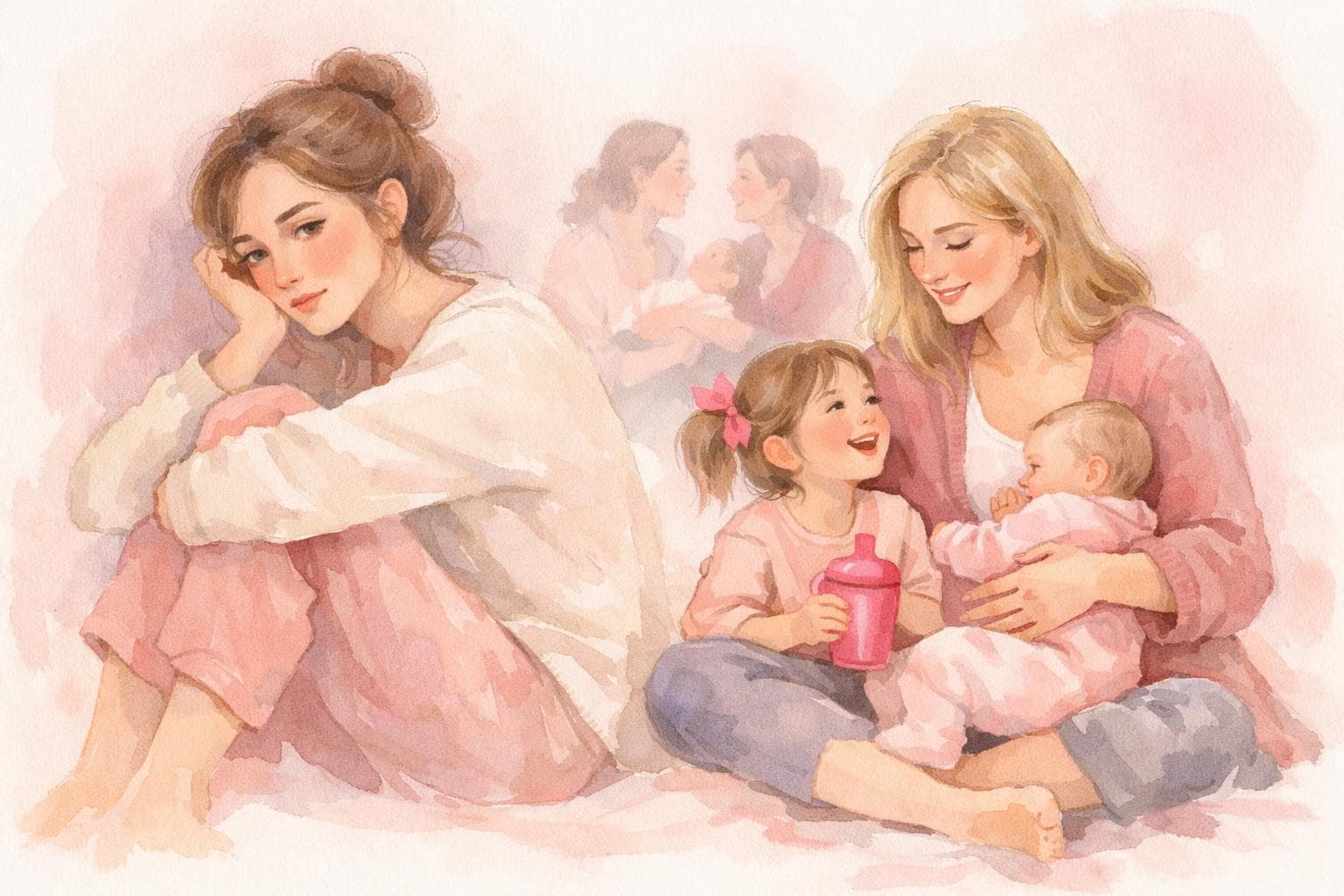

Nobody says it at the baby shower. It doesn't come up in the parenting books, the prenatal classes, or the well-meaning conversations with friends who've already done it. But somewhere between the first year and the third, many mothers find themselves sitting with a feeling they weren't expecting and aren't sure what to do with.
Resentment.
Not toward their children though even that, in fleeting moments, is more common than anyone admits. More often it's resentment toward a partner who seems to move through parenthood with fewer constraints. Toward a society that handed them a role with impossible expectations and insufficient support. Toward the version of their life that existed before, which nobody told them to grieve. Toward the relentlessness of it all.
The feeling arrives like a guest nobody invited. And because it feels incompatible with loving your children which you do, deeply, without question most mothers do the only thing that seems safe: they push it down and carry on.
That approach has a cost. And understanding where maternal resentment comes from is the first step toward addressing it in a way that doesn't require pretending it isn't there.
Why resentment and love coexist in motherhood
The most important thing to say first: resentment in motherhood is not a sign that you love your children less, or that you're failing at this, or that you're a fundamentally ungrateful person. It is a psychological signal and like most signals, it's pointing at something real.
Psychologist Susan David, in Emotional Agility (2016), describes resentment as "anger that has been marinating." It's what happens when a legitimate need or expectation goes unmet for long enough that the disappointment ferments into something harder and more persistent. That definition is important because it repositions resentment from a character flaw into useful information: something in your situation needs to change.
Research published in the Journal of Family Issues (2018) found that maternal resentment was most strongly predicted by three factors: perceived unfairness in the division of household and childcare labor, lack of personal time, and feeling unseen or unacknowledged by a partner. None of these are irrational grievances. All of them are entirely addressable which makes the fact that they so rarely get addressed directly all the more worth examining.
The specific sources of resentment most mothers recognize
Resentment in motherhood rarely has a single origin. It builds from several directions at once, which is part of what makes it so hard to name clearly. Here are the most common ones:
The inequality of invisible labor. This is, consistently, the largest single source. Mothers carry a disproportionate share of not just physical childcare but the planning, anticipating, remembering, and organizing that surrounds it what researchers call cognitive labor. A 2019 study from the University of Southern California found that mothers spent on average 10.5 more hours per week than fathers on household management tasks, many of which were entirely invisible to the other partner. Invisible labor breeds resentment specifically because it cannot be acknowledged by those who cannot see it. The Invisible Mental Load Moms Carry Every Day is worth reading if you've ever struggled to explain why you're exhausted when nothing obvious seems to have happened.
The asymmetry of sacrifice. Becoming a parent changes both partners' lives. But it doesn't change them equally. Mothers are statistically more likely to reduce or leave paid employment, more likely to absorb disrupted sleep, more likely to experience significant changes to their physical body, social identity, and sense of self. When that asymmetry is unacknowledged when the changes to a mother's life are treated as simply what happens, rather than as a significant personal cost resentment is a completely logical outcome.
The gap between expectation and reality. Motherhood is one of the most mythologized experiences in human culture. The gap between what we are told it will feel like transcendent, natural, instinctive, fulfilling and what it actually feels like, especially in the early years, is wide enough to produce genuine grief. And unexplained grief has a way of curdling into resentment, particularly when the people around you seem to be having the experience you were promised.
Unmet needs that were never voiced. This one is circular and worth noting: many mothers don't express their needs clearly for reasons explored in How to Communicate Your Needs as a Mom which means those needs go unmet, which generates resentment, which makes communicating feel even more loaded and difficult.
The loss of personal freedom. Not the abstract kind. The concrete, daily loss of being able to decide, spontaneously and without coordination, what you do with your own time and body. For mothers who had significant independence before children, this loss is substantial. For mothers who had already given up a great deal of themselves in relationships before children arrived, it compounds what was already there. Losing Yourself in Motherhood and Relationships explores this particular dimension more fully.
What resentment looks like when it goes underground
Unaddressed resentment rarely stays quiet. It tends to surface in recognizable patterns:
What It Looks LikeWhat It Usually Means
Disproportionate irritability over small things
Larger, unnamed frustrations with nowhere to go
Emotional withdrawal from a partner
Protection from a dynamic that feels unfair
Chronic cynicism about the relationship
Accumulated disappointment that hasn't been spoken
Fantasies of escape or a different life
A legitimate need for space and individuality going unmet
Passive communication rather than direct requests
Fear that direct expression will be dismissed or punished
Physical exhaustion without clear cause
The somatic weight of unexpressed emotional labor
None of these patterns are character flaws. They are adaptations ways a person manages when the direct route feels unavailable.
The way through is rarely around
"Resentment is like drinking poison and waiting for the other person to die." - Carrie Fisher
The uncomfortable truth about resentment is that suppressing it doesn't protect the relationship or the person inside it. It accumulates. It compounds. And it eventually emerges in forms that are harder to repair than the original grievance would have been.
The way through resentment in motherhood is not simply to express it though that's part of it. It's to trace it back to its source: the specific unmet need, the unacknowledged sacrifice, the expectation that reality never matched. And then, with as much directness as possible, to address that source rather than its symptoms.
That work is hard. It often requires conversations that feel risky. It sometimes requires professional support not because the resentment has made you broken, but because some patterns are genuinely difficult to navigate without a skilled third party to help. How Therapy Can Help Moms Who Feel Stuck makes the case for that kind of support without making it feel like a last resort.
What resentment is not, in the end, is proof that you chose wrong, or love insufficiently, or are ungrateful for a life that contains real good. It is a signal that something in your situation deserves attention. And you are allowed to pay attention to it.
Further reading: Susan David, Emotional Agility: Get Unstuck, Embrace Change, and Thrive in Work and Life (2016). Harriet Lerner, The Dance of Anger (1985). Eve Rodsky, Fair Play: A Game-Changing Solution for When You Have Too Much to Do (2019).