
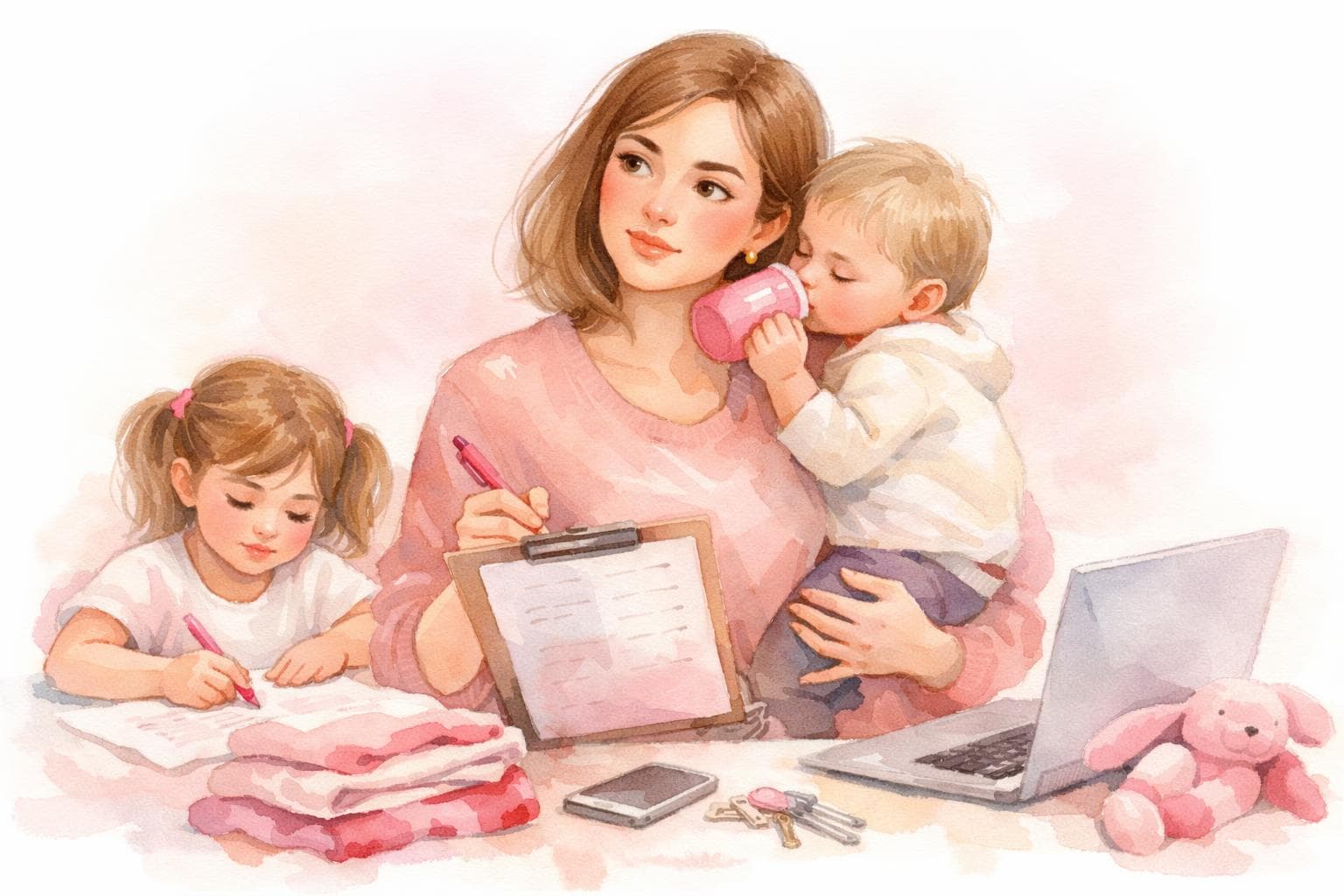
Picture this: your partner offers to cook dinner. You say yes, grateful for the break. Twenty minutes later they appear in the doorway: "Where are the pasta? What sauce? Do we have cheese? Are the kids having the same thing?" And suddenly you're not resting at all. You're project-managing from the couch.
If that exchange is familiar and for most mothers it is you've just had a brush with the thing researchers call cognitive household labour. Not the cooking. The remembering, tracking, and coordinating that makes the cooking possible. And the research is now clear: that invisible layer of work is more gendered, more damaging, and more poorly understood than almost anything else in family life.
The Load No One Sees Until Someone Maps It
In 2019, sociologist Allison Daminger published a landmark study in the American Sociological Review that gave this phenomenon a precise academic definition. Using in-depth interviews with 35 couples, she identified cognitive labour as four distinct activities: anticipating needs, identifying options for meeting them, deciding among those options, and monitoring outcomes. Her finding: women did more cognitive labour overall in 26 of 32 couples and were almost exclusively responsible for the most invisible phases, anticipating and monitoring, across virtually every domain of family life.
A follow-up study by researchers at the University of Southern California, published in Archives of Women's Mental Health (2025), was the first to quantify this in parallel with physical labour. Across 30 common household tasks — from grocery shopping to school coordination mothers performed 73% of all cognitive planning, while physical execution was considerably more shared. The imbalance in thinking was measurably worse than the imbalance in doing (PMC, 2025).
A 2024 survey of 3,000 U.S. parents by researchers at the University of Bath found that mothers carry 71% of total household mental load tasks and that fathers consistently overestimated their own contribution, often describing division as equal when it was not (Journal of Marriage and Family, 2024).
"Cognitive and emotional labour is enduring and boundaryless, and the gender gap in these responsibilities is even wider than for visible tasks such as cooking and cleaning." - Aviv et al., Archives of Women's Mental Health, 2025
What It Actually Looks Like Day to Day
One of the most illuminating aspects of Daminger's research was how invisible this work is not just to partners, but to the mothers carrying it. It happens internally, in the margins of other activities, on the way to work, during a meeting, in the three seconds between loading the dishwasher and answering a question.
Here's what the cognitive load looks like mapped onto an ordinary week:
What's happening on the surface | What's happening in someone's head |
|---|---|
Child gets to a birthday party on time | Remembered the date, bought and wrapped the gift, checked the address, noted the collection time |
Healthy snacks appear in the school bag | Tracked what ran out, anticipated next week, bought during the already-planned shop |
Doctor's appointment gets made | Noticed a symptom, researched what it might mean, identified a suitable GP slot, remembered to call |
Dinner is on the table | Planned the week's meals, cross-referenced with what's in the fridge, delegated the actual cooking |
Child has what they need for the school play | Remembered the costume requirement, sourced the material, monitored the deadline |
None of this appears on a to-do list. None of it gets credit. And none of it switches off when the working day starts.
Why "Just Ask Me to Help" Isn't Enough
This is the most common friction point in conversations about mental load the partner who says, in good faith, "I'd do it if you just told me." Eve Rodsky, Harvard-trained lawyer and author of Fair Play (Penguin, 2019), interviewed over 500 couples while researching this dynamic. Her finding: the problem with "just tell me what to do" is that it assigns the mental labour of noticing, planning, and delegating to the person already carrying it.
Rodsky identifies what she calls the "she-fault parent" the person who is the default manager of the household, regardless of income, hours worked, or stated commitment to equality. In a 2024 study conducted by the Fair Play Institute with the University of Southern California, women took on cognitive labour for virtually every household task. The one exception: men owned the planning and execution of taking out the garbage.
The distinction Rodsky and researchers alike emphasise is the difference between helping and owning. Helping means responding when asked. Owning means holding the mental responsibility for a domain noticing when it needs attention, deciding what to do, and following through without being reminded. The mental load is the weight of ownership, not of task completion.
What the Mental Load Does Over Time
The USC study finding that stands out most isn't the percentage. It's what cognitive labour was associated with not physical housework hours, but depression, burnout, relationship dissatisfaction, and overall mental health decline in mothers. The researchers found that physical labour alone was not significantly linked to these outcomes. It was the invisible, cognitive kind that predicted them.
This makes sense. A task you finish gives you a natural moment of completion. Mental monitoring never finishes. There's no point at which you've finished tracking the family calendar or anticipating what your child will need next week. It's the kind of work that colonises leisure time, interrupted conversations, and the first minutes of morning before anyone else is awake.
The connection to emotional exhaustion in motherhood is direct. So is the link to relationship distance research consistently finds that perceived unfairness in cognitive labour is a source of resentment that compounds over time, regardless of how much physical help a partner provides.
Making the Invisible Visible and Negotiable
Naming the mental load changes conversations because you can't redistribute something that hasn't been seen. Some practical frames that researchers and practitioners consistently point to:
Shift from task-sharing to domain-ownership. Instead of "can you handle bath time tonight," the conversation becomes "you own the entire bath and bedtime routine noticing when it needs adjusting, deciding the approach, managing the follow-through." This removes the delegation work from the person already managing everything else.
Track cognitive labour explicitly. Who remembers the school schedule? Who tracks what's running low? Who notices when the child seems off? Making this concrete tends to shift how both partners see the distribution.
Connect the load to burnout and life balance. The conversation isn't "you need to do more tasks." It's "this is what's draining the resources that everything else depends on."
Research by Ana Catalano Weeks at the University of Bath (2025) found that the mental load doesn't shrink significantly when women earn more or when couples profess egalitarian values. It shrinks when cognitive ownership is explicitly and deliberately redistributed not through goodwill alone, but through structural change in who holds responsibility for what.
The invisible mental load moms carry is real, it is measurable, and it matters. It's not a personality trait or a sign that someone is naturally more organised. It is work invisible, boundaryless, and currently distributed with remarkable consistency. Seeing it clearly is the first step toward changing it.
Further reading: How to reconnect with your partner as parents | Emotional exhaustion in motherhood: what it really means | Life balance for modern moms: myth or reality?