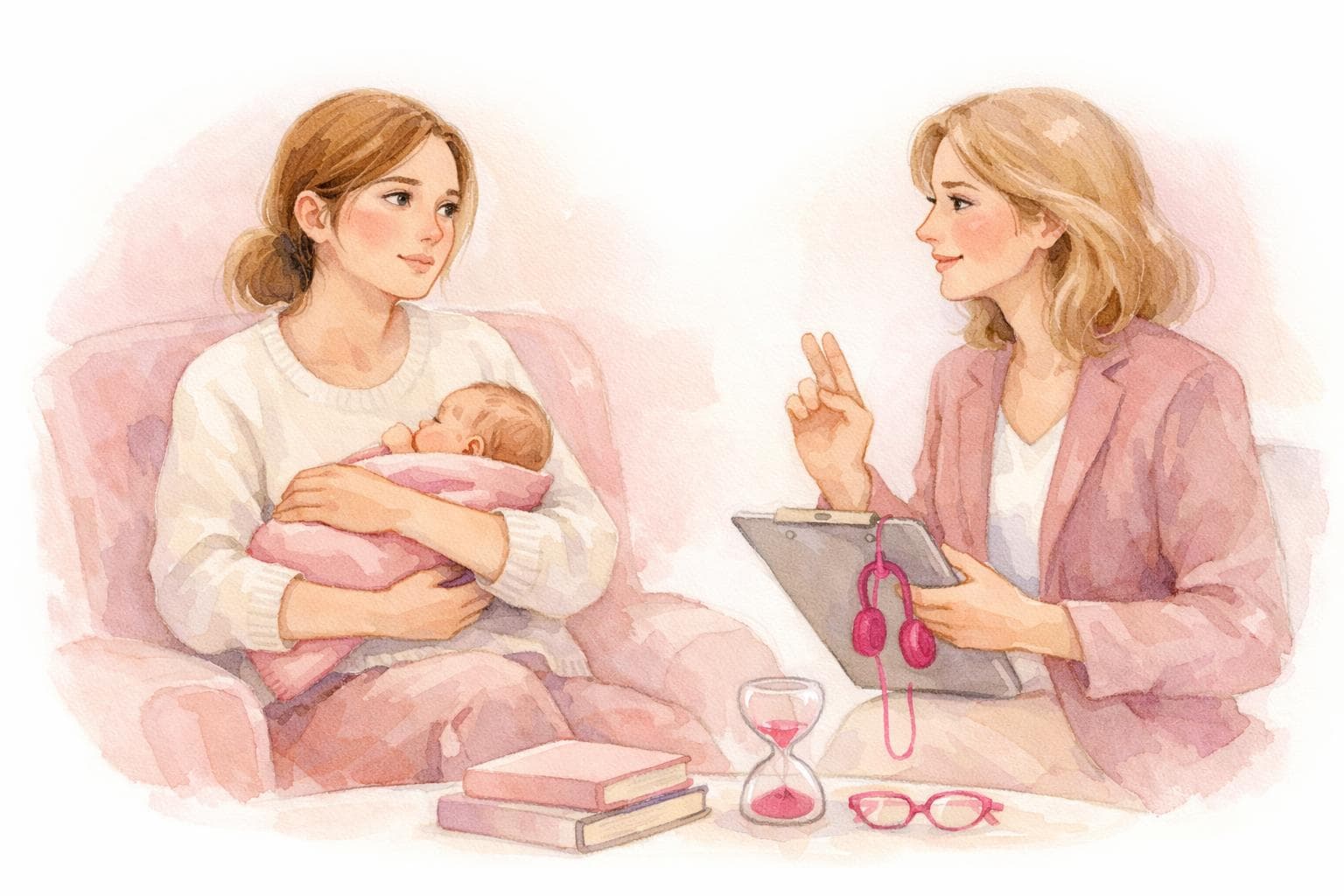

Therapy is often the first recommendation. And for good reason: talking therapies have a strong evidence base for a wide range of mental health difficulties, and for many mothers they make a meaningful difference. But therapy is not the only form of support, and for some mothers, some of the time, it is not enough on its own.
This is not a criticism of therapy. It is an honest observation about the gap between what weekly sessions can contain and the full scope of what some mothers are carrying. A fifty-minute appointment with a therapist, however skilled, cannot address sleep deprivation, financial stress, the absence of community support or the structural conditions of a life that does not have enough space in it for recovery. Therapy can help a person understand what they are experiencing and build capacity to navigate it. It cannot change the conditions that are producing it.
For mothers who are struggling and finding that therapy alone is not sufficient, knowing what else is available, and when it is appropriate, matters.
Why therapy alone sometimes isn't enough
Therapy works best when the person attending it has enough stability in their life to do the reflective work it requires. When someone is in acute crisis, severely sleep-deprived, experiencing significant physical health issues or living in conditions of sustained stress without relief, the capacity for reflective processing is significantly reduced.
Research on the effectiveness of psychological therapy published in Psychological Medicine (2019) found that treatment outcomes were substantially better when basic stabilising conditions were in place: adequate sleep, some social support and sufficient physical health to engage with the process. This finding does not mean therapy should be withheld from people in difficult conditions. It means that therapy is more likely to produce lasting change when it is part of a broader support picture rather than the only element in it.
What else is available and when it helps
Medication alongside therapy. For moderate to severe depression, anxiety and OCD, medication and therapy together consistently produce better outcomes than either alone. A 2021 Cochrane review confirmed this for perinatal mental health specifically. Many mothers resist medication out of concern about breastfeeding or the idea that taking medication represents a failure of some kind. Both concerns are worth discussing directly with a GP or psychiatrist. Several SSRIs are considered safe during breastfeeding, and medication for mental health is no more a failure than medication for any other health condition.
Psychiatric support. When symptoms are severe, complex or not responding to standard therapy or medication, referral to a perinatal psychiatrist provides a level of expertise and monitoring that a GP or general therapist cannot offer. In the UK, perinatal mental health teams are attached to NHS trusts and can be accessed through GP referral. In the US, the Postpartum Support International directory lists perinatal mental health specialists by location.
Peer support and community. Research consistently finds that social connection is one of the strongest protective factors against mental health difficulties in the postpartum period. A 2020 study in BMC Psychiatry found that structured peer support programmes, where mothers with shared experiences meet regularly with facilitation, produced measurable improvements in mood, isolation and parenting confidence. This is not a replacement for clinical support. It is a meaningful supplement, and for some mothers with subclinical difficulties, it may be the most impactful single intervention available.
Somatic and body-based approaches. Talking therapy reaches the rational, narrative-constructing parts of the brain. Some of what mothers are carrying lives in the body rather than in the narrative: in the chronic physical tension of sustained vigilance, in the nervous system dysregulation produced by sleep deprivation and in the unprocessed physical experience of pregnancy and birth. Approaches including EMDR, somatic experiencing and trauma-informed yoga have growing evidence bases for addressing this body-held material in ways that talk therapy alone often doesn't reach.
Practical support as mental health intervention. This one is often dismissed as not really mental health support, but the evidence is clear: practical relief from the conditions that are producing stress reduces stress. A regular night of unbroken sleep provided by a partner, family member or night nurse. Domestic help that reduces the cognitive and physical labour of managing a household. Financial support that reduces the anxiety of economic pressure. These are not luxuries. For mothers in acute distress, they can be as clinically significant as a medication adjustment.
When to seek more intensive support
Signs that more support is needed | What to do |
|---|---|
Symptoms are worsening rather than stable or improving | Contact your GP or therapist this week, not at your next scheduled appointment |
You are having thoughts of harming yourself or your baby | Contact your GP, midwife or crisis line today |
You are unable to care for yourself or your child | Seek urgent assessment through your GP or A&E |
You have been in therapy for several months without improvement | Ask your therapist about alternative approaches or consider a second opinion |
Medication has been prescribed but doesn't seem to be helping | Return to your prescribing doctor: there are other options |
Building a support ecosystem rather than a single intervention
The framing that tends to work best is not "find the thing that will fix this" but "build a set of conditions in which recovery becomes possible."
That set of conditions will look different for every mother. For some it involves therapy and nothing else. For others it involves medication, peer support and a restructured household arrangement. There is no hierarchy of legitimacy. There is only what actually helps.
"Recovery is not one and done. It is one day at a time." - Anonymous
If you are in therapy and finding it insufficient, it is worth naming that explicitly with your therapist. A skilled therapist will welcome that information. It is not a criticism of the work. It is the most useful thing you can bring to the next session.
For more on what therapy specifically offers mothers who are stuck, how therapy can help moms who feel stuck makes the case for professional support and addresses what that process actually involves. And if postpartum depression is part of what you're navigating, how to cope with postpartum depression: getting help without the shame covers the treatment landscape with more depth.
Support that is working is not always visible. But it is always worth looking for.
In crisis or having thoughts of harm: UK Samaritans 116 123. US 988 Suicide and Crisis Lifeline. Postpartum Support International: postpartum.net.
Further reading: Wendy Davis & Walker Karraa, Transformed by postpartum depression (2015). Mind UK: www.mind.org.uk. Postpartum Support International: www.postpartum.net.