
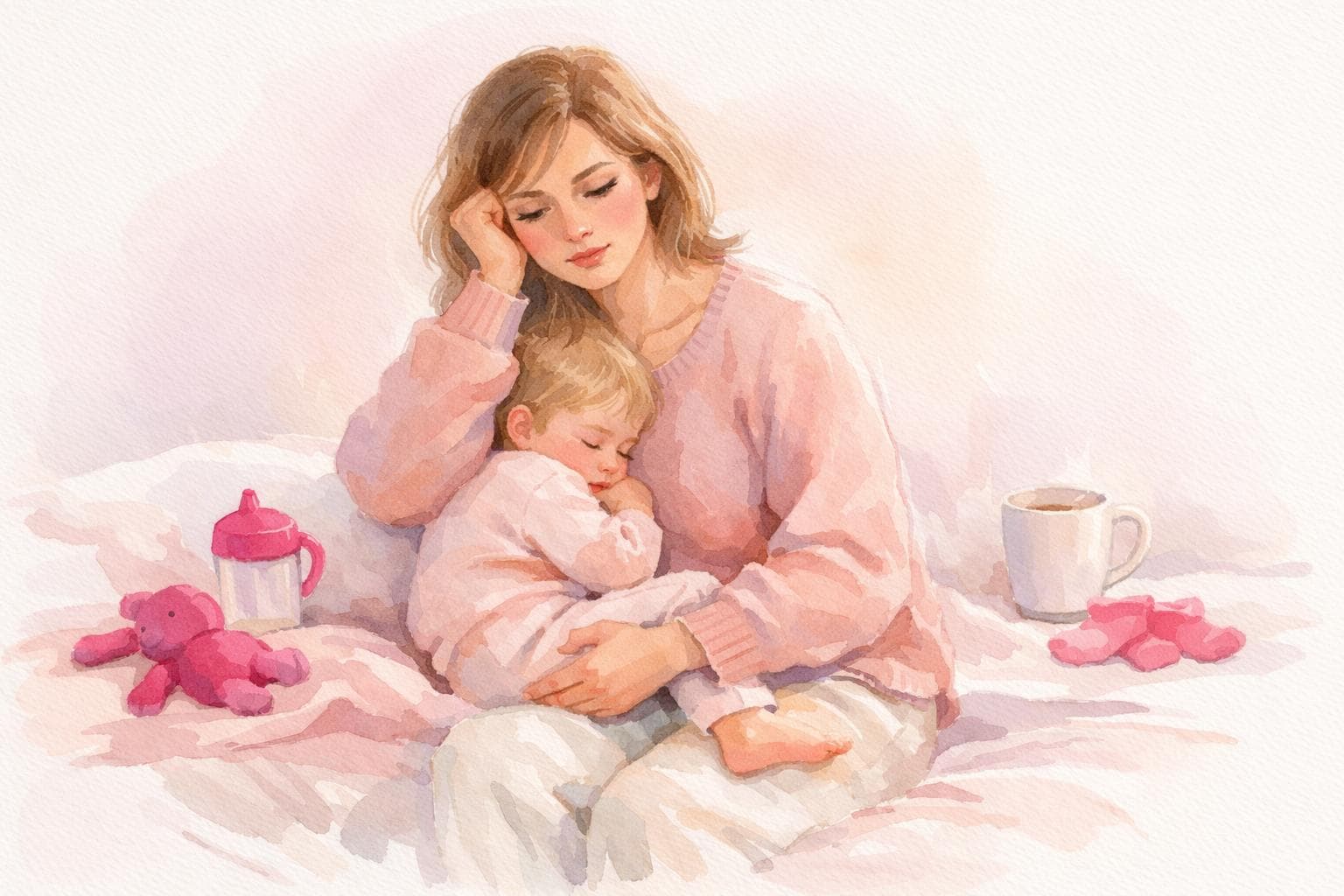
Someone asked you recently how you're finding it, and you said "amazing." Or "tiring but wonderful." Or "I feel so lucky." Because those are the words that exist in the script, and departing from the script takes more energy than you have right now.
But quietly, in the honest space between one task and the next, you've had a different thought. It's boring sometimes. Or grinding. Or you didn't feel a rush of love in the delivery room the way you were supposed to. Or you love your child genuinely and deeply and you still sometimes think: this is not what I imagined. This is not how the story goes.
This needs to be said clearly: that doesn't make you a bad mother. It makes you a real one.
The Gap Between the Story and the Experience
The version of motherhood that circulates culturally through social media, through well-meaning conversations, through decades of "cherish every moment" is almost entirely composed of the best parts. What research consistently shows is that the experience of becoming and being a mother is far more mixed than this narrative allows.
A 2024 study published in the Journal of Reproductive and Infant Psychology, drawing on in-depth interviews with eleven first-time mothers, found that every single participant experienced maternal ambivalence — coexisting feelings of love and frustration, joy and resentment, deep connection and desperate longing for a different kind of day. This wasn't a side effect of struggling mothers. It was universal (PubMed, 2024).
Research published in Sex Roles (Springer Nature, 2025) studying 499 mothers of children aged 0–5 in the United Kingdom — found that what drives maternal distress is not the ambivalence itself, but the gap between how mothers feel and how they believe they're supposed to feel. The "good mother" discourse prescribing that mothers be always devoted, always loving, always enjoying the role creates a standard against which normal human experience registers as failure.
The problem isn't the feeling. It's the expectation that the feeling should be different.
"Most of the time, the experience of motherhood is not good or bad it's both good and bad. It's important to learn how to tolerate, and even get comfortable with, the discomfort of ambivalence." - Dr. Alexandra Sacks, reproductive psychiatrist
What "Not Magical" Can Look Like
Maternal ambivalence covers a wide spectrum of experiences that rarely get named:
- Finding long stretches of baby care genuinely boring, not because you don't love your child but because it objectively involves a lot of repetition
- Feeling relieved when the baby goes to sleep, then guilty for feeling relieved
- Not experiencing a dramatic rush of love at birth bonding that develops quietly over weeks rather than arriving in a cinematic moment
- Resenting your partner for getting to leave the house, and then resenting yourself for resenting them
- Loving your child while simultaneously grieving the version of your life you had before, and understanding these as separate, parallel truths
- Experiencing postpartum flatness not the dramatic clinical presentation, but a quiet absence of the glow you expected
All of this is documented. All of this is normal. None of it predicts the quality of your love or the quality of your parenting.
The Research Behind "Good Enough"
In 1953, British paediatrician and psychoanalyst Donald Winnicott introduced a concept that upended the perfectionist view of mothering: the good enough mother. Observing thousands of infants and mothers over his career, Winnicott came to a counterintuitive conclusion that perfect attunement was not what children needed, or even what was developmentally beneficial.
What children actually need, he argued, is a mother who is present and responsive enough that they feel safe, while also allowing them to experience manageable frustrations that teach them about reality. The good enough mother doesn't need to feel magical about every moment. She needs to be reliably, imperfectly, humanly there.
Here's what the framework looks like in practice:
The perfectionist standard | The "good enough" reality |
|---|---|
You should love every moment | You can love your child while not loving every stage |
You should feel complete and fulfilled | Fulfilment can coexist with boredom, grief, and ambivalence |
Negative feelings signal something is wrong | Negative feelings signal that you're human |
Your child needs perfect attunement | Your child needs consistent, imperfect presence |
The magic should be immediate | Bonding often builds slowly, quietly, over time |
Research shows that Winnicott was right on the developmental side too: children who are allowed to experience manageable frustration build more resilience, stronger emotion regulation, and greater independence than those whose every need is met instantly and perfectly. The pressure to perform perfect motherhood doesn't serve your children. It just exhausts you.
When to Pay More Attention
The distinction that matters is between the ordinary mix of feelings and something that may need more support:
Normal: Some days feeling flat, bored, or resentful alongside days of connection and warmth. Missing your old life. Not feeling consistently enchanted. Loving your child deeply while finding aspects of the role exhausting.
Worth mentioning to a doctor or therapist: Persistent inability to feel any connection with your baby. Overwhelming sadness or flatness that doesn't lift over weeks. Intrusive thoughts that frighten you. Inability to function day to day. These can be signs of postpartum depression or anxiety, which are treatable and not a reflection of you as a mother.
Mom guilt about not feeling the right way is one of the more corrosive parts of the maternal experience and one that feeds on silence. The moment you hear another mother say "me too, I don't love every second either," something loosens. That's not the exception. That's the room.
The Permission Slip You Didn't Know You Needed
The version of motherhood that is sustainable that actually allows you to show up day after day is one that has room for the full range of your experience. Not just the photogenic parts. Not just the moments you'd put in a caption.
You are allowed to find long nights grinding. You are allowed to miss your old life. You are allowed to feel loved and overwhelmed simultaneously. You are allowed to be imperfectly, honestly, good enough which, as Winnicott knew seventy years ago, is what was always needed.
Further reading: Is it normal to miss your life before kids? | How to deal with mom guilt without blaming yourself | Postpartum anxiety: how to recognise it and cope