The word "narcissist" gets thrown around so casually now that it has almost lost its meaning. People use it for a difficult ex, a demanding boss, anyone who cuts them off in traffic. But when the word gets applied to your own parent, it carries a different weight entirely. It is an attempt to name something that never had a name growing up, a pattern that always felt wrong but got filed under "that's just how they are" for years, sometimes decades.
This article explains what "narcissistic parent" actually means clinically and colloquially, where the pattern comes from, and how it differs from simply having a difficult or self-centred parent.
Definition: what a narcissistic parent actually is
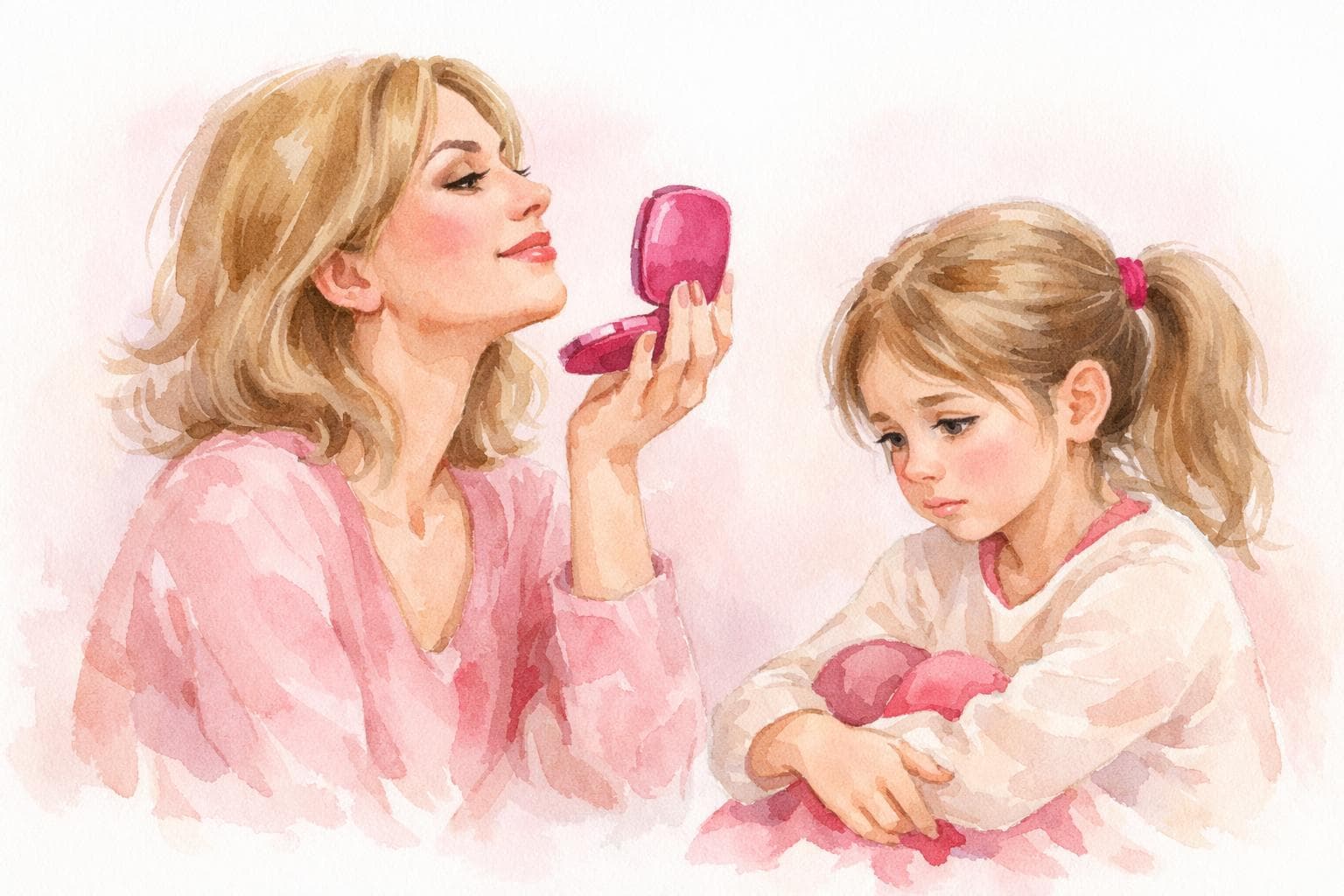
A narcissistic parent is a parent or parental figure who displays pronounced narcissistic personality traits, or in more severe cases meets criteria for narcissistic personality disorder, and who relates to their child primarily as an extension of themselves rather than as a separate person with independent needs, feelings and the right to autonomy. Clinical literature on narcissistic parenting describes these parents as tending toward possessive and controlling behaviour, viewing a child's growing independence as a threat rather than a milestone to celebrate, a dynamic that shapes what researchers call narcissistic attachment, where the parent treats the child as existing primarily to meet their own emotional needs.
Psychologist Ramani Durvasula, a leading researcher on narcissism cited by TODAY, offers an important clarification: narcissistic parents often have a poor sense of differentiation from their child. Their child is an extension of themselves. This single sentence captures the core mechanism behind nearly every specific behaviour associated with narcissistic parenting.
Narcissistic traits vs narcissistic personality disorder: the distinction that matters
Not every self-centred or difficult parent has a clinical disorder, and this distinction genuinely changes how you understand the situation.
Narcissistic traits | Narcissistic Personality Disorder (NPD) | |
|---|---|---|
Consistency | May appear situationally, often worsening under stress | A rigid, stable pattern across most areas of life |
Diagnosis | Not a diagnosis; a behavioural observation | A clinical diagnosis under the DSM-5, requiring professional assessment |
Criteria | Not formally defined | At least 5 of 9 DSM-5 criteria: grandiosity, need for excessive admiration, lack of empathy, and others |
Prevalence | A broader range of people display isolated traits | The clinical disorder affects an estimated 1% to 6% of the general population |
Impact on a child | Can be real and damaging even without a formal diagnosis | Typically produces a deeper, more consistent impact on development |
Prevalence estimates for full NPD vary depending on assessment method and population, according to a 2025 review published in Cureus, and a significant portion of people with the disorder remain undiagnosed or unaware of it, partly because the condition's poor reputation discourages people from seeking evaluation.
What this actually looks like day to day
Narcissistic parenting rarely looks dramatic from the outside. These parents can be charming, publicly devoted to family, and materially generous. The damage happens in the private, relational texture of daily life, in the way a child's feelings get dismissed as inconvenient, achievements get absorbed into the parent's own image, and expressing a genuine preference produces either indifference or punishment.
A few recurring behavioural patterns:
- Triangulation and the golden child. Narcissistic parents often play favourites, praising one child while criticising another, creating rivalry and psychological insecurity between siblings.
- Conditional love. Warmth and affection appear when a child meets expectations, and disappear when they do not.
- Minimising achievement. A child's wins get treated as unremarkable, while any failure is met with disproportionate criticism.
- Dismissing the child's emotions. A child's feelings are either ignored outright or reframed as somehow being about the parent instead.
Where this pattern actually comes from
The foundation of personality forms in the earliest years of life, when a child's brain is developing rapidly and building basic assumptions about self and world, and the roots of a parent's own narcissistic pattern typically trace back to their own early childhood.
One detail that often gets left out of popular explanations: narcissism does not always stem from a lack of childhood love. Some research links it to the opposite, childhood overvaluation, being told constantly and unrealistically that you are special and superior to others, without grounded, honest feedback. A study of 565 children aged 7 to 12, assessed four times over six months, found that higher levels of parental overvaluation significantly predicted higher narcissistic traits in the children later on. This builds a fragile self-esteem that comes to depend on constant external validation rather than a stable, internal sense of worth.
This matters because narcissistic parenting can, and often does, pass down a generation. Adults raised by narcissistic parents frequently report that their central concern as a new parent themselves becomes making sure they do not repeat the same pattern with their own children.
Can it change?
Yes, though working with these entrenched patterns takes real time. Regular psychotherapy, deliberate development of empathy, correcting distorted self-esteem, and conscious awareness of one's own emotional reactions can gradually reduce narcissistic patterns and improve relationships, both for a parent willing to acknowledge the problem and for an adult child working to interrupt the inherited pattern in their own parenting.
"The narcissistic parent often has a poor sense of differentiation from their child. Their child is an extension of themselves." - Dr. Ramani Durvasula, psychologist and narcissism researcher, cited by TODAY
How to tell if this is your family
Definitions and theory are one thing. Recognising these patterns in your own childhood, often decades later, is something else entirely. If any of this sounds familiar, our guide to 11 signs you were raised by a narcissistic parent breaks down the specific, often invisible ways this shows up in adult life, from struggling with boundaries to a persistent fear of disappointing people and difficulty trusting that love can be unconditional.
This article is also available in Ukrainian: Хто такі нарцисичні батьки: пояснення простими словами.
Key takeaways
- A narcissistic parent relates to their child as an extension of themselves, rather than as a separate person with their own independent needs, according to clinical descriptions of narcissistic attachment.
- Narcissistic personality disorder affects an estimated 1% to 6% of the general population, while the broader group with narcissistic traits, distinct from the clinical diagnosis, is considerably larger and often undiagnosed.
- Narcissistic traits and full NPD are not the same thing. The clinical disorder requires at least 5 of 9 DSM-5 criteria and can only be diagnosed by a qualified professional.
- The pattern often originates not from a lack of love but from childhood overvaluation, unrealistic praise without grounded feedback, which research links to higher narcissistic traits later in life.
- Narcissistic parenting can pass down generations, but therapy and deliberate self-awareness can interrupt the inherited pattern, both for the parent and for the adult child raising their own kids differently.
Sources and further reading
- TODAY. (2025). The No. 1 sign you were raised by a narcissist, according to a psychologist. today.com
- Orovou, E., Jotautis, V., Vousoura, E., Koutelekos, I., Rigas, N. & Sarantaki, A. (2025). Impact of Parental Narcissistic Personality Disorder on Parent-Child Relationship Quality and Child Well-Being: A Systematic Review. Cureus, 17(12), e100229. cureus.com
- Psychology Today. (2025). Signs a narcissistic parent has affected your adult life. psychologytoday.com
- Psychology Today. (2024). How a parent's narcissism affects a child's mental health. psychologytoday.com
- Newport Institute. (2026). How a narcissistic parent impacts young adults. newportinstitute.com
- Psychiatry Magazine. (2026). Narcissistic parent: hidden psychological damage in adult children. psychiatrymagazine.com