The problem with most self-care advice for mothers is that it was written for a different person. Someone with a predictable schedule, an hour to herself in the morning, and the emotional bandwidth to journal at the end of the day. The mother it's actually aimed at depleted, interrupted, carrying far more than anyone can see tends to read that advice and feel worse, not better.
So this piece is an attempt to do something different: to look at what the research actually identifies as effective for maternal wellbeing, and translate it into forms that are honest about the conditions mothers are working with.
Why Self-Care Isn't Just a Luxury
Before the rituals, a brief word on why this matters enough to fight for. A 2024 structural equation modelling study published in ScienceDirect examining data from 248 caregivers found that promoting self-care was more effective at improving mental health than interventions aimed at improving coping strategies directly. The model explained 54% of the variance in mental health outcomes. Self-care decreases stress, which then improves coping not the other way around (ScienceDirect, 2024).
A cross-sectional study of 514 mothers with children under three, conducted in 2023, found that self-care behaviours were significantly associated with both physical and mental wellbeing and that social support amplified these effects considerably (PMC, 2025).
None of this is an argument for adding another item to an already impossible to-do list. It's evidence that small, consistent acts of care for yourself are not indulgent. They're the scaffolding that makes everything else possible.
"Engaging in self-care behaviours such as getting sufficient sleep, frequent exercise, and taking time out when necessary should be considered essential for preventing and reducing psychopathology and promoting well-being." - ScienceDirect, self-care in early motherhood study, 2025
The Problem With "Rituals"
Most self-care rituals assume two things: uninterrupted time, and the desire to be alone. Many mothers have neither. What tends to work better is habit-stacking attaching a small self-care act to something that's already happening and reframing the intention behind ordinary moments, not adding new ones.
What also works is dropping the perfection threshold entirely. Research is clear that consistent but small acts of self-care build cumulatively. The ten-minute walk matters. The five-minute tea. The one phone call with someone who asks how you're doing and actually listens.
Here's a way of thinking about self-care that maps more honestly to maternal life:
The self-care we're told to do / The self-care that actually accumulates
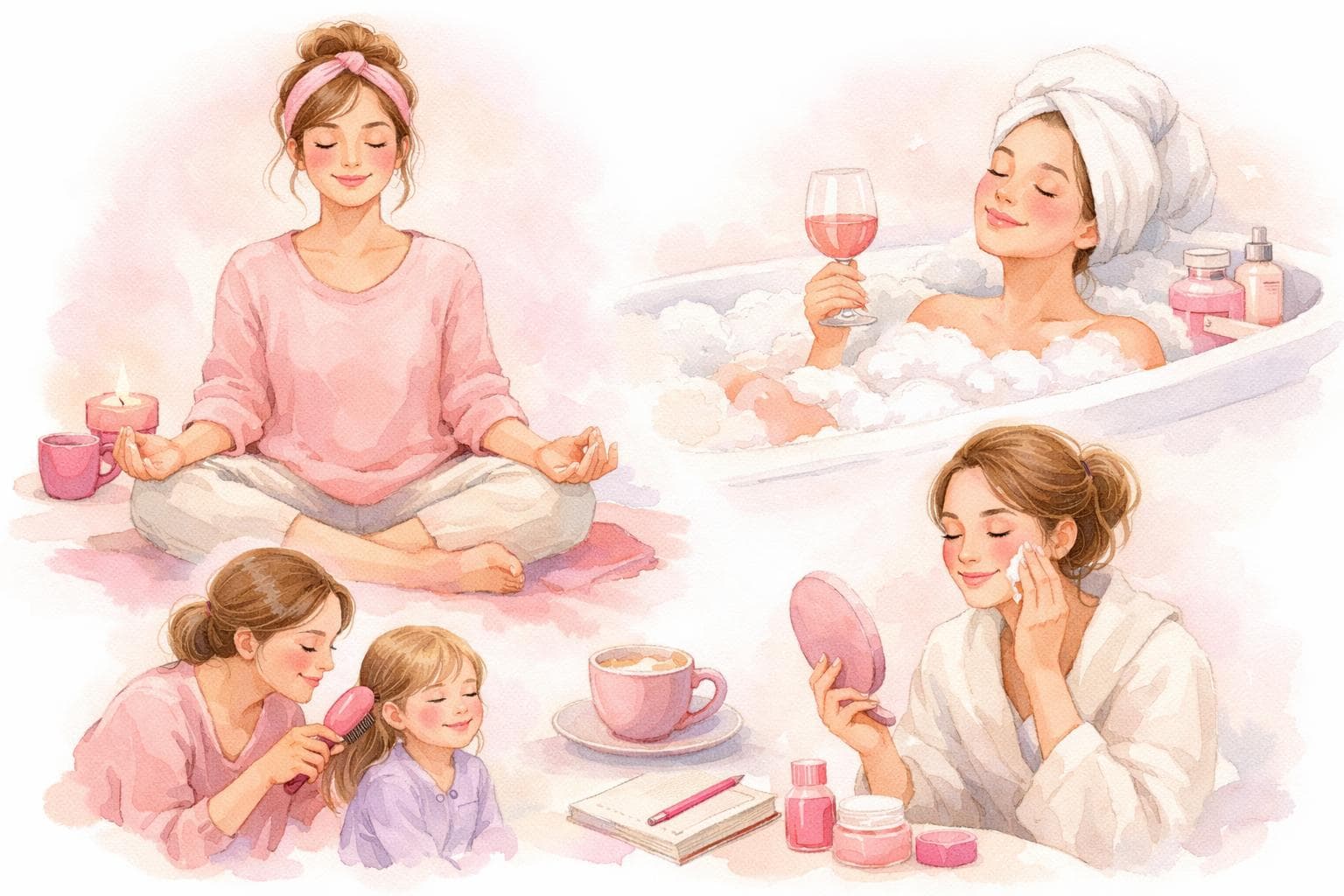
Morning routine before the household wakes / Intentional first five minutes after coffee — no scrolling
Hour-long bath once a week / Ten-minute shower without rushing or guilt
Meditation practice / Three slow breaths before responding when depleted
Journaling every evening / One honest sentence in the notes app whenever
Exercise class / Walking with the pram counts. Walking alone also counts.
Weekend trip with friends / One real conversation with someone who sees you, not just your role
Rituals That Are Small Enough to Be Real
Time in nature any amount. Research published in BMC Women's Health (2023) involving 30 postpartum mothers across four focus groups at the University of Bristol found that being outside in natural spaces provided sensory relief from daily stressors, a sense of spaciousness, and improved mood. The mothers described it as one of the few activities that produced noticeable wellbeing benefit consistently (PMC, 2023). This doesn't mean a park run. A bench in the sun for ten minutes. A walk around the block. Green space, at whatever scale is possible.
Self-compassion over self-improvement. A 2024 feasibility study published in ScienceDirect found that brief, remote self-compassion interventions for working mothers measurably reduced stress and improved wellbeing with effects comparable to longer, more structured programmes. Dr. Kristin Neff's work at the University of Texas (cited in over 6,000 studies) consistently identifies self-compassion as more effective for maternal mental health than either positive thinking or achievement-based goals. When you've had a hard day, the question isn't "how could I have done that better?" It's "what would I say to a friend in this exact situation?" Applying that answer to yourself is self-care.
Movement that asks nothing of you. Ninety minutes of any physical activity per week — confirmed across a meta-analysis of 186,412 women meaningfully reduces postpartum depression risk. The format doesn't matter. It can be broken into whatever units actually fit. See fitness for moms without pressure or perfection for a fuller look at how to approach this without the usual guilt.
Social connection chosen carefully. Research on maternal wellbeing consistently identifies social support as one of the most protective factors. Not all social contact has this effect; performative socialising, or time spent around people who increase rather than reduce your sense of inadequacy, can worsen things. The ritual here is identifying one or two people with whom you can be genuinely honest about the hard parts, not just the highlights and protecting time with them.
Deliberate transitions. New mothers describe one of the most difficult aspects of early motherhood as the absence of any moment that belongs only to them including the moments they're technically "off". A simple practice: five minutes between one thing and the next, used to do nothing in particular. Not to plan, not to scroll. This is a micro-recovery, and over time, it accumulates.
The Rituals That Don't Work and Why
Research is equally clear about what tends not to help, despite its frequent recommendation:
- Self-care that requires significant advance planning tends to get cancelled under the first wave of competing needs
- Activities framed as "deserved rewards" reinforce the idea that self-care must be earned, which mom guilt then systematically undermines
- Grand gestures once a month are less effective than small, daily acts , the data on consistency vs. intensity is consistent across studies
A Practical Starting Point
Rather than building a full routine from scratch, pick one thing from the list below and do it for two weeks:
- Go outside for ten minutes every day, without a phone
- Say something to yourself that you'd say to a friend when you've made a mistake
- Text one person you trust and say something true about how you're doing
- Stop one activity any activity five minutes earlier than usual and sit quietly with tea
If burnout has already set in, or postpartum anxiety is making the simplest things feel difficult, then self-care alone isn't the complete answer. And understanding why motherhood feels so overwhelming is often the first step toward giving yourself something more workable to stand on.
Start small. Let it be imperfect. And take seriously the idea that caring for yourself is, in fact, part of caring for your family.
Further reading: Why self-care isn't selfish when you're a mother | What self-care really means after kids | How to reconnect with yourself after motherhood