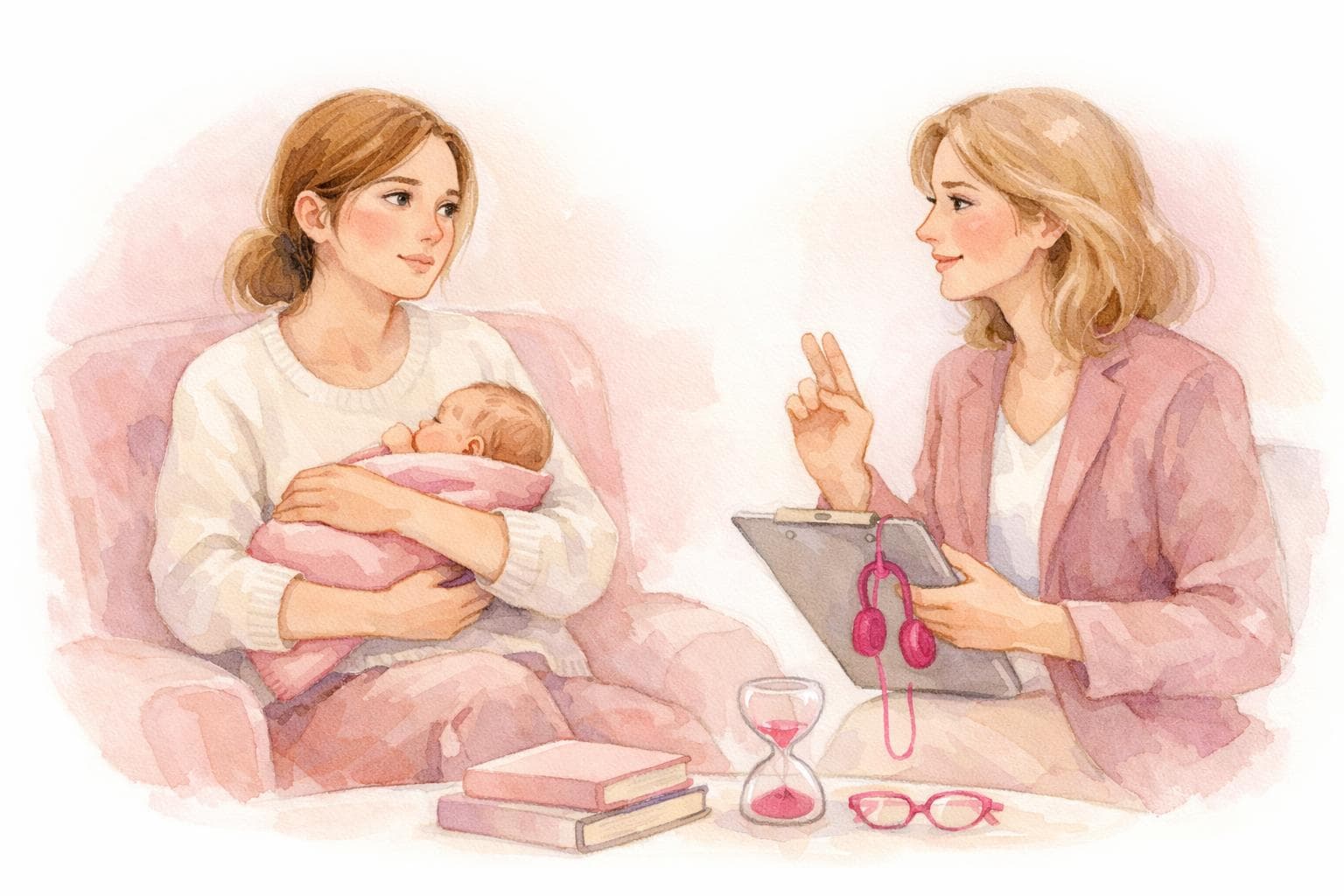

You are holding your baby and a thought flashes through your mind. Something awful. Something you would never, ever do. And then comes the shame, the panic, the question: "What kind of mother thinks that?"
You close the thought down quickly, check the baby, do the same thing again twenty minutes later. You tell yourself it is just exhaustion. Just anxiety. But it keeps coming back, and the mental effort of pushing it away is consuming your entire day.
What you are experiencing may not be anxiety at all. It may be perinatal OCD and it deserves a proper name, a proper explanation and proper support.
What is perinatal OCD?
Perinatal OCD is a subtype of obsessive-compulsive disorder that develops during pregnancy or in the months after giving birth. It is driven by intrusive thoughts (obsessions), typically about harm coming to the baby, followed by compulsive behaviours designed to neutralise the fear or prevent the imagined outcome.
It is distinct from general postpartum anxiety, though the two are often confused. The key difference lies in the cycle: obsession, distress, compulsion, temporary relief, and then the thought returns. That loop is the hallmark of OCD.
How common is it really?
More common than anyone is telling new mothers.
A landmark study found that 17% of postpartum women reported OCD symptoms in the 38 weeks following delivery, with prevalence peaking at around nine per cent approximately eight weeks after birth. Prior research had placed the figure at just 2.2%, suggesting that the condition has been significantly underdetected.
Research shows that between 70% and 100% of new mothers describe passive intrusive thoughts involving infant harm, with about half endorsing thoughts of intentional harm to the infant. That does not mean half of all mothers have OCD. What it means is that intrusive thoughts are extremely common, and in most cases they pass. In perinatal OCD, they do not pass. They stick, spiral and drive exhausting behavioural responses.
Pregnant and postpartum women are also estimated to be 1.5 to 2 times more likely to experience OCD than the general population.
What perinatal OCD looks like
The obsessions in perinatal OCD tend to cluster around specific fears:
- Accidentally dropping or hurting the baby
- Germs, contamination or illness reaching the infant
- Acting on a violent or sexual thought involving the baby (thoughts the mother finds completely horrifying)
- Something being wrong medically that has been missed
- Being an unfit or dangerous parent
The compulsions that follow are attempts to manage the fear:
Compulsion type | Example behaviour |
|---|---|
Checking | Repeatedly checking the baby is breathing at night |
Reassurance-seeking | Asking a partner or doctor the same question many times |
Avoidance | Refusing to use knives in the kitchen or bathe the baby |
Mental rituals | Replacing a "bad" thought with a "safe" one |
Over-researching | Spending hours looking up symptoms or risks online |
The compulsions bring temporary relief. But they also reinforce the idea that the thought was dangerous, which makes the next intrusive thought feel even more threatening.
The thought does not reflect who you are
This needs saying plainly: an intrusive thought about harming your baby is not a wish, a plan or a reflection of your character. Research consistently shows that intrusive thoughts of infant harm are not associated with an increased risk of actual harm to children.
The difference between a mother with perinatal OCD and a dangerous one is that the mother with OCD is terrified of the thought and desperate to prevent it. That terror is, paradoxically, one of the clearest signs that the thought is ego-dystonic, meaning it goes completely against the person's values and desires.
"Intrusive thoughts in OCD are not dangerous impulses. They are painful symptoms of a disorder that is highly treatable. The shame around them is one of the biggest barriers to women getting help." - Dr. Nichole Fairbrother, clinical associate professor of psychiatry, University of British Columbia
Perinatal OCD vs postpartum anxiety: what is the difference?
Perinatal OCD | Postpartum anxiety | |
|---|---|---|
Thought pattern | Specific, intrusive, repeated | More generalised worry |
Response | Compulsive rituals to neutralise | Overthinking, restlessness, reassurance |
Distress about the thought itself | High, the thought feels unacceptable | The situation feels threatening |
Avoidance | Often tied to specific triggers | Broader, more diffuse |
Misidentifying perinatal OCD as anxiety is one reason why it often goes untreated for so long. Standard anxiety approaches are less effective and, in some cases, can reinforce OCD patterns.
Treatment that actually works
A Delphi consensus study among international experts identified ERP (Exposure and Response Prevention) as a first-line treatment for perinatal OCD, either alone or with SSRIs. Exposure-based cognitive behavioural therapy is considered safe, acceptable and effective during the perinatal period.
ERP works by gradually exposing the mother to the feared thought without allowing the compulsive response. Over time, the brain learns that the thought is not dangerous, and the urgency to respond to it diminishes.
Acceptance and Commitment Therapy (ACT) can support ERP by helping women make space for the thoughts rather than fighting them, without the rituals that keep the cycle going.
SSRIs are also used, particularly when symptoms are severe or therapy is not enough on its own.
What to do if this sounds familiar
If you recognise yourself in this article, please speak to your GP, midwife or a perinatal mental health specialist. Be specific about the intrusive thoughts and the rituals. Perinatal OCD is often missed because clinicians do not ask the right questions, and many mothers do not volunteer the information out of fear and shame.
You may also find it useful to read about how therapy can help moms who feel stuck, or about the emotional exhaustion that builds when you are managing invisible mental health symptoms every day. And if reaching out still feels hard, this piece on asking for help might be a good starting point.
Perinatal OCD is common, it is treatable and it does not make you a bad mother. It makes you someone who needs and deserves the right support.
Sources and further reading
- Fairbrother, N. et al. (2021). High prevalence and incidence of OCD among women across pregnancy and the postpartum. The Journal of Clinical Psychiatry. psychiatrist.com
- Drake, K. et al. (2024). OCD symptoms and intrusive thoughts in the postpartum period: associations with trauma and PTSD. Stress and Health. onlinelibrary.wiley.com
- International OCD Foundation. Perinatal OCD: what research says about diagnosis and treatment. iocdf.org
- Ferra, I., Bragança, M. & Moreira, R. (2024). Exploring the clinical features of postpartum OCD: a systematic review. The European Journal of Psychiatry.
- Abramowitz, J.S. (2012). The Practice of Exposure Therapy. Guilford Press.
- Postpartum Support International: postpartum.net