
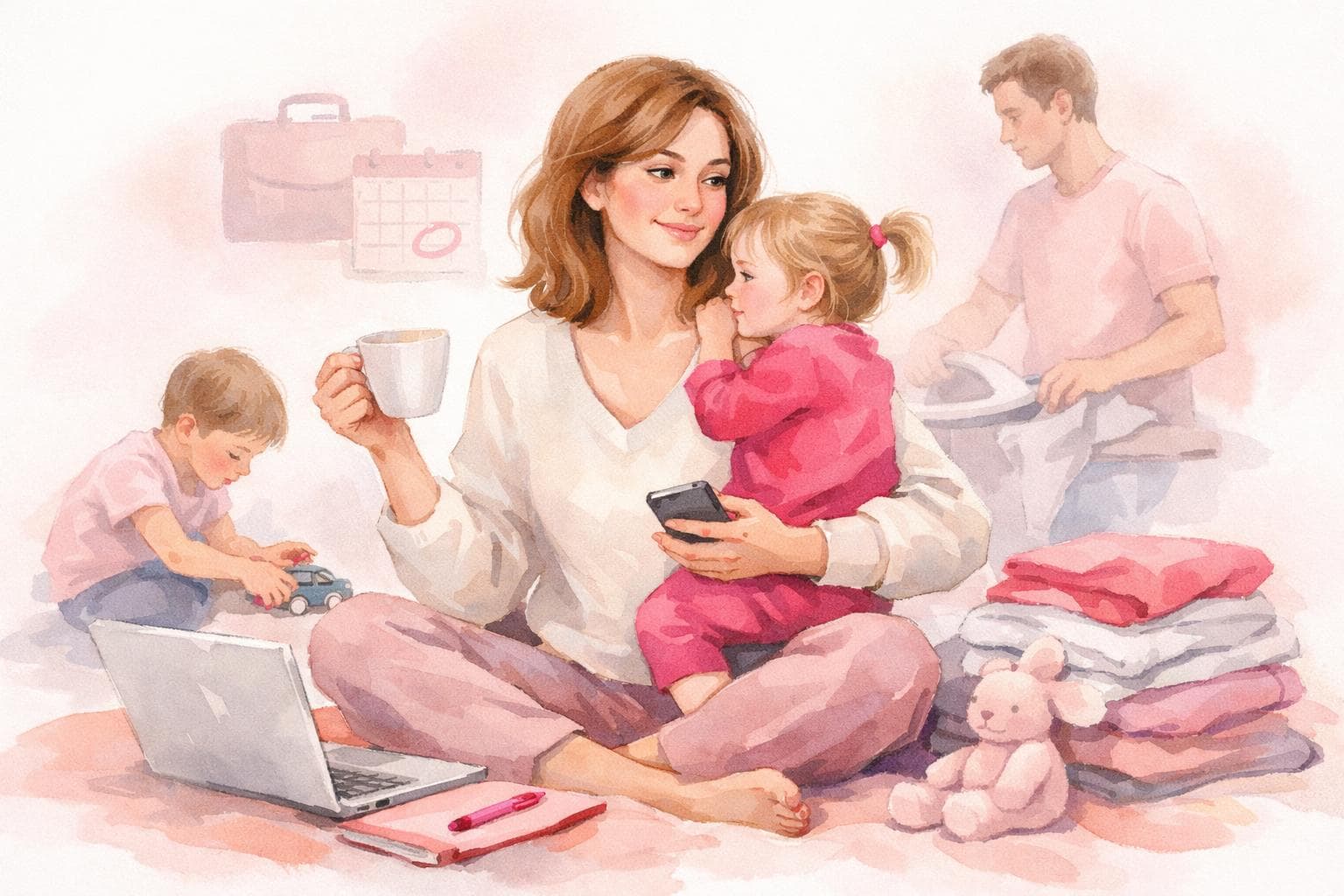
Somewhere between the third unread email, the dinner you haven't started, and the school permission slip you just remembered was due yesterday, the question lands: is this it? Is this what balance is supposed to feel like?
For most mothers, the answer — quietly, guiltily — is no. And yet the conversation about balance rarely gets to the honest part: maybe what we're chasing doesn't actually exist in the form we imagine it.
The Problem With "Balance" as a Concept
The word balance implies equal weight on both sides of a scale — work and home, self and family, ambition and presence, all perfectly counterpoised. It's a compelling image. It's also, for the vast majority of mothers, completely at odds with reality.
In her book Overwhelmed: Work, Love and Play When No One Has the Time, journalist Brigid Schulte coined the phrase "time confetti" to describe how working mothers experience their days — not in long, coherent blocks, but in shredded fragments of 10 minutes here, 15 minutes there, constantly interrupted, never clean. She argued that this isn't a personal failing, but the predictable outcome of a culture that created the "ideal worker" (always available, no competing demands) and the "ideal mother" (endlessly present, selflessly devoted) simultaneously — and then told women to be both.
Nothing in the research suggests this has become easier.
What the Numbers Actually Show
The scale isn't close to tipped. A 2024 study published in the Journal of Marriage and Family — analysing data from 3,000 U.S. parents — found that mothers handle 71% of all household mental load tasks. That's everything that requires thinking, planning and anticipating: scheduling appointments, tracking what the kids need, remembering that someone has to buy the birthday present. When physical housework was measured separately, mothers still did significantly more, taking on 79% of cleaning and childcare (University of Bath, Weeks & Ruppanner, 2024).
A 2025 survey of 3,000 working parents found that 74% of working mothers report carrying the parenting mental load, compared to 48% of working fathers — and 31% of mothers are concerned about burnout, nearly double the rate of fathers at 19%.
Separate research in the Journal of Pediatric Health Care (2024) found that 65% of working parents reported burnout. The rate among mothers was disproportionately high, driven by the compounding of professional demands and the invisible cognitive labour that doesn't switch off when the working day ends.
"This kind of work is often unseen, but it matters. It can lead to stress, burnout and even impact women's careers. In many cases, resentment can build, creating strain between couples." — Dr. Ana Catalano Weeks, University of Bath, 2024
Why Mothers Feel It More
The imbalance isn't just structural — it's psychological. Research consistently shows that even when women work full time, they continue to carry the majority of what sociologist Arlie Hochschild called the "second shift" — the unpaid domestic and emotional work that follows the paid workday home. The heaviest part of that shift is invisible: the remembering, anticipating, planning, and worrying that happens inside someone's head while they appear to be doing something else entirely.
A 2024 study published in Archives of Women's Mental Health — conducted by University of Southern California researchers on 322 mothers of children under three — found that mothers perform 73% of all cognitive household labour, and that this imbalance was directly linked to increased rates of depression, stress, and burnout. Not the dishes. The thinking about the dishes.
Guilt compounds everything. Cultural pressure to be an "ideal mother" — always emotionally available, always prioritising the child — sits uncomfortably alongside the expectation to also perform well professionally. And the standards of intensive motherhood have, if anything, risen in the age of curated social media.
Here's what this mismatch looks like in practice:
The "Balance" VersionThe Reality
Equal time for work, self, and family
Constant reprioritising with no good answer
Leisure that feels restorative
"Time confetti" — fragmented, interrupted, guilt-laden
Shared mental load at home
One person managing the cognitive life of the household
Guilt-free time for yourself
Self-care squeezed in between obligations, with justification required
Knowing when you've done enough
A moving standard that's never quite met
What Actually Helps (Instead of "Balance")
The research doesn't suggest equal balance is achievable in the way it's usually framed. But it does offer reframes that are more workable — and more honest.
Replace "balance" with "integration." Balance implies that work and family are always competing and you need to manage the zero-sum trade-offs correctly. Integration acknowledges that these parts of life coexist, overlap, and shift depending on the season. Some weeks, work takes more. Some weeks, family does. The goal isn't equal distribution — it's that neither is permanently sacrificed.
Make the invisible visible. Much of the inequity in domestic mental load persists because the work is invisible — not just to partners, but sometimes to the mothers themselves. Writing down who carries what — not just the tasks, but the management of those tasks — changes conversations. You can't redistribute something that hasn't been named. How motherhood changes your relationships explores the relational dimension of this further.
Reframe what self-care actually means. The idea that balance requires lengthy personal time sets an unrealistic threshold most mothers can't reach. Research is clearer on what actually works: consistency over intensity, movement that feels good rather than punishing, and moments of genuine rest rather than guilt-laden pause. What self-care really means after kids unpacks why the standard advice often misses the point entirely.
Allow "good enough" to be enough. One of the quieter findings in research on maternal wellbeing is that perfectionism — the belief that your parenting, professional work, and home all need to be excellent simultaneously — is among the strongest predictors of burnout. Good-enough parenting, in the psychological sense, means meeting your child's actual needs — not every standard set by comparison. The gap between those two things is where a lot of exhaustion quietly accumulates.
Seek support before you reach the wall. Why motherhood feels overwhelming is a question worth sitting with — because the overwhelm rarely comes from one source. And if anxiety has become a low-level backdrop rather than a passing response to a specific stressor, that's worth taking seriously rather than managing around.
An Honest Answer
Is life balance for modern moms a myth? In the equal-weight-on-both-sides sense: mostly, yes. The structural conditions — disproportionate mental load, intensive motherhood standards, workplaces still built around an "ideal worker" who has no children — make it genuinely hard to achieve, and framing it as a personal management problem is unfair to the structural reality mothers are actually navigating.
But that doesn't mean nothing can change, or that chronic overwhelm is inevitable. What tends to help isn't chasing an idea of balance you haven't been able to reach. It's building something more honest — a life where you're not perpetually last on your own list, where the invisible work is shared rather than silently accumulated, and where "enough" has an actual definition rather than a horizon that keeps moving further away.
That's harder than achieving balance. But it's real.
Further reading: Why self-care isn't selfish when you're a mother | Identity loss after becoming a mother | How to reconnect with yourself after motherhood