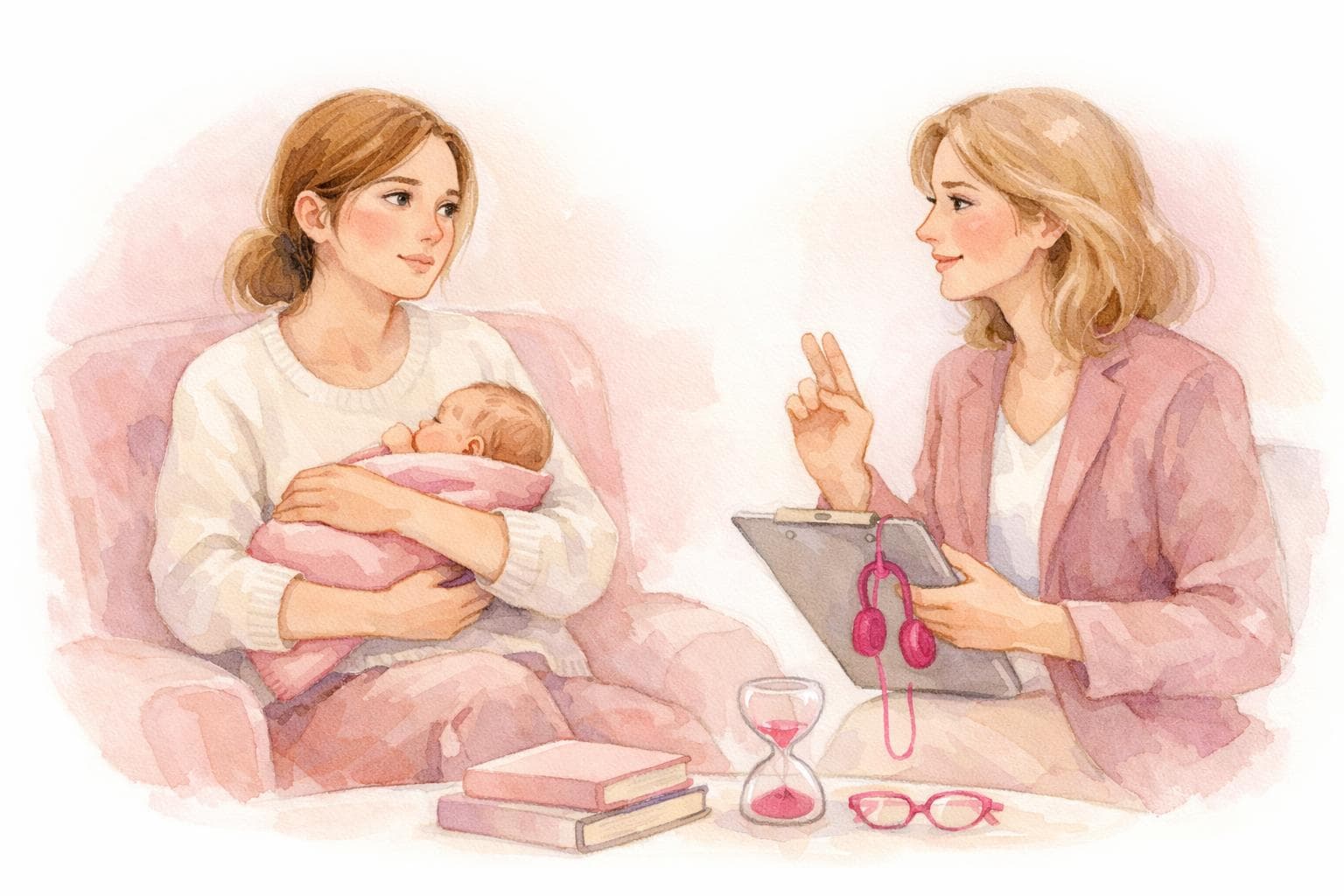

The appointment is the easy part to book. It is the conversation inside it that most mothers find difficult.
Not because they don't know something is wrong. Most mothers who make the appointment have been aware for some time that what they are experiencing is more than ordinary tiredness or a rough patch. They have been sitting with it, managing it quietly, performing well enough from the outside while the inside has been getting louder.
The difficulty is in saying it out loud to a professional. In finding the words that are clear enough to communicate the real picture without feeling dramatic. In believing that what they are experiencing qualifies as something worth taking to a doctor. In knowing what to ask for, and how.
This piece is about that specific part: the practical mechanics of how to ask.
Why mothers underreport to health professionals
The underreporting of maternal mental health difficulties to GPs and other health professionals is not a minor problem. Research published in Women and Birth (2021) found that fewer than half of mothers experiencing significant postpartum mental health difficulties had disclosed this to a health professional, with shame, fear of judgment and uncertainty about whether their symptoms were serious enough cited as the most common barriers.
A separate 2019 study in the British Journal of General Practice found that mothers were significantly more likely to downplay symptoms during appointments, particularly if they were also managing parenting responsibilities in the waiting room. The clinical environment, combined with the presence of children and the time pressure of a standard GP appointment, produces conditions in which it is very easy to say "I'm managing" when "I'm not managing" would be closer to the truth.
Understanding this is not about blame. It is about recognising that the conditions for honest disclosure are not automatically created by booking an appointment, and that getting there may require some deliberate preparation.
Before the appointment: what to prepare
The most useful thing you can bring to a mental health conversation with a GP is specificity. Doctors cannot respond adequately to vague distress. They can respond to described symptoms, duration and impact.
Before your appointment, it helps to have thought through:
- What you are experiencing. Not in clinical terms, just in honest description. Low mood, persistent anxiety, emotional numbness, inability to feel pleasure, intrusive thoughts, rage that feels disproportionate. Write it down if it helps, and bring the writing.
- How long it has been happening. Two weeks is different from two months is different from a year. The timeline matters diagnostically.
- How it is affecting your daily life. Not just how you feel but what you cannot do, or do less well, as a result. This is the functional impact and it is the most diagnostically useful information.
- Whether there are specific triggers or patterns. Worse at certain times of day, or in certain situations, or linked to specific events.
- What you have already tried. Including any self-management strategies, whether they have helped and to what extent.
In the appointment: what to say
The opening sentence is the hardest. Most mothers lead with minimisation. "I've been feeling a bit off lately" or "I think I might just be tired." This framing invites reassurance rather than investigation.
A more useful opening is direct: "I'm not coping well and I'd like some help working out what's happening and what support is available."
If you find directness difficult in the moment, you are allowed to say: "I've written some things down because I find it hard to talk about this." GPs can read. Handing over a piece of paper with your key points on it is a legitimate and often effective approach.
What a mental health diagnosis involves
Many mothers are uncertain about what asking for help actually leads to, which contributes to avoidance. The process is not as complex as it tends to feel from the outside.
Step | What it involves |
|---|---|
Initial GP appointment | Description of symptoms, duration and impact. The GP may conduct a validated screening tool such as the PHQ-9 or GAD-7. |
Further assessment or referral | Depending on presentation, the GP may refer for a more detailed psychiatric assessment or directly to a talking therapy service. |
Diagnosis | Not always given immediately. Some conditions require further assessment. A diagnosis is a tool for accessing appropriate treatment, not a verdict. |
Treatment options | Discussed in collaboration. May include therapy, medication or both. You have the right to ask questions and to be involved in decisions. |
Follow-up | A good GP will schedule follow-up to assess how you are responding to any treatment or support offered. |
What you are entitled to ask for
Many mothers do not know that they can advocate for themselves in this process. You are entitled to:
- Ask for a longer appointment if you need more time
- Request a female doctor if that feels important for this conversation
- Ask your GP to explain what they are recommending and why
- Ask for a referral if you do not feel the initial response is adequate
- Seek a second opinion if you feel your concerns are not being taken seriously
- Request information about local perinatal mental health services specifically
In the UK, NHS perinatal mental health teams provide specialist support for mothers during pregnancy and in the year following birth. In the US, the Postpartum Support International provider directory lists practitioners with perinatal mental health specialisms. You are allowed to ask for specialist support.
On deserving to be there
The most significant barrier for most mothers is not the process. It is the belief that they do not qualify. That things are not bad enough. That someone else needs the appointment more.
"You don't have to be at rock bottom to deserve support." - Unknown
This belief is worth examining directly. Mental health support is not a scarce resource rationed to those who are most visibly unwell. It is most effective when accessed early, before a manageable difficulty has become a crisis.
If you are unsure whether what you are experiencing is significant enough to bring to a professional, it is. The uncertainty itself is part of what makes it worth raising.
For more on what therapy can specifically offer when you do access support, how therapy can help moms who feel stuck is a useful companion piece. And if postpartum depression specifically is what you're navigating, how to cope with postpartum depression: getting help without the shame addresses the emotional dimension of that process in more depth.
You have been managing alone for long enough. The appointment is worth making.
Further reading: Mind UK, how to talk to your doctor about mental health. Postpartum Support International: postpartum.net. Royal College of Psychiatrists: rcpsych.ac.uk.