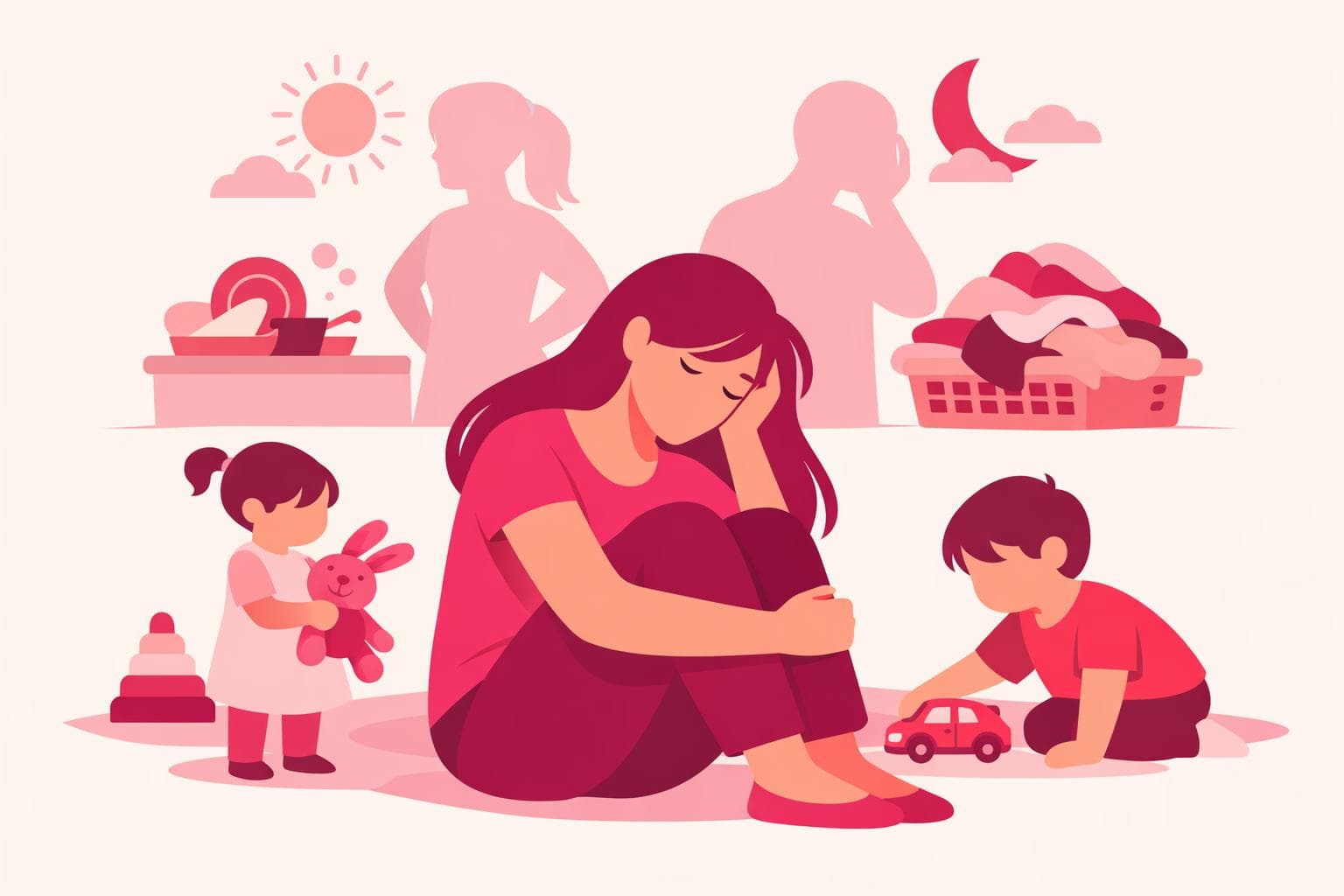
There's a voice in your head that keeps a running tally. It counts every short-tempered reply, every frozen dinner, every bedtime that went sideways. It reminds you of the craft projects you didn't do, the school email you forgot to answer, and the fact that your toddler watched three episodes of something while you just sat there trying to breathe.
That voice is convinced you're failing. And it's wrong.
If you've ever whispered to yourself, "I'm a bad mom," while doing the very best you could with what you had — this is for you.
Why So Many Mothers Feel Like They're Not Enough
You're not imagining it, and you're not alone. A 2023 Pew Research Center survey of nearly 4,000 U.S. parents found that 62% said parenting has been harder than they expected — with 30% of mothers saying it's been a lot harder. Yet almost all of them still showed up. Every single day.
The gap between expectation and reality is where guilt lives. And modern motherhood has widened that gap to a canyon.
What feeds the "I'm failing" feeling:
- comparing your worst moments to other mothers' curated best
- carrying the majority of the mental load without acknowledgement
- internalising the myth that good mothers never struggle
- exhaustion so deep it erodes your patience and then punishes you with shame
- absorbing parenting advice that contradicts itself at every turn
The pressure isn't coming from one place. It's coming from everywhere — social media, family expectations, parenting culture, and the impossible standard of "intensive mothering" that researchers have been documenting for decades.
You're not failing. You're parenting in a system that was never designed to support you — and blaming yourself for the gaps.
The Science Behind Mom Guilt
Psychologists use the term parental self-efficacy to describe how confident a parent feels in their own ability to raise their child well. Research published in Adolescent Research Review found that when self-efficacy drops, mothers are more likely to experience anxiety, depression, and harsher self-criticism — even when their actual parenting hasn't changed.
In other words: feeling like a bad mom doesn't mean you are one. It means your confidence tank is empty.
And guilt compounds it. A 2023 study in the British Journal of Social Psychology found that mothers with stronger internalised gender stereotypes experienced more work-family guilt on days they worked longer hours — guilt that led them to sacrifice personal time and consider reducing their careers. The guilt didn't improve their parenting. It just made them smaller.
What "Failing" Actually Looks Like vs. What You're Doing
Most mothers who feel like failures are doing far more than they give themselves credit for. This comparison can help put things in perspective:
What You Think Is FailingWhat It Actually Is
Losing your temper after the fifth tantrum
Being human with a depleted nervous system
Letting your kid have screen time so you can rest
Meeting your own needs so you can keep going
Not doing educational activities every day
Trusting that play, conversation, and love are enough
Forgetting the school event or permission slip
Managing an impossible mental load with no PA
Feeling relieved when bedtime finally arrives
A completely normal response to a demanding day
Not enjoying every moment
Experiencing motherhood honestly, not performing it
Your children don't need a perfect mother. Decades of developmental research — including the foundational work of paediatrician and psychoanalyst Donald Winnicott — tell us that children thrive with a "good enough" parent. One who is present, responsive most of the time, and willing to repair when things go wrong.
Not one who never gets it wrong. One who comes back.
How to Quiet the Voice That Says You're Failing
There's no switch that turns off mom guilt overnight. But there are ways to loosen its grip.
Notice the should. Every time you think "I should be doing more," ask yourself: according to whom? Most of these standards weren't set by anyone who knows your family, your circumstances, or your Tuesday at 5pm.
Track what you did, not what you didn't. At the end of the day, your brain will offer you a highlight reel of everything that went wrong. Deliberately counter it. You fed your children. You kept them safe. You showed up. That's not nothing — that's everything.
Limit the comparison loop. Research from Meeussen and Van Laar (2018) found a direct link between pressure to be a perfect parent and parental burnout. Social media accelerates that pressure. Unfollow accounts that make you feel worse about yourself. That's not weakness. That's self-care.
Talk to someone who gets it. Isolation makes guilt louder. A friend, a therapist, a support group — even an honest conversation with your partner — can break the cycle. As psychologist Dr. Kristin Neff writes in Self-Compassion: The Proven Power of Being Kind to Yourself, treating yourself with the same kindness you'd offer a struggling friend is one of the most effective tools for reducing shame.
Repair instead of ruminate. You yelled. You snapped. You weren't the parent you wanted to be for ten minutes. Instead of spiralling into guilt, go back to your child and say, "I'm sorry I lost my patience. That wasn't about you. I love you." That moment of repair teaches your child more about emotional intelligence than a hundred perfect days ever could.
The mothers who worry about being good enough almost always are. It's the worrying itself that proves it.
You're Doing Better Than You Think
Motherhood doesn't come with performance reviews or quarterly feedback. There's no one to tell you that you're doing a good job — so you assume you're not.
But look at your child. Are they loved? Are they fed? Do they come to you when they're scared? Do they laugh in your house?
Then you're not failing. You're mothering — imperfectly, exhaustedly, humanly — and that has always been enough.