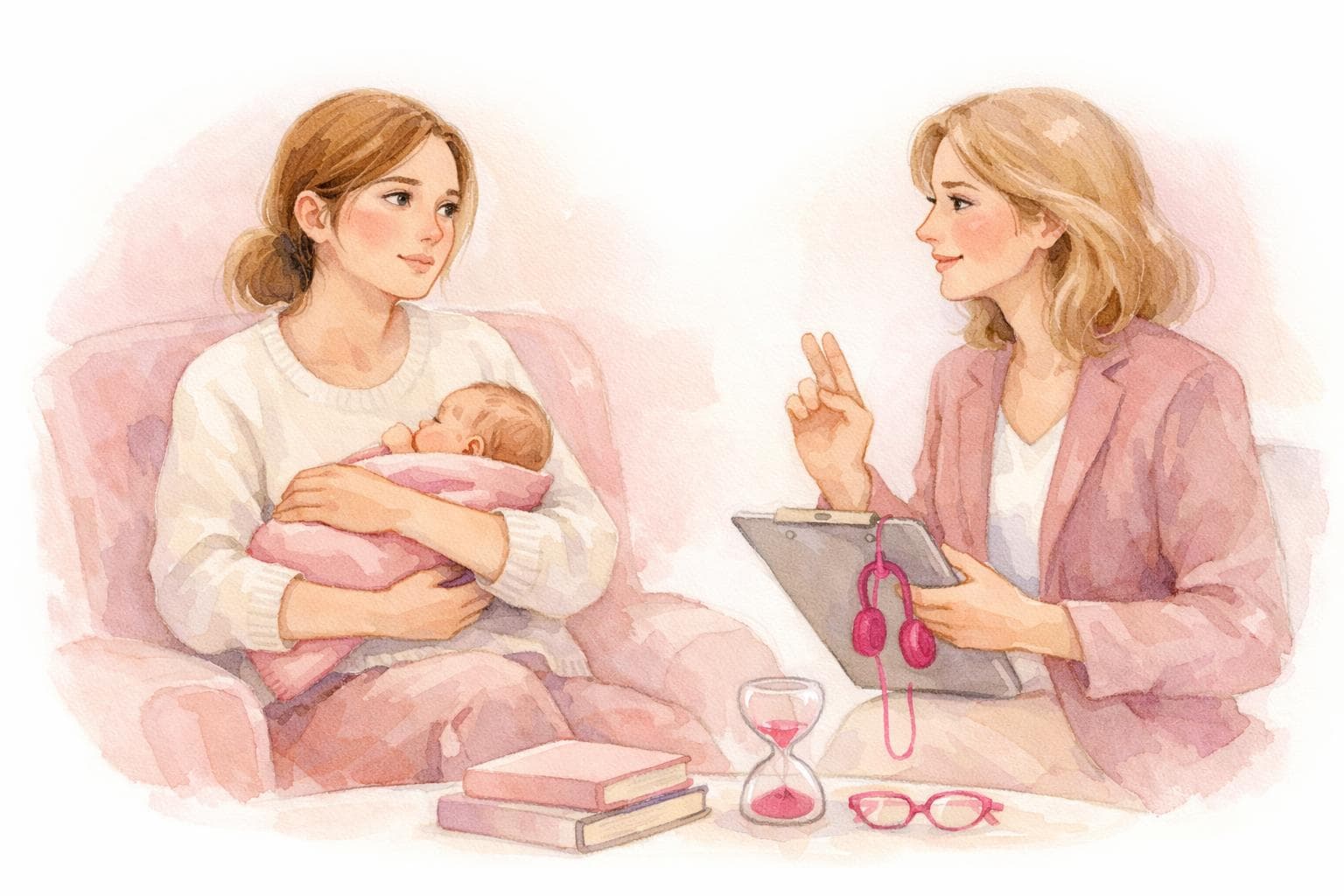

The baby is two weeks old. You're recovering, feeding every two hours, and running on something that resembles neither sleep nor consciousness. And your mother-in-law has announced she's coming to stay for three weeks — because she's "here to help." Your own mother has sent seventeen texts with advice about feeding schedules, swaddling, and whether you should be worried about that sound the baby makes. And your sister-in-law posted a photo of your newborn on Instagram without asking.
Nobody meant harm. And yet here you are, already depleted, now managing everyone else's feelings about your baby while desperately trying to manage your own.
This is the boundary problem in early motherhood — and it's one nobody prepares you for.
Why Boundaries Feel So Much Harder After a Baby
Having a child doesn't just change your life. It reorganises your entire social system. Relationships that were previously settled suddenly require renegotiation: who visits when, how often, what they're allowed to say, what role they play. The arrival of a baby activates deep instincts in extended family members — grandparents especially — and those instincts don't always align with what you actually need.
At the same time, you're least equipped to navigate this while it's happening. The postpartum period involves enormous emotional and physical vulnerability, hormonal upheaval, sleep deprivation, and an identity in flux. Research published in Frontiers in Psychology (2025) confirms that stressful social interactions — including conflict within the family system — directly affect maternal mental health and the mother-infant bonding process during this period. It's not just annoying when family dynamics go wrong in the postpartum weeks. It's measurably harmful.
Grandparental support, when it works well, is genuinely protective. A 2024 study in Journal of Affective Disorders — drawing on 725 Australian women, including 230 with perinatal depression — found that perceived grandparental support significantly reduced depressive symptoms and parenting stress. The keyword is perceived: support that doesn't feel supportive, or that comes packaged with criticism and unsolicited advice, does not produce the same benefit (ScienceDirect, 2024).
What a Boundary Actually Is (and Isn't)
Before we get to scripts and strategies, a reframe that matters. Licensed therapist Nedra Glover Tawwab — whose book Set Boundaries, Find Peace (Penguin, 2021) became a New York Times bestseller — defines boundaries not as walls but as expectations and needs that help you feel safe and comfortable in a relationship.
"People don't have to like, agree with, or understand your boundaries to respect them." — Nedra Glover Tawwab, Set Boundaries, Find Peace
This is worth sitting with. You do not need family members to think your boundary is reasonable. You do not need to justify, explain, or convince anyone. A boundary is a statement about what you need, not a debate to be won.
Tawwab is also honest about the emotional cost: "There is no such thing as guilt-free boundaries." The guilt you feel when you tell your mother you're not ready for visitors, or when you ask your in-laws to call before coming, is real. It doesn't mean the boundary is wrong. It usually means someone has taught you that your needs come after others' feelings — a lesson worth unlearning.
The Most Common Boundary Challenges for New Mothers
The situationWhy it's hard to nameWhat's actually needed
Relatives visiting without calling
Feels rude to mention when they "mean well"
Predictable, limited-contact scheduling
Unsolicited parenting advice
Hard to challenge people with more experience
Space to parent on your own terms
Holding or passing around the baby
Guilt about seeming possessive
To be asked, not assumed
Photos posted without permission
Seems trivial compared to the gesture
Control over your child's digital footprint
Being told how you feel ("you look tired," "you must be struggling")
Difficult to push back without seeming ungrateful
To be asked, not told
Extended stays
Enormous guilt given travel involved
Your home, your timeline
How to Say It Without Starting a War
The most common reason people avoid setting limits with family is the fear that it will damage the relationship. Research on boundaries consistently finds the opposite: resentment from unspoken limits tends to do far more damage than the discomfort of stating them clearly.
Some principles that hold up in practice:
Be specific, not general. "We need space" lands differently than "We're not taking visitors for the first two weeks, and after that we'd love to have you over for one afternoon." Specific limits are easier for people to work with and leave less room for interpretation.
Say it before the situation becomes a problem. A proactive boundary — "We've decided we want the first few days to just be the three of us" — is easier for everyone than a reactive one issued after a boundary has already been crossed.
Separate the care from the limit. You can acknowledge what someone is trying to do and still redirect it. "I love that you want to help — the most useful thing right now is [specific thing]" validates the intention while redirecting the form.
Expect some pushback — and hold the line anyway. Tawwab's research is clear: the pushback you get when you set a limit is almost never really about you. It's about the other person's discomfort with change. Engaging with it — explaining further, apologising, softening the limit — tends to reinforce the pattern. Naming it once, calmly and clearly, and then maintaining it, tends to produce better outcomes over time.
If You're Carrying All of This Alone
One of the most exhausting parts of boundary-setting in the postpartum period is that it often falls to the person who already has the least capacity — the mother. If you have a partner, the negotiation with family is genuinely part of what partnership looks like after having a baby. The load of managing extended family relationships, like the mental load more broadly, lands disproportionately on mothers. Making it visible — and shared — is both fair and practical.
If postpartum anxiety is part of what you're navigating, family boundary difficulties can intensify it significantly. The intrusive quality of well-meaning but overwhelming visitors is a known stressor in this period, and acknowledging that — to yourself, and to a healthcare provider if needed — is important.
You're not protecting yourself at the expense of your family. You're protecting the environment in which you're learning to be a mother. That's a legitimate use of a limit — and you don't need anyone's permission to set one.
Further reading: How to deal with mom guilt without blaming yourself | How to reconnect with your partner as parents | What no one tells you about early motherhood