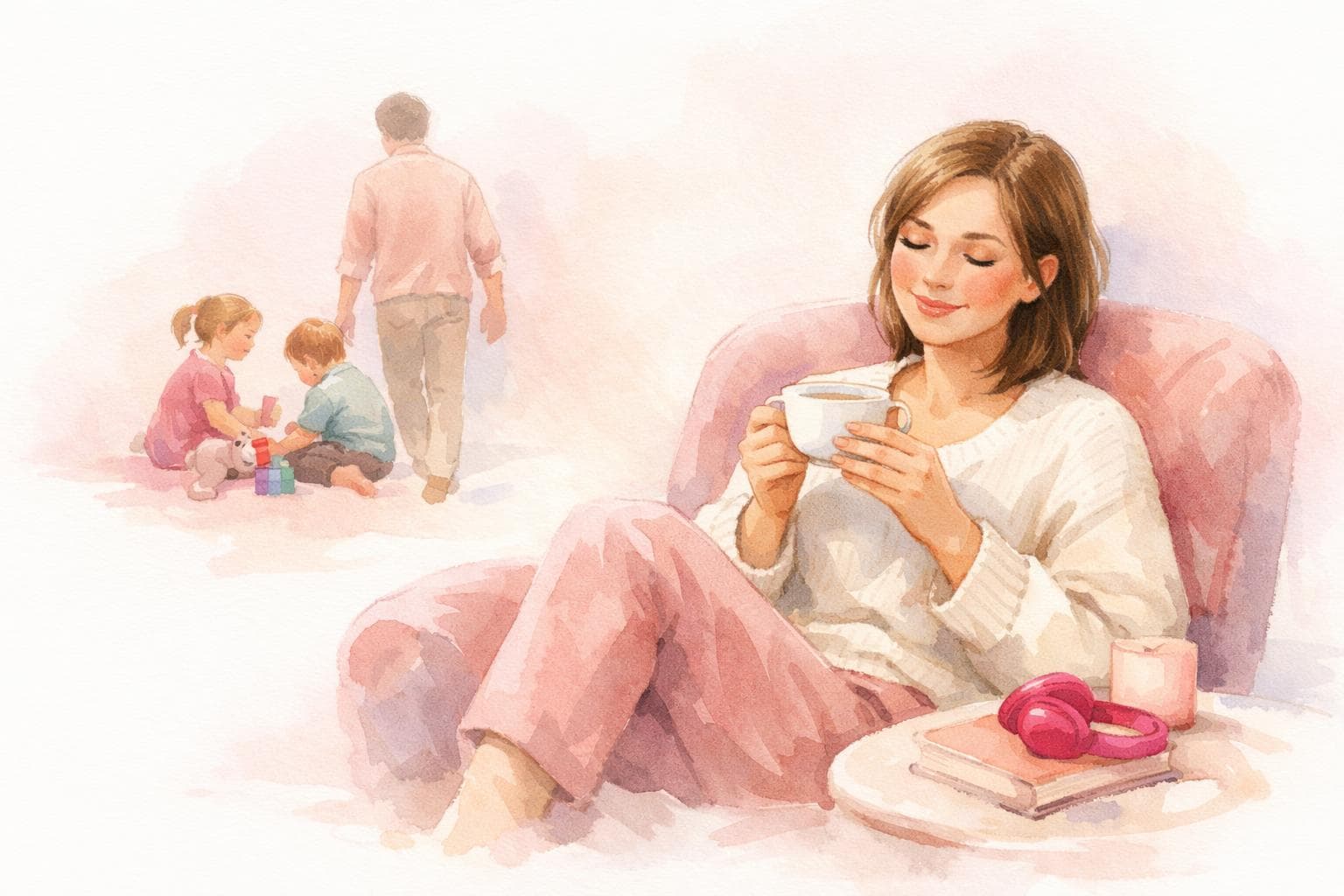
There is a version of alone time that sounds luxurious from the outside and feels from the inside like oxygen.
Not a spa day or a weekend away though those things are also good. The simpler version. Thirty minutes in a house where nobody needs anything from you. A walk where you are not also monitoring someone else's proximity to traffic. Ten minutes in a car engine off before going inside. The specific quiet of being temporarily accountable to no one at all.
For most mothers this kind of time is rarer than sleep, harder to claim than money and more consistently deprioritised than almost anything else on the list. It tends to feel selfish in a way that other needs do not. And that feeling, that it is self-indulgent to want to be alone, tends to keep it from happening even when the need is genuinely acute.
Understanding why alone time is not optional and where the guilt about wanting it comes from, is the beginning of getting it.
Why alone time is a biological need not a preference
The need for solitude is not a personality quirk. It is a neurological requirement.
Neuroscientist and author Matthew Lieberman whose work on the social brain has been influential in understanding how humans process connection and its absence, describes the default mode network: the set of brain regions that become active when we are not focused on an external task. This network is where we make sense of our own experience, consolidate memory, process emotion and construct what psychologists call the narrative self, the ongoing story of who we are and what our life means.
The default mode network activates during solitude and relative quiet. It does not activate during caregiving, managing other people's needs or monitoring external demands. Which means that a mother who has no genuine alone time has a nervous system that is never completing the basic processing cycle that regulates emotion, consolidates experience and maintains psychological coherence.
A 2016 study published in Frontiers in Psychology found that the absence of genuine solitude was associated with increased emotional reactivity, reduced sense of personal clarity and diminished ability to regulate mood, independent of sleep quality and general stress levels. The alone time was doing something that nothing else was doing.
Why mothers find it hardest to claim
Two reasons operating together.
The first is practical. Mothers are statistically more likely than fathers to be primary caregivers and to have less unstructured time that belongs entirely to them. Research from the Office for National Statistics in the UK found that mothers of children under five reported an average of 68 minutes of unstructured personal time per day, compared to 107 minutes for fathers in equivalent households. The alone time is simply less available.
The second is psychological. Even when time is theoretically available, many mothers find it genuinely difficult to occupy without guilt or the ambient awareness of everything that could be being done instead. The permission to be unproductive and unaccountable, to exist temporarily outside the caregiving role is something that has to be actively claimed rather than simply accessed.
Research on the psychology of leisure and personal time in mothers including work by sociologist Deb Gruenfeld at Stanford found that the quality of rest and personal time in mothers was significantly compromised by what she described as "anticipatory guilt": the sense of obligation toward unmet tasks or others' needs that makes even genuine downtime feel conditional and incomplete.
What alone time actually does
Not what the surface description suggests. Not just rest.
- Emotional processing. Difficult or intense emotional experiences require time and quiet to be metabolised. Without it, they accumulate.
- Identity maintenance. Sustained contact with your own thoughts, preferences and inner life is what keeps the self coherent over time. It is harder to know who you are when you are never alone with yourself.
- Nervous system regulation. The physiological downregulation that reduces cortisol and restores baseline functioning requires conditions that sustained social demand prevents.
- Creative and cognitive restoration. Complex thought, planning, problem-solving and creative processing all benefit from the undistracted attentional state that solitude produces.
- The experience of being a full person. Not a role. Not a function. A person who exists independently of what they are providing to others.
How to actually get it in conditions that are not ideal
The idealised version | The realistic version that actually helps |
|---|---|
A full day alone to do whatever you like | Twenty minutes in a parked car before going inside |
Regular uninterrupted evenings | One evening a week that is genuinely protected |
A morning routine before anyone wakes | Getting up fifteen minutes earlier than necessary |
Time carved out by a supportive partner automatically | A specific, explicit conversation about what you need and when |
Alone time that feels guilt-free immediately | Alone time that feels slightly uncomfortable and is worth having anyway |
The conversation with a partner deserves specific attention. Alone time particularly for mothers who are primary caregivers tends not to arrive unless it is explicitly requested and arranged. Not hinted at, not hoped for, but asked for clearly: "I need two hours on Saturday morning where I am not responsible for the children." That conversation is harder than it should be and worth having anyway. How to communicate your needs as a mom has a framework for exactly this kind of request.
On the guilt
The guilt about wanting to be alone tends to rest on an implicit belief: that a good mother should always prefer to be with her children. That the desire for solitude is evidence of insufficient love.
This belief is not supported by any research and is contradicted by a great deal of it. Mothers who have regular alone time show better emotional regulation, lower rates of burnout and more positive interactions with their children than those who do not.
"Loneliness is the poverty of self; solitude is the richness of self." - May Sarton
Wanting to be alone sometimes is not the opposite of loving your children. It is part of what makes the loving sustainable.
If the guilt is a significant obstacle, how to prioritise yourself without guilt addresses the internal architecture of that pattern. And if the exhaustion underneath the need for alone time goes deeper than a few quiet hours can reach, emotional exhaustion in motherhood: what it really means is worth reading alongside this.
You need to be alone sometimes. That is not a character flaw. It is a requirement.
Further reading: Ester Buchholz, The call of solitude: alonetime in a world of attachment (1997). Susan Cain, Quiet: the power of introverts in a world that can't stop talking (2012). Matthew Walker, Why we sleep (2017).