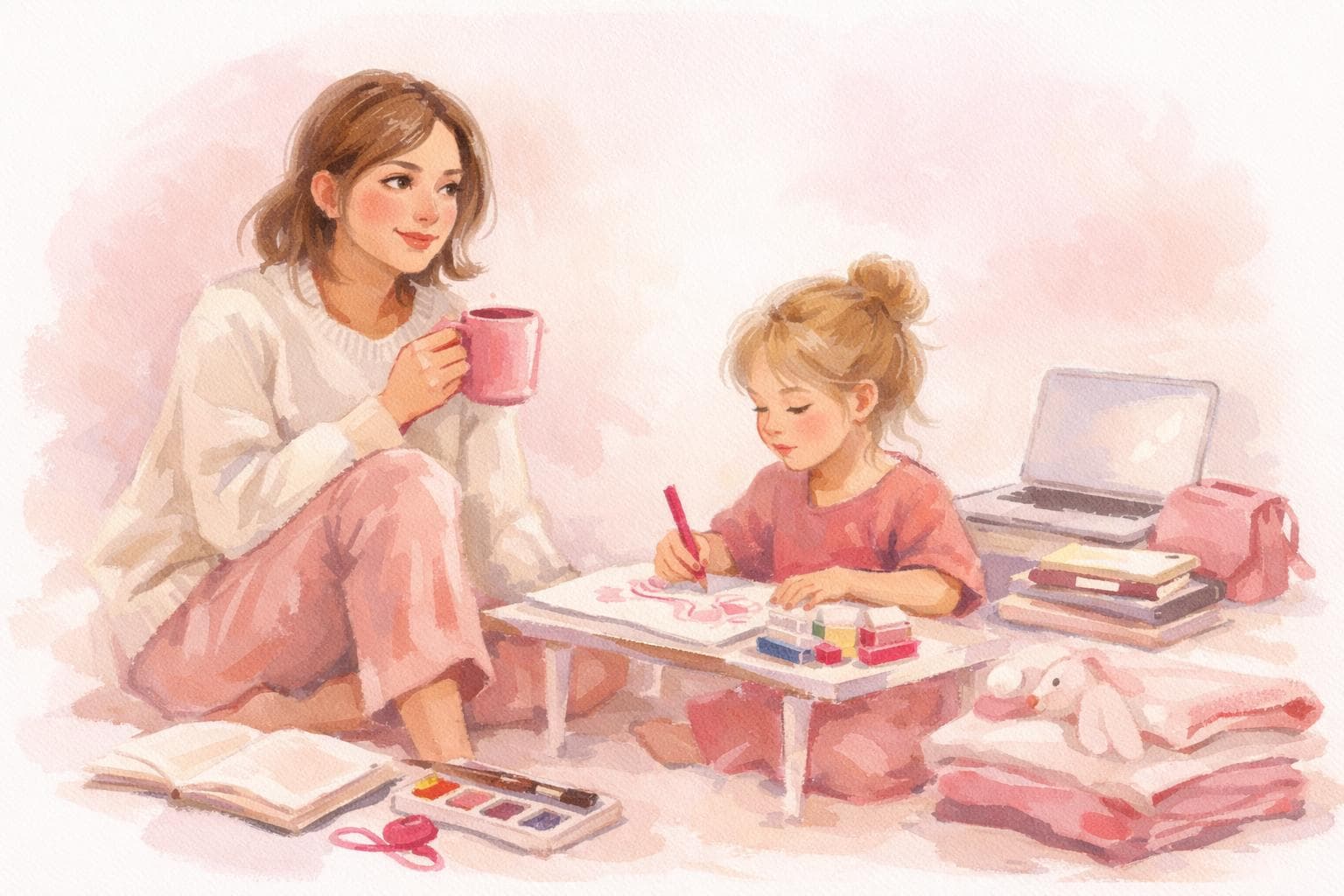
Creativity was the first thing I let go of when I had children.
Not deliberately. Not with the thought: I am choosing to give this up. It happened in the way that most things disappear in early parenthood, gradually and without a specific moment you can point to. One week I did not paint because I was too tired. The next week the paints were still out but I walked past them. By the time the month was over they were in a cupboard somewhere and I had stopped thinking about it.
For a long time I treated that loss as one of the unremarkable costs of the chapter I was in. The kind of thing you pick up again later, when life is less full. What I did not understand then is that life never becomes less full. It becomes full in different ways. And waiting for a future window that contains both adequate time and adequate energy is, for most people, a form of indefinite deferral.
Why creativity matters more than it seems
The case for creative expression tends to get framed in terms that feel optional: it is good for you, it is fulfilling, it makes life richer. All of those things are true. The research behind them is more robust than the framing suggests.
Psychologist Mihaly Csikszentmihalyi, whose decades of work on the experience of flow produced some of the most replicated findings in positive psychology, identified creative engagement as one of the primary routes to what he called optimal experience: the state of absorbed, effortless focus that produces both immediate satisfaction and long-term wellbeing. His research, published in Flow: the psychology of optimal experience (1990), found that people who regularly accessed this state reported significantly higher life satisfaction across every demographic he studied.
What matters for mothers specifically is that creative engagement provides a quality of experience that caregiving, for all its meaning, tends not to produce. It is self-directed. Its output belongs to you. The feedback is immediate. And it requires, at its best, the kind of full absorption in something that gives the part of the brain that monitors other people's needs a temporary holiday.
A 2016 study published in the Journal of Positive Psychology found that everyday creative activities, including drawing, writing, crafting and cooking with attention, were associated with higher positive affect and flourishing the following day. The effect was consistent regardless of skill level or the scale of the creative act.
What actually prevents it
Not time, primarily. Or not only time. Three other things tend to be equally significant.
The permission problem. Creativity for many mothers feels less like a need than a luxury, and luxuries require justification in a way that necessities do not. The belief that creative time is indulgent, that it should come after everything else is done, keeps it permanently at the end of a queue it never reaches.
The performance anxiety problem. The creative self that existed before children was practised. The returning one is rusty, and rustiness in creative work can feel like permanent loss of ability rather than the temporary gap it almost always is. Fear of being bad at something we used to do well keeps many people from starting again.
The context problem. The conditions that supported creativity before, uninterrupted time, physical space, the mental availability to be absorbed, have changed significantly. Trying to recreate those conditions rather than finding the formats that work within the current ones tends to produce waiting rather than making.
How to actually make space for it
Not by finding more time. By changing the format.
Shrink the version. The painting that took two hours becomes a twenty-minute sketch. The novel becomes a paragraph in a notebook. The elaborate meal becomes one genuinely attentive, deliberately made thing on a Tuesday. The shrunken version is not the lesser version. It is the version that actually happens.
Attach it to something that already exists. A journal kept next to the bed, opened for five minutes before sleep. A podcast listened to while doing the school run that keeps you connected to ideas and conversation. Drawing during the children's activities rather than scrolling. The creative act embedded in the existing routine has a dramatically higher completion rate than the one that requires its own dedicated slot.
Separate making from judging. One of the most consistent findings in creativity research is that the evaluative function, the internal critic that assesses whether the thing being made is good, suppresses creative output. Deliberately separating the making phase from the judging phase, producing first and evaluating after, removes the most significant internal barrier most people face.
Allow mess and incompleteness. A creative project that is started and unfinished is not a failure. It is evidence of a creative life. The culture around creativity tends to valorise outputs rather than processes, which makes partial projects feel like defeats. Changing that standard changes what feels possible.
The thing about waiting for the right moment
The waiting version | The working version |
|---|---|
Waiting until the children are older | Starting with whatever the current season allows |
Waiting until there is more time | Finding the format that fits the time that exists |
Waiting until you feel ready | Beginning before readiness, and finding it on the other side |
Waiting for a dedicated space | Making do with the kitchen table and noise-cancelling headphones |
Waiting until it can be done properly | Doing the imperfect version because imperfect is what exists |
"You can't use up creativity. The more you use, the more you have." - Maya Angelou
If part of what is getting in the way is a more general loss of the self that used to make things, how to feel like yourself again after kids addresses the retrieval of that self from a wider angle. And if the guilt of taking time for something that feels non-essential is the more immediate obstacle, how to prioritise yourself without guilt is the companion piece that addresses the internal permission directly.
Make something small today. Not because it will be good. Because making things is part of what makes you you.
Further reading: Mihaly Csikszentmihalyi, Flow: the psychology of optimal experience (1990). Julia Cameron, The artist's way (1992). Elizabeth Gilbert, Big magic: creative living beyond fear (2015).