
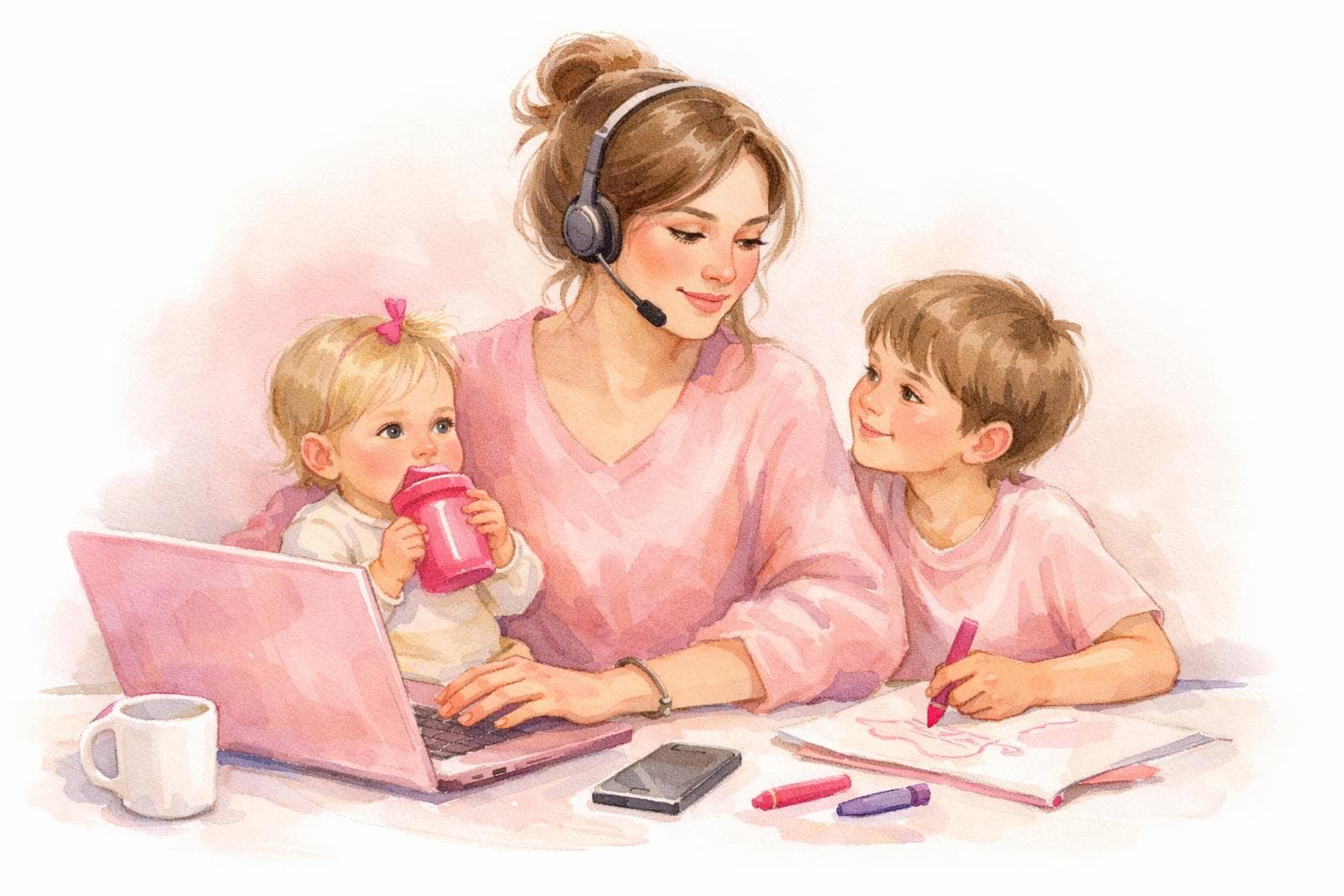
The word sounds like freedom. Mompreneur. Your own hours. Your own rules. Your own kitchen table doubling as a headquarters while the baby naps.
Then it is 11pm. The baby did not nap. You are behind on a client deadline, the house looks like a crime scene and you cannot remember the last time you did something that was not work or mothering. The Instagram version and the lived version are not even in the same postcode.
A mompreneur is a woman who builds and runs a business while simultaneously being the primary caregiver for her children. In 2026, mompreneurs represent a growing share of new business owners: women now start 49% of all new US businesses, a 69% increase from 29% in 2019. There are 14.5 million women-owned businesses in the United States, generating $3.3 trillion in revenue. Yet the average revenue for a woman-owned business is $226,000, well below the average for male-owned firms, and the vast majority are one-person operations without employees.
This article covers what the mompreneur economy actually looks like in 2026, what moms earn, what burns them out and what the alternatives are.
The numbers behind the movement
Statistic | Source |
|---|---|
Women start 49% of all new US businesses (up from 29% in 2019) | Gusto 2025 New Business Formation Report |
14.5 million women-owned businesses in the US | Wells Fargo 2025 Impact Report |
Women-owned businesses generate $3.3 trillion in revenue | Wells Fargo 2025 |
Average revenue for women-owned businesses: $226,000 | Wells Fargo 2025 |
1 in 4 women plan to start a business in 2026 | Intuit QuickBooks (n=3,000) |
70% of new female business owners cite flexibility as their primary motivation | Gusto 2025 |
Women are 47% more likely than men to close a business due to family reasons | GEM 2024/2025 |
The growth is real. But so is the revenue gap. Wells Fargo estimates that if women-owned businesses matched the average revenue of male-owned firms, it would add $10.2 trillion annually to the US economy. The gap is not about ambition. It is about structure: access to funding, childcare, time and the compounding cost of being the default parent.
"Women aren't less ambitious than men; rather, they're more deliberate, building lean, tech-enabled businesses that prioritize stability over acceleration and household stability over leverage." - Intuit QuickBooks (2026)
Mompreneur vs employed remote worker vs freelancer
This comparison matters because many mothers use "mompreneur" as a catch-all when they are actually freelancing or working remotely. The distinction affects income, benefits, risk and burnout.
Mompreneur (business owner) | Remote employee | Freelancer | |
|---|---|---|---|
Income source | Clients, product sales, passive revenue | Employer salary | Client projects |
Income stability | Variable; no guaranteed income | Stable; regular pay cheque | Variable; depends on client pipeline |
Benefits | None unless self-arranged | Often includes health insurance, pension, parental leave | None unless self-arranged |
Schedule control | Full; but business demands often override | Partial; employer sets expectations | High; but deadlines are non-negotiable |
Ceiling | Unlimited in theory; most earn modestly | Capped by salary band | Capped by available hours |
Burnout risk | Highest; no separation between roles | Moderate; some role boundaries exist | High; no safety net, constant pitching |
Startup cost | Variable ($0 to $10,000+) | $0 | $0 to $50 |
Best for | Moms with a product, service or brand to scale | Moms who need stability and benefits | Moms who need flexibility and quick income |
If you are unsure which route suits your season, our guide to 14 proven ways SAHMs make real money from home covers each path with realistic earnings. And our fully remote jobs guide for SAHMs includes 18 employed roles with application tips for career gaps.
What mompreneurs actually earn
The income picture is less inspiring than the headlines suggest. Side Hustle Nation's 2026 survey found that the average side hustle earns $1,122 per month, but the median is $200. Half of all side hustlers earn less than $100 monthly.
Income level | What it typically requires | Timeline |
|---|---|---|
Under $500/month | Early-stage service work or first digital products | Months 1 to 3 |
$500 to $2,000/month | 2 to 5 recurring clients, 10 to 15 hours/week | 3 to 6 months |
$2,000 to $5,000/month | Established client base or scaled product catalogue | 6 to 18 months |
$5,000+/month | Team, systems, significant passive income streams | 12+ months of sustained investment |
For real profiles with actual numbers, our SAHM income playbook shows what 12 mothers earn at each level.
The burnout nobody photographs
A 2025 study in Entrepreneurship and Regional Development found that motherhood acts as both a catalyst and a constraint for entrepreneurship. Mothers held competing versions of themselves: the hoped self (successful, independent), the feared self (neglectful, selfish) and the ought self (the version everyone expects).
The US Surgeon General's 2024 advisory named parental burnout a significant public health concern. Pew Research (2023) found that 41% of parents describe parenting as tiring and 29% as stressful most of the time. Layer a business on top and the pressure compounds.
Mompreneur burnout has specific patterns:
- No sick days. When you are the business, stopping means no income
- No boundaries. The kitchen table is both the office and the dinner table
- No external validation. Nobody gives you a performance review or a "well done"
- Guilt in both directions. Working means guilt about children; playing means guilt about the business
If this sounds familiar, our guide to emotional exhaustion in motherhood names what you might be carrying. And if the burnout is already affecting your ability to function, therapy is worth considering before it gets worse.
The funding gap
Only 2.3% of global venture capital went to female-only founding teams in 2024, compared to 83.6% for all-male teams. Intuit QuickBooks found that 55% of women with children cite finding money for initial expenses as the top barrier to starting a business.
Most mompreneurs bootstrap. That means slower growth, longer hours and a longer road to profitability. It also means the businesses that survive tend to be lean, practical and built around real demand.
Is the word "mompreneur" even helpful?
A man running a business while parenting is not called a "dadpreneur." He is called a founder. The term bundles motherhood and business into a single identity, which means neither gets taken fully seriously.
Some women embrace the label. Others reject it as diminishing. What matters is not what you call yourself but whether the business serves your life or consumes it.
If you are building a public presence alongside your business, our guide to building a personal brand as a mom explores how to start without losing yourself. And if MLM recruiters have already found your inbox, this article explains how to spot the traps before you commit.
Key takeaways
- Women now start 49% of all new US businesses, up from 29% in 2019, but average revenue for women-owned firms ($226,000) remains well below male-owned firms.
- The median side-hustle income is $200/month, not the $1,122 average that headlines report; half of all side hustlers earn less than $100 monthly.
- Mompreneur burnout is structurally different from employee burnout: no sick days, no boundaries, no external validation and guilt in both directions.
- The funding gap is severe: only 2.3% of global VC goes to all-female founding teams.
- Before calling yourself a mompreneur, compare the three paths (business owner, remote employee, freelancer) and choose the one that fits your current season, not just your long-term ambition.
Sources and further reading
- Gusto. (2025). 2025 New Business Formation Report: women are on par with men. gusto.com
- Wells Fargo. (2025). The 2025 Impact of Women-Owned Businesses Report. Cited in Founder Reports.
- Intuit QuickBooks. (2026). Women Entrepreneurs 2026: trends in funding, AI, and growth. quickbooks.intuit.com
- Empower. (2026). Leading the way: female entrepreneurship is up 69%. empower.com
- Entrepreneurship and Regional Development. (2025). Entrepreneuring mothers' identity work from the perspective of possible selves. tandfonline.com
- Side Hustle Nation. (2026). Side hustle statistics 2026. sidehustlenation.com
- US Surgeon General. (2024). Advisory on the mental health and well-being of parents.
- GEM. (2025). 2024/2025 Women's Entrepreneurship Report. gemconsortium.org