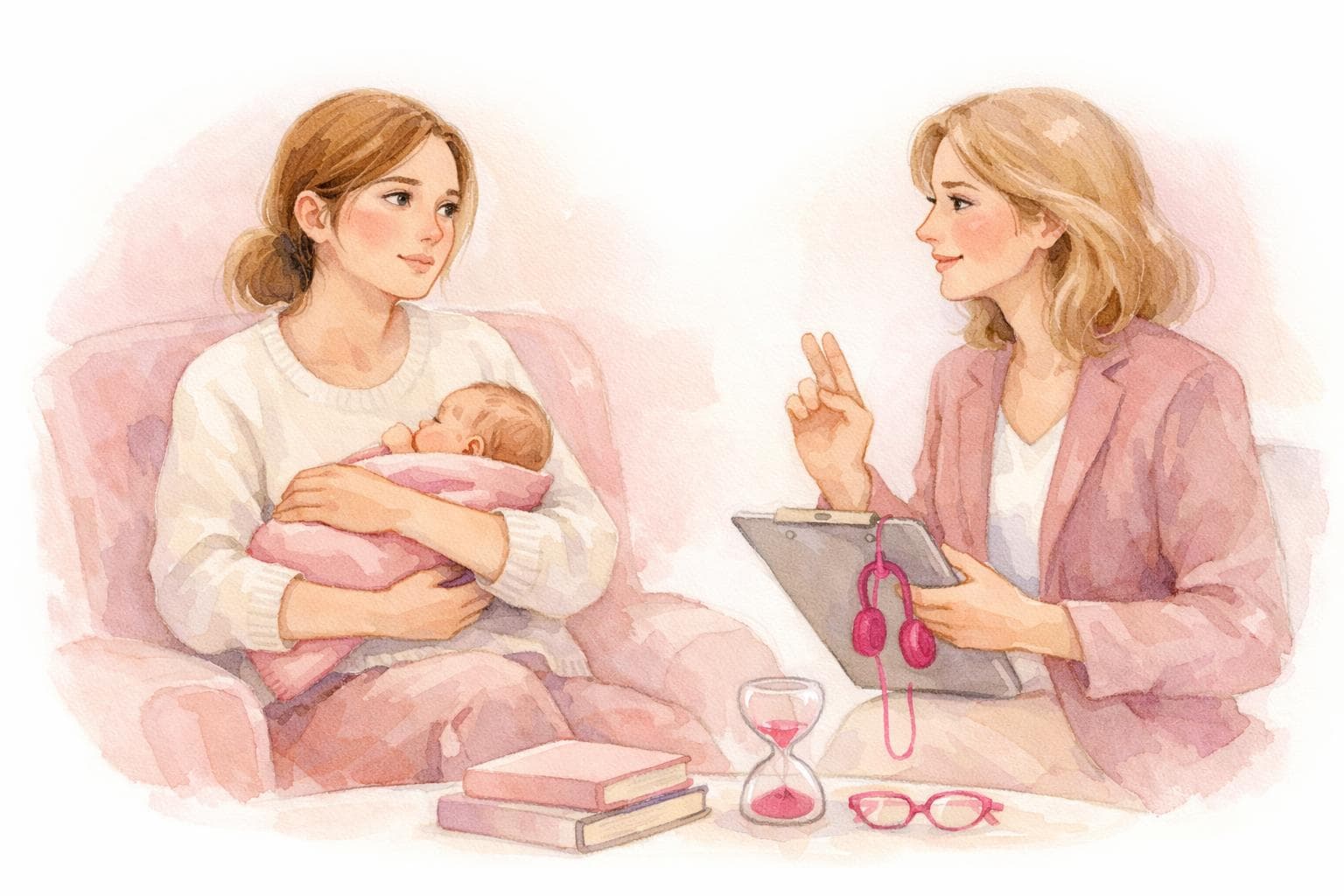

You have been referred. Maybe your GP sent the letter. Maybe your health visitor flagged something on a screening form. Maybe you asked for help yourself, which took more courage than anyone around you realises.
Now there is an appointment in your diary and a knot in your stomach. You do not know what to expect. You are not sure what they will ask. You are worried about saying the wrong thing, or the right thing, or too much.
Here is what actually happens, step by step, so you can walk in knowing what is coming.
How referrals work
Most perinatal mental health referrals come from three sources: your GP, your midwife or your health visitor. In the UK, specialist perinatal community mental health teams (SPCMHTs) accept referrals for women from pregnancy through 12 months postpartum. In the US, the route typically goes through your OB-GYN, paediatrician or primary care provider.
A 2024 service evaluation of one UK perinatal team found that midwives and GPs made the greatest number of referrals (37% and 26% respectively). Not all referrals are accepted: in that study, 47 out of 263 did not meet criteria for specialist assessment and were redirected to primary care services.
This does not mean your referral will be rejected. It means the system triages. If your symptoms are mild to moderate, you may be offered support through talking therapies or your GP rather than the specialist team. If your symptoms are moderate to severe or complex, you will be offered a full assessment.
How long you will wait
This varies widely. NICE guidelines recommend that women referred for psychological interventions in the perinatal period should be assessed within 2 weeks and begin treatment within 6 weeks of referral.
A 2024 audit of one UK specialist team found that the average waiting time from referral to assessment was approximately 30 days. Some women waited as little as a week. Others waited over five months. The reality depends on your area, the team's capacity and the urgency of your presentation.
If you are struggling while you wait, that gap is not dead time. You can use it. Our guides to CBT for postpartum depression and what to do after your EPDS score include self-help strategies and digital tools that can support you during the wait.
What happens at the assessment itself
A perinatal mental health assessment is a structured clinical conversation. It is not a test. There are no right or wrong answers. The clinician is trying to understand what you are experiencing so they can recommend the right support.
Here is what you can expect:
The questions they will ask
Topic area | What they want to know |
|---|---|
Current symptoms | How you are feeling now: mood, sleep, anxiety, energy, appetite, concentration |
Timeline | When the symptoms started, whether they fluctuate, what makes them better or worse |
Birth experience | How the delivery went, whether it was traumatic, how you feel about it now |
Bonding | How you feel about your baby, whether connecting feels natural or forced |
Intrusive thoughts | Whether you experience unwanted, distressing thoughts about harm to yourself or your baby |
Previous mental health history | Any past episodes of depression, anxiety, OCD, psychosis or self-harm |
Family psychiatric history | Whether close relatives have experienced mental health conditions |
Substance use | Alcohol, drugs, prescribed medication |
Social support | Who is around you, whether you feel supported, relationship quality |
Risk | Thoughts of self-harm or suicide, any plans, any previous attempts |
The risk questions can feel confronting. But they are routine. Every perinatal assessment includes them because the clinician needs to understand the full picture. Answering honestly does not mean your baby will be taken away. It means you will receive the level of care that matches your actual needs.
"Perinatal mental health is a crucial but frequently overlooked and neglected element of maternal and infant care. WHO estimates that approximately 10% of pregnant women and 13% of those who have just given birth will develop a mental health disorder." — eClinicalMedicine / The Lancet (2024)
The tools they may use
In addition to the conversation, your clinician may ask you to complete one or more standardised questionnaires:
- EPDS (Edinburgh Postnatal Depression Scale) for depression screening. Our EPDS guide explains every question and what the scores mean.
- GAD-7 for generalised anxiety. Our article on postpartum anxiety screening explains why this matters alongside the EPDS.
- PHQ-9 for depression severity in some services.
- A clinical interview (such as the M.I.N.I.) for formal diagnostic assessment if a specific condition is suspected.
The Canadian Network for Mood and Anxiety Treatments published comprehensive 2024 clinical practice guidelines for perinatal mood and anxiety disorders, recommending that assessment should cover depression, anxiety, PTSD, OCD and psychosis, not just depression alone.
Who you will see
The professional conducting your assessment depends on the service.
Professional | What they do |
|---|---|
Perinatal psychiatrist | Diagnoses complex conditions, prescribes medication, manages severe presentations |
Clinical psychologist | Conducts detailed psychological assessment, delivers therapy (CBT, EMDR, IPT) |
Perinatal mental health nurse | Coordinates care, provides support, monitors progress between appointments |
Specialist midwife | Bridges maternity and mental health care, often the first contact |
Social worker | Assesses safeguarding needs, connects you with community support |
In many teams, your first assessment will be with a nurse or psychologist. A psychiatrist is involved when medication is needed or the presentation is complex. Our guide to choosing the right mental health provider explains the differences in detail.
What happens after the assessment
After the assessment, the clinician will discuss their findings with you and recommend a care plan. This typically includes one or more of the following:
- Talking therapy (CBT, IPT, EMDR) delivered individually or in a group
- Medication (usually SSRIs) prescribed and monitored by the team
- Crisis planning if risk was identified
- Follow-up appointments to review progress
- Discharge back to GP with recommendations if the specialist team is not needed long term
The 2024 CANMAT guidelines recommend that treatment selection consider symptom severity, patient preference, breastfeeding status and access to services. You have a say in your care plan. If something does not feel right, you are allowed to ask questions, request alternatives or ask for a second opinion.
What they will not do
A perinatal mental health assessment will not:
- Judge your parenting
- Remove your baby
- Force you to take medication
- Put anything on a permanent record that prevents you from working with children
- Dismiss your experience because your baby is healthy
These fears are common and they keep women away from services. A UK referral study found that women who had experienced domestic abuse were more likely to miss their assessment appointment, suggesting that fear and vulnerability create barriers even after a referral is made.
If fear is what is stopping you, know this: the team exists to help you, not to evaluate your fitness as a mother. Their job is to get you well. That is all.
How to prepare
You do not need to prepare a speech. But having a few things ready can help you feel more grounded:
- Write down your main symptoms and when they started
- Note any medication you are currently taking
- Bring your baby if you have no childcare; most services expect this
- Ask someone to come with you if that helps; a partner, a friend, your own mother
- If you have already taken the EPDS, bring the score
And if you are nervous about being honest, remember: the clinician has heard everything before. Your intrusive thoughts, your ambivalence, your darkest moments. None of it will shock them. And all of it helps them help you.
If you are still weighing whether to pursue a referral at all, our article on why every new mom should consider therapy makes the case for acting before things get worse. And how to ask for help without feeling weak is written for exactly the moment before you pick up the phone.
You are not going to be judged. You are going to be heard. And that is where healing begins.
Sources and further reading
- Best, F. & Dakroury, M. (2024). An evaluation of referrals and attendance at a perinatal specialist mental health service. BJPsych Open. pmc.ncbi.nlm.nih.gov
- Ibiwoye, O. & Joshi, S. (2024). The time to psychology assessment and provision of psychological interventions for perinatal women. BJPsych Open. pmc.ncbi.nlm.nih.gov
- CANMAT. (2024). Clinical practice guideline for the management of perinatal mood, anxiety, and related disorders. Canadian Journal of Psychiatry / PMC. pmc.ncbi.nlm.nih.gov
- eClinicalMedicine / The Lancet. (2024). Safeguarding maternal mental health in the perinatal period. pmc.ncbi.nlm.nih.gov
- NICE. (2014, updated 2020). Antenatal and postnatal mental health: clinical management and service guidance. nice.org.uk
- Postpartum Support International: postpartum.net