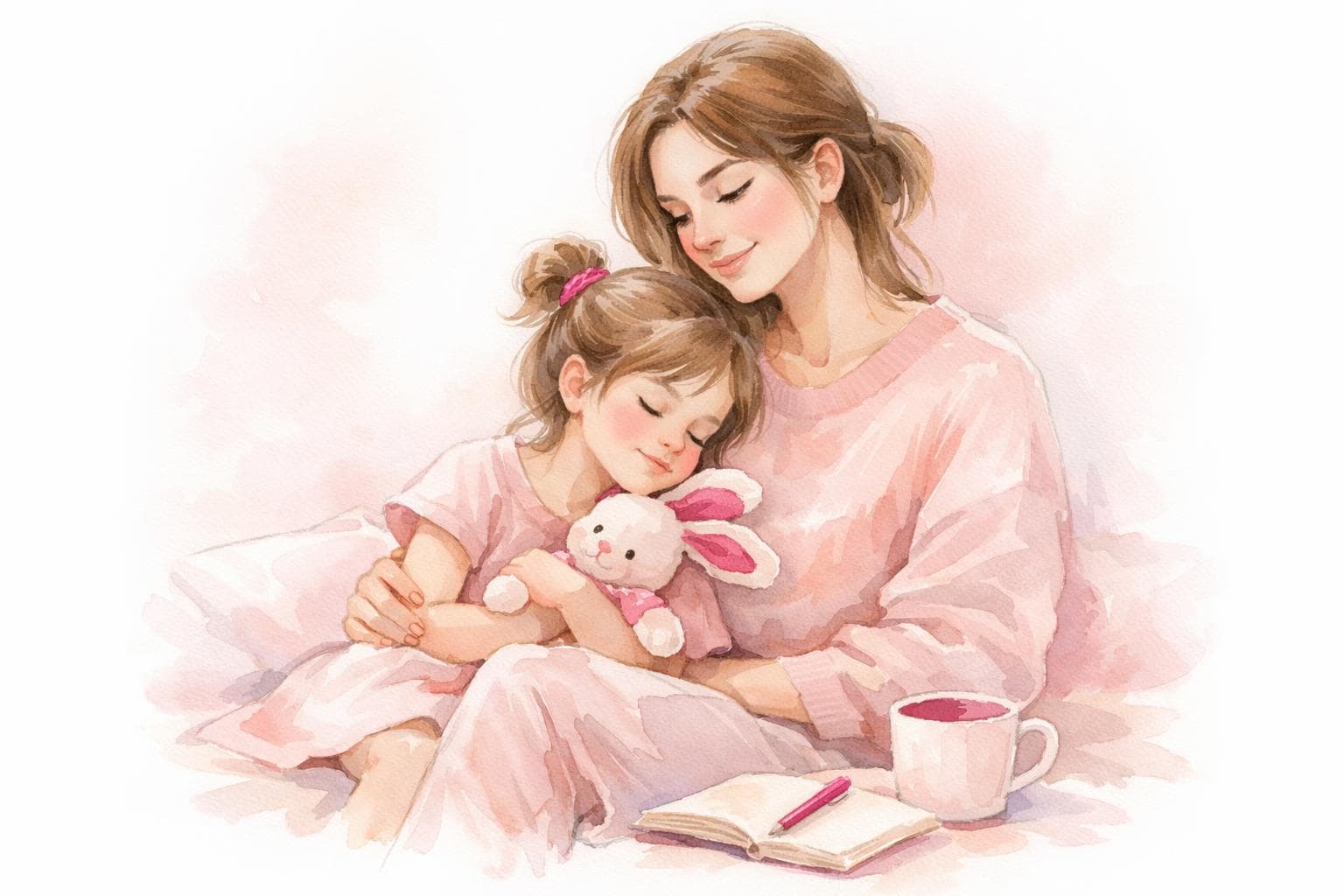
There is a particular kind of tiredness that comes from being the only adult in the house.
Not just the physical tiredness of doing everything, though that is real and significant. It is the tiredness of being the one who makes every decision, absorbs every piece of information the children bring home and has no one to hand any of it to at the end of the day. The tiredness of not being able to say, to someone who is equally invested, "did you see what she did today?" and have them already know the whole picture.
Single motherhood is one of the most demanding human experiences, and one of the least romanticised or adequately supported. The cultural conversation tends to veer between extremes: either the superhero narrative (she does it all and somehow thrives) or the deficit narrative (the children are missing something essential). Neither of those is useful. What is useful is an honest conversation about what single motherhood actually requires, and what protects a mother's sense of self inside it.
The landscape of single motherhood today
Single-parent families are not a minority experience. In the UK, there are approximately 1.8 million single parents, over 85% of whom are women. In the US, the figure is around 15.6 million single-parent families, with single mothers heading the vast majority. These numbers represent an enormous portion of the parenting population, yet much of the practical and psychological support infrastructure still operates as though two adults are the default.
The financial dimension of single motherhood is significant and cannot be separated from the emotional and psychological one. Research from the Joseph Rowntree Foundation found that single parents in the UK face a substantially higher poverty risk than couple families, with the combination of a single income and the cost of childcare creating a structural inequality that affects every other dimension of wellbeing. Stress about money is not separate from stress about everything else. They compound.
A 2020 study published in the Journal of Family Issues found that single mothers reported significantly higher rates of parental burnout than partnered mothers, with the primary drivers being lack of social support, limited recovery time and the chronic absence of an adult to share the cognitive and emotional load.
None of this is said to diminish what single mothers accomplish. It is said to name the actual conditions, because solutions that don't account for the actual conditions don't work.
The identity question that single motherhood intensifies
When there is no partner in the picture, the role of mother can expand to fill every available space. Not because single mothers are less boundaried than partnered ones, but because the structural conditions of doing it alone leave fewer natural interruptions to the caregiving role.
The evenings that partnered parents use to decompress together, to talk about something other than the children, to remember each other as people rather than co-managers, don't exist in the same way for a single parent. The moments of being seen as a full person rather than primarily as a mother are rarer and require more deliberate effort to find.
This is where the "without losing yourself" part of the conversation becomes practical rather than aspirational. Not self-care in the spa sense. Self-continuity: the maintenance of enough threads of your own identity that you remain recognisably yourself through the demands of the role.
What that tends to require:
- At least one relationship where you are known as a full person. Not a co-parent relationship, not a logistics-based friendship, but someone who knows what you think and feel and care about beyond your children.
- Something in your week that is yours. A practice, an interest, even a regular phone call. Something you'd describe as belonging to you rather than to the household.
- Permission to have needs that are separate from the children's. This sounds obvious and is, in practice, very difficult. The structure of single parenting can make a mother's needs feel entirely subordinate for years at a stretch.
- A clear-eyed view of what you can actually sustain. Saying no to things that are genuinely beyond your current capacity is not failure. It is resource management in a context where the resources are limited.
The support question
Most single mothers describe being told, at some point, to "ask for help." The advice is well-intentioned and frequently useless, because it doesn't account for the fact that building and maintaining a support network takes time and energy that single mothers are often not in surplus of.
What works | Why |
|---|---|
Specific, time-limited requests | "Can you pick up the kids on Thursday" is easier to ask and easier to respond to than "I need more support" |
Reciprocal arrangements with other parents | Swapping childcare removes the power imbalance of always receiving |
Local or online communities of single parents | Peer support from people in the same situation reduces isolation |
Accepting that the support network will be imperfect | Waiting for the ideal network means waiting a very long time |
Professional support when needed | A therapist, a financial adviser, a GP who knows your situation |
The loneliness that single motherhood can produce is real and worth taking seriously. If it has become persistent rather than situational, Loneliness in motherhood: why it happens and how to find connection addresses it specifically and with more depth than there is space for here.
On guilt and the impossible standard
Single mothers carry a particular kind of guilt: not just the ordinary maternal guilt about choices and adequacy, but a guilt rooted in the belief that their children are missing something by virtue of the family structure itself.
The research on this is more nuanced than the cultural narrative. A 2019 meta-analysis in Psychological Bulletin found that children's outcomes are more strongly predicted by economic stability, parenting quality and social support than by family structure per se. A child in a stable, warm single-parent household with adequate support has better outcomes than one in a two-parent household characterised by conflict, instability or emotional unavailability.
The structure is not the deciding factor. The environment is.
"You don't have to have it all figured out to move forward." - Unknown
If the emotional weight of doing this alone has become something that feels too large to manage by yourself, How therapy can help moms who feel stuck makes the case for getting support without making it feel like an admission of defeat. And if the question of who you are beneath the role has become genuinely hard to answer, How to feel like yourself again after kids is worth reading as a companion.
You are doing something genuinely hard. That deserves acknowledgment, not from anyone else in particular, but from you, to yourself, regularly and without qualification.
Further reading: Emma Johnson, The kickass single mom (2017). Rachel Sarah, Single mom seeking (2006). Joseph Rowntree Foundation, Poverty and single parents in the UK (2023 report).