There's a version of single motherhood that gets held up as aspirational. She does it all. She never complains. She is strong for her children and somehow also maintains her career, her friendships, her sense of humour and a reasonably tidy house. She has become, through necessity, completely self-sufficient.
That version is not aspirational. It is exhausting. And it is built on a foundation of self-erasure that tends to crack eventually, usually quietly, in ways that are hard to explain to anyone who hasn't lived it.
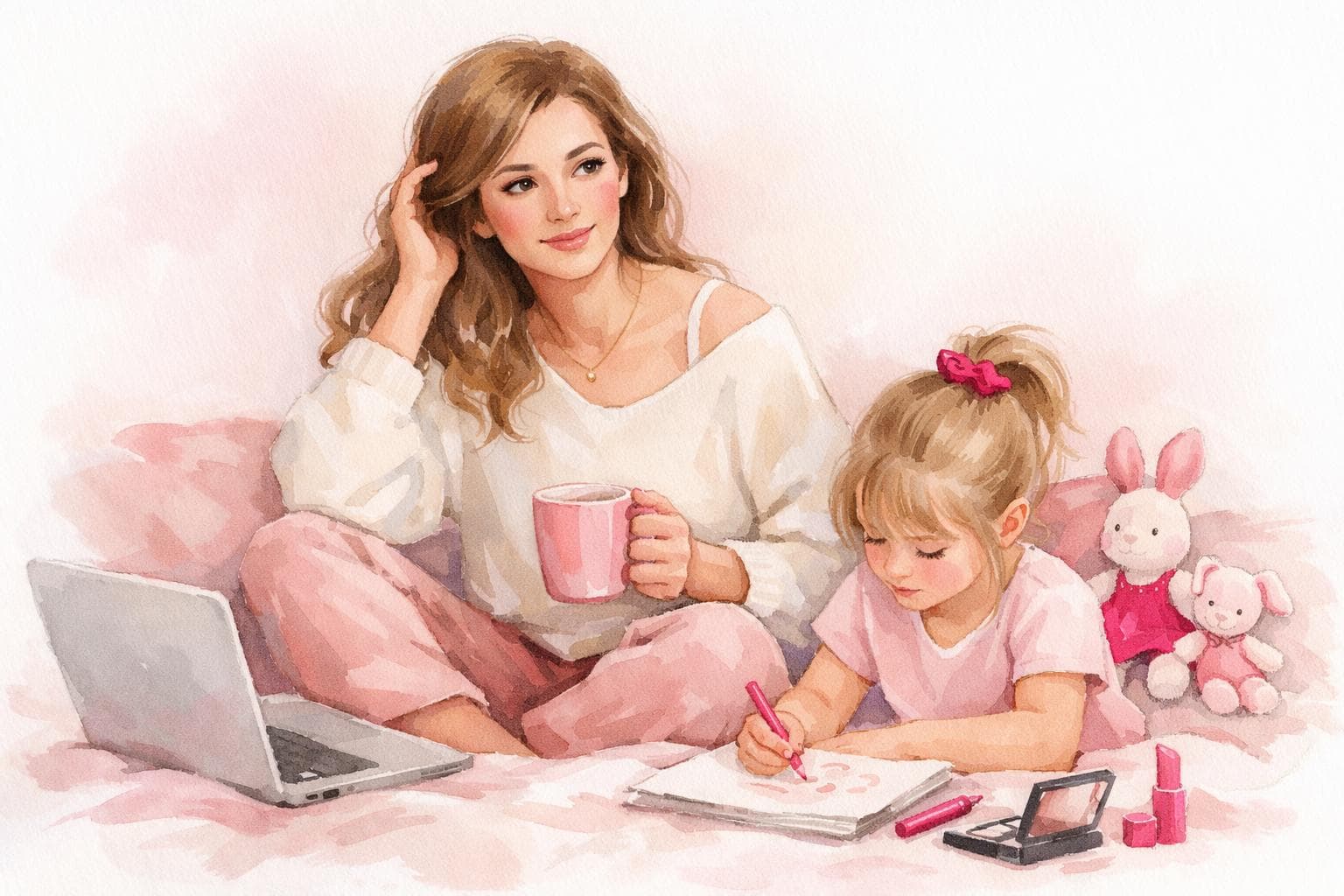
What single motherhood actually requires is not superhuman capacity. It is something more specific and considerably less glamorous: a deliberate, ongoing practice of staying connected to yourself inside conditions that make that genuinely difficult.
The particular shape of single-parent exhaustion
There are different kinds of tired, and it helps to name them separately.
There is the physical tiredness of doing everything: the school runs, the meals, the laundry, the admin, the ill-child nights when there is nobody to tap out to and you simply have to keep going. This is real and significant and tends to get acknowledged, at least in theory.
There is the cognitive tiredness of holding it all: the mental list that never clears, the decisions that land on one person's desk, the awareness that if you forget something there is nobody else to catch it. Research on cognitive load and sole-parent households consistently finds that single parents carry roughly twice the mental load of their partnered counterparts, even when accounting for household size.
And then there is the relational tiredness that gets talked about least: the absence of an adult at the end of the day who already knows the context, who was there for the same things you were, who you can hand something to without having to first explain the whole situation. That particular kind of exhaustion is the one that most single mothers describe as the hardest. Not the tasks. The aloneness of the tasks.
A 2021 report from the Nuffield Foundation found that single parents in the UK were significantly more likely to report chronic stress and psychological distress than partnered parents, with the gap widening when the sole parent was also in paid employment. These are structural realities, not personal inadequacies.
Why your sense of self is at specific risk
When you are the only adult in the household, the caregiving role has no natural edges. There is no handover, no one to take the children off your hands so you can remember who you are when you're not being someone's parent. The role expands to fill everything available, which over time means there is less and less of you that exists outside it.
Psychologist Murray Bowen described this process as "fusion," the absorption of individual identity into a relational role, as one of the core ways that high-stress family systems produce long-term psychological difficulty. For single mothers, the conditions for fusion are structural rather than chosen. It is not that they lack the desire for a separate self. It is that the system they are operating in leaves very little room for one.
This matters not only for the mother's own wellbeing but for the children she is raising. Research published in Development and Psychopathology found that maternal psychological health was the single strongest predictor of positive child outcomes in single-parent households, outweighing income, social support and a range of other variables. A mother who is depleted and self-erased cannot offer her children what a mother who has some version of herself intact can offer.
What staying yourself actually requires
Not retreats or elaborate self-care rituals. Smaller, more structural things.
- One relationship where you exist as a full person. Not the parent-teacher communication relationship, not the logistics friendship, but someone who knows what you think and feel about things that have nothing to do with your children. If that relationship has atrophied, rebuilding it is worth treating as a genuine priority.
- A consistent way of spending time that is yours. Not conditional on the children being sorted, not earned after everything else is done. A regular, recurring pocket of time that belongs to you because you decided it does.
- An honest account of what you can and cannot take on. Single motherhood requires the ability to say no without extensive justification, because the alternative is a schedule that consumes the person inside it. Getting comfortable with no as a complete sentence is a specific skill worth developing.
- Some form of peer support from people in a similar situation. The particular relief of speaking to someone who doesn't need the context explained, who already understands what it is to be the only one, is genuinely distinct from the support of people who empathise but don't really know.
On asking for help when the infrastructure isn't there
The advice to ask for help is well-meaning and structurally incomplete. Single mothers often lack the extended network of easily available people that the advice assumes. Building that network takes time, energy and sometimes financial resources that are already stretched.
What tends to work. Why?
Reciprocal childcare arrangements with other parents (Removes the power imbalance of always receiving)
Online communities of single parents (Low-barrier, available when the children are asleep)
Specific, time-limited requests rather than general appeals (Easier to ask and easier to say yes to)
Professional support when the load becomes clinical (A GP, therapist or financial adviser who knows your situation)
Accepting imperfect support over waiting for ideal support (Imperfect help is still help)
The identity question nobody asks
Most support for single mothers focuses on practical management: finances, childcare, logistics. Almost none of it asks the harder question: who are you, outside of this enormous role?
"You yourself, as much as anybody in the entire universe, deserve your love and affection." - Jack Kornfield
That question is not a luxury. It is the question that determines whether you are surviving single motherhood or actually living inside it. And it is worth asking yourself, quietly and without judgment, at regular intervals.
If the self underneath the role has become genuinely hard to locate, How to feel like yourself again after kids starts at exactly that point. And if loneliness has become a persistent feature of the experience rather than a situational one, Loneliness in motherhood: why it happens and how to find connection addresses it with more depth than there is space for here.
You are more than what this season requires of you. Keeping that fact somewhere visible is not indulgence. It is maintenance.
Further reading: Emma Johnson, The kickass single mom (2017). Nedra Tawwab, Set boundaries, find peace (2021). Nuffield Foundation, single parents and wellbeing (2021 report).