
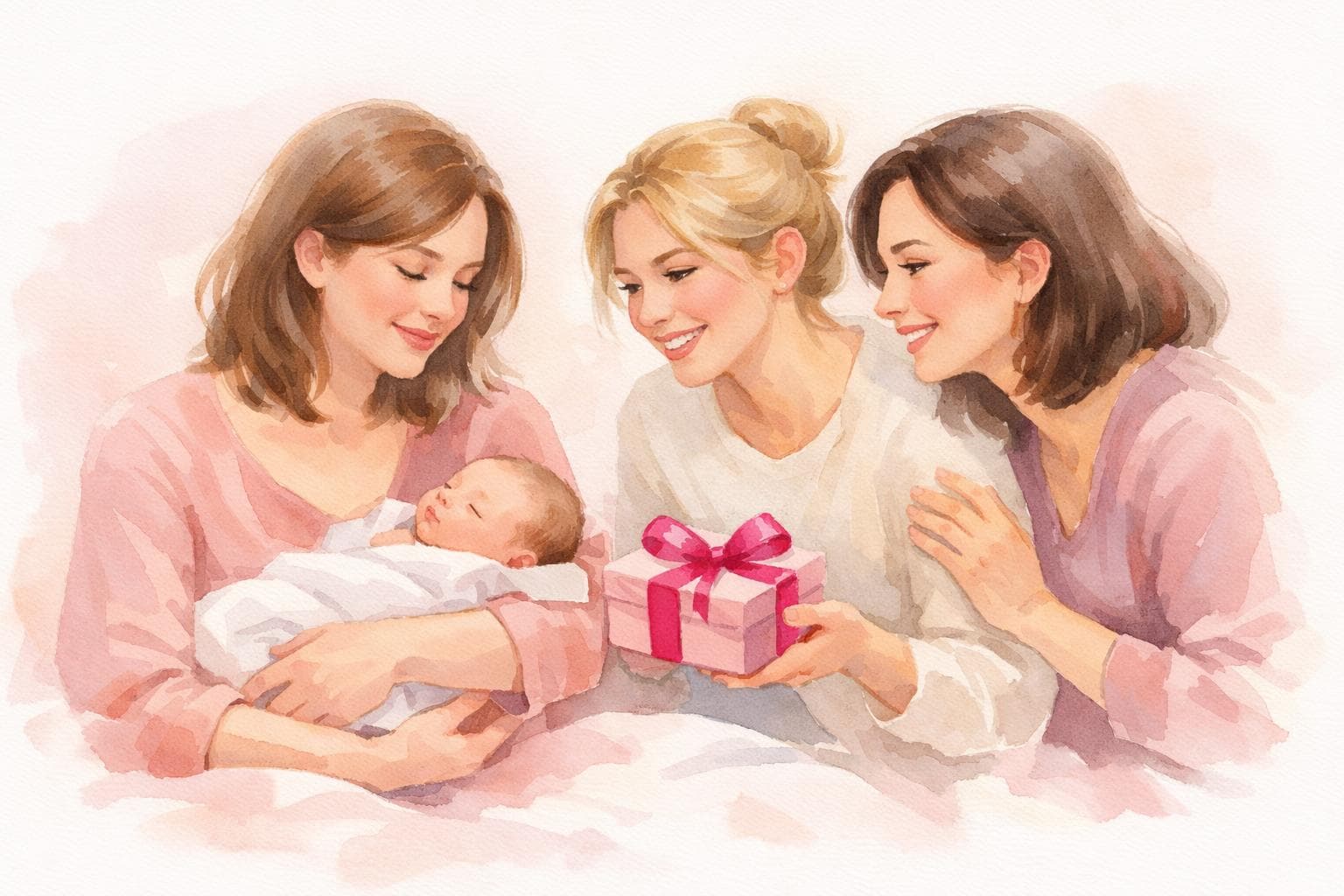
You want to say something. Of course you do, she just had a baby, this is huge news, and you are genuinely happy for her. But you have also seen the posts. The lists of things people say to new mothers that land wrong, the comments that were meant kindly and still stung for weeks. So you hesitate, phone in hand, message half-typed, wondering if "congratulations" is somehow not enough and everything else is somehow too much.
It does not have to be complicated. Congratulating a new mom well means centring her experience rather than the baby's cuteness, avoiding comments about her body or her ability to cope, and offering something specific rather than generic well-wishes. A survey of new parents compiled by HuffPost found that the most commonly cited unhelpful comments were "enjoy every minute," comments about the baby's weight or appearance and remarks that minimised the difficulty of the transition. Research on postpartum body image, cited by registered dietitian Crystal Karges, found that body image dissatisfaction is consistently associated with prenatal and postpartum depression, which is exactly why the most common "compliment," praising quick weight loss, is one of the most damaging things you can say.
This guide gives you the words that actually land, and the comparison that shows you why.
What lands vs what backfires
What people commonly say | Why it backfires | What to say instead |
|---|---|---|
"Enjoy every minute!" | Invalidates the difficulty; implies she should feel constant joy | "This season is a lot. I'm thinking of you." |
"You look amazing, have you lost weight already?" | Ties her worth to appearance during a vulnerable recovery period | "How are you feeling, really?" |
"Welcome to parenthood!" | Offers nothing useful; can feel dismissive of a specific struggle | "What would actually help this week?" |
"It gets easier / It gets harder" | Both are unhelpful predictions that centre the future over the present | "However this feels right now is valid." |
"At least the baby is healthy" | Minimises her own experience and struggles | "I'm glad the baby is healthy. How are you doing?" |
"My sister/friend had it so much worse" | Comparison invalidates her specific experience | "I can't imagine exactly what this is like for you." |
"Just sleep when the baby sleeps" | Impractical advice disguised as support | "Can I take a shift so you can actually rest?" |
The four things worth saying
1. Something that centres her, not just the baby
Most congratulations messages are entirely about the baby: how cute, how lucky, how blessed. Try adding a sentence about her specifically.
- "You did something extraordinary. How are you feeling?"
- "Congratulations on your new baby, and congratulations on carrying and delivering them. That was you."
- "I'm so proud of you. Not just excited about the baby. Proud of you."
2. A specific offer, not a vague one
"Let me know if you need anything" places the burden of asking on her, at the exact moment she has the least capacity to ask for things. A specific offer removes that burden.
- "I'm dropping off dinner Thursday. What does your family actually eat?"
- "I have two hours free Saturday morning. Want me to take the baby so you can shower or sleep?"
- "I'm doing a grocery run tomorrow. Send me your list."
3. Permission, not pressure
New mothers receive an enormous amount of implicit pressure to feel a certain way. A message that removes pressure rather than adding to it is rare and valuable.
- "You don't have to respond to this. Just wanted you to know I'm thinking of you."
- "No need to reply, no need to host visitors, no expectations. Just love."
- "Whatever this week looks like for you is exactly right."
4. Honest acknowledgment of the hard parts
You do not need to pretend everything is joyful. Acknowledging the difficulty, briefly and without dwelling on it, tends to land better than forced positivity.
- "This is a huge adjustment. I see you doing it."
- "I know this is beautiful and also really hard. Both things are true."
- "You are allowed to find this difficult and still be a wonderful mother."
What never to say, and why
Anything about her body. Research consistently links body image dissatisfaction to postpartum depression risk. Comments about weight loss, "bouncing back" or appearance, even meant as compliments, reinforce the idea that her value is tied to how quickly her body returns to a prior state. If you want to say something about her body, say: "Your body did something incredible."
"Enjoy every minute." Nearly universally cited as the most common unhelpful phrase by new parents surveyed. It implies that struggling with any part of it is a failure to appreciate the gift.
Anything that assumes she has support she may not have. "It takes a village" assumes she has one. Many new mothers, particularly those without nearby family, do not. If you want to reference community, offer to be part of hers specifically.
Comparisons to your own experience or someone else's. The Postpartum Depression Alliance of Illinois specifically warns against phrases like "my sister had it worse" or "you'll get over it like everyone else." Every postpartum experience is distinct, and comparison minimises rather than reassures.
"What do you have to be sad about?" If she discloses any struggle, including postpartum depression or anxiety, do not question the legitimacy of her feelings against her circumstances. A healthy baby does not prevent PPD. Our guide to what postpartum depression actually is explains why gratitude and depression can coexist.
If she tells you she is struggling
This is the moment most people get wrong, not because they are unkind but because they do not know what to say next. The Postpartum Depression Alliance of Illinois recommends specific, validating responses:
- "Tell me more about how you're feeling."
- "I'm here to listen if you want to talk."
- "It's okay to feel this way."
- "I'm here for you."
Avoid minimising ("it could be worse"), avoid unsolicited advice, and avoid comparing her experience to anyone else's. If what she describes sounds like more than adjustment, gently pointing her toward her EPDS screening options or why every new mom should consider therapy is more useful than reassurance alone.
The message format that works for any relationship
Close friend or family: "Congratulations. You did something extraordinary. I'm bringing dinner Thursday, no need to reply, just eat well and rest when you can."
Coworker: "Congratulations on your new baby. Take all the time you need. We're covering things here, and we're thinking of you."
Acquaintance or distant relation: "Congratulations on your new arrival. Wishing you a smooth transition and lots of rest in the weeks ahead."
Adjust the specificity to the closeness of the relationship, but keep the same principle across all three: acknowledge her, not just the baby, and remove pressure rather than adding it.
Key takeaways
- The most damaging "compliments" are about weight loss or physical recovery. Research links body image comments directly to postpartum depression risk; centre her wellbeing instead of her appearance.
- "Enjoy every minute" is the single most commonly cited unhelpful phrase among surveyed new parents. Replace it with acknowledgment of the difficulty.
- Specific offers beat vague ones. "I'm bringing dinner Thursday" removes the burden of asking; "let me know if you need anything" adds to it.
- If she discloses struggle, validate rather than minimise or compare. "Tell me more" and "I'm here" outperform "it could be worse" or comparisons to other people's experiences.
- Permission without pressure is rare and valuable. A message that says "no need to reply" is often more comforting than one that expects a response.
Sources and further reading
- Karges, C. (2025). Postpartum support: what to say to a new mom (and what not to say). crystalkarges.com
- HuffPost. (2024). People reveal the most toxic comments they received as first-time parents. huffpost.com
- Postpartum Depression Alliance of Illinois. (2024). What not to say to a mom who has postpartum depression. ppdil.org
- The Mother Chapter. (2024). Triggering phrases in postpartum. themotherchapter.com
- Happiest Baby. (2025). Things you should never say to a new mom. happiestbaby.com
- Nagoski, E. & Nagoski, A. (2019). Burnout: The Secret to Unlocking the Stress Cycle. Ballantine Books.