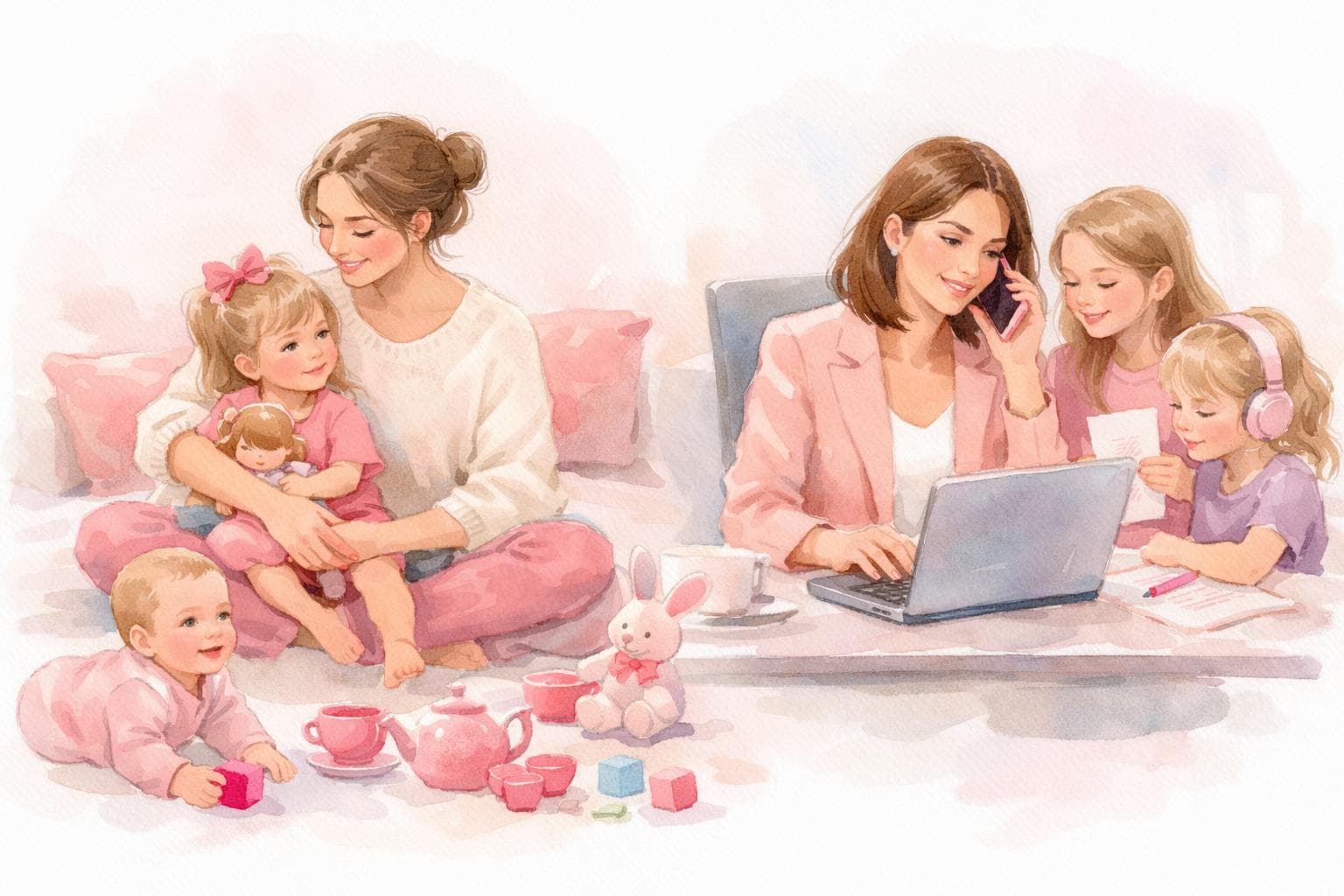
You have probably had the thought in both directions. If you stay home, you wonder whether you are wasting a degree, losing your professional edge, disappearing into a role nobody sees. If you work, you wonder whether you are missing something irreplaceable, whether someone else is getting the good parts of your child's day.
Neither picture in your head is the full truth. Government time-use data, tracked for decades, actually tells you what both days look like, and the comparison is more interesting than either side of the debate usually admits.
A day-in-the-life comparison between stay-at-home mothers and working mothers uses time-use survey data to show how each group actually spends a 24-hour period, rather than relying on assumptions about which role involves more effort or more time with children. The Bureau of Labor Statistics' American Time Use Survey found that mothers at home spend an average of 18 hours a week in direct childcare, compared to 11 hours for employed mothers, a real but smaller gap than either side of the mommy-wars debate tends to assume. This article breaks down where the rest of each day actually goes.
The core numbers, side by side
Category | Stay-at-home mom, weekly average | Employed mother, weekly average |
|---|---|---|
Direct childcare, as primary activity | 18 hours | 11 hours |
Paid work | 0 hours | Full-time employed people average 8.1 to 8.4 hours on days they work |
Household activities | Higher share of total daily time | Compressed into non-work hours |
Total time with children, including secondary activity | Higher overall, but the gap narrows significantly here | Substantial, since childcare is frequently a background activity during other tasks |
Sleep | Comparable across both groups | Comparable across both groups; the 2024 ATUS reported an average of 9.04 hours daily across the general population |
The 18-versus-11-hour figure is the most cited statistic in this comparison, but it measures only childcare as a primary, focused activity, not the constant background awareness of a child's needs that both groups report experiencing throughout the day.
A realistic SAHM weekday
Time | Activity |
|---|---|
6:00 to 7:30am | Wake, morning care for children, breakfast preparation |
7:30am to 12:00pm | Childcare as primary activity: play, errands, appointments, household management |
12:00 to 2:00pm | Lunch, nap-time window, household tasks that require quiet, such as laundry or meal prep |
2:00 to 5:30pm | Afternoon childcare, school pickup if applicable, homework support, activities |
5:30 to 8:00pm | Dinner, bath, bedtime routine |
8:00 to 10:00pm | Household tasks, personal time, planning for the next day |
Much of this day involves childcare as a secondary activity even during tasks coded separately, cooking while supervising, folding laundry while a toddler plays nearby, which is part of why the lived experience often feels more intensive than the primary-activity hours alone suggest.
A realistic working mom weekday
Time | Activity |
|---|---|
6:00 to 7:30am | Wake, morning care for children, breakfast, drop-off preparation |
7:30 to 8:30am | Commute or transition to remote work setup, drop-off logistics |
8:30am to 5:00pm | Paid work, averaging 8.1 to 8.4 hours on days worked according to 2024 to 2025 ATUS data |
5:00 to 6:00pm | Pickup, transition home |
6:00 to 8:00pm | Dinner, homework, bath, bedtime routine, compressed into a shorter window than the SAHM equivalent |
8:00 to 10:00pm | Household catch-up, remaining work tasks, personal time |
The defining difference is not the presence or absence of childcare. It is where in the day that childcare gets compressed, and how much of the remaining household labour happens after a full workday rather than spread across it.
What the data does not fully capture
BLS time-use data measures activities, not the emotional and cognitive weight of the day. Both groups report significant time spent on what researchers increasingly call the mental load, anticipating needs, managing logistics and making decisions, much of which does not register as a discrete, codeable activity in a time-use survey.
Our guide to the invisible mental load moms carry every day covers this dimension directly, and it applies to both stay-at-home and working mothers, though the specific content of that load differs by role.
The remote work shift changes both pictures
The 2025 ATUS found that 35% of employed people did some or all of their work at home on days they worked, a figure that has remained elevated compared to pre-pandemic 2019 levels of 24%. This has blurred the line between the two day-in-the-life pictures above for a growing share of working mothers, who now compress childcare and paid work into overlapping windows rather than cleanly separated ones.
If you are exploring which category actually fits your circumstances, our guide to remote jobs for moms in 2026 and our breakdown of childcare costs and career decisions cover the practical trade-offs each path involves.
"On average, mothers at home spend 18 hours a week caring for their children compared with 11 hours for employed mothers. The researchers' analysis of time-use data also shows disparities in how stay-at-home moms and working moms spend their time." - U.S. Bureau of Labor Statistics, Monthly Labor Review
What both groups have in common
Despite the differences in schedule structure, both groups report similar total sleep, similar levels of household responsibility once total daily hours are accounted for, and both carry forms of guilt tied specifically to the role they occupy. Research on maternal identity consistently finds that the emotional experience of motherhood, rather than the specific time allocation, is what most strongly predicts wellbeing outcomes. If the identity questions underneath either path feel bigger than a schedule comparison can address, our guide to identity beyond mom explores that dimension in more depth.
Key takeaways
- Stay-at-home mothers spend an average of 18 hours a week in direct childcare as a primary activity, compared to 11 hours for employed mothers, according to BLS American Time Use Survey data, a real but smaller gap than common assumptions suggest.
- Full-time employed people average 8.1 to 8.4 hours of paid work on the days they work, compressing household and childcare responsibilities into a narrower window than stay-at-home mothers experience.
- 35% of employed people now work from home on days they work, a figure significantly higher than pre-pandemic levels, blurring the traditional distinction between the two day-in-the-life patterns.
- Time-use data does not capture the mental load, the anticipating, planning and decision-making that both groups report carrying regardless of employment status.
- Both roles involve trade-offs, not a clear winner. Comparable sleep and comparable overall responsibility levels suggest the meaningful difference lies in when and how the day is structured, not in who works harder.
Sources and further reading
- U.S. Bureau of Labor Statistics. (2014). Stay-at-home mothers through the years. Monthly Labor Review. bls.gov
- U.S. Bureau of Labor Statistics. (2025). American Time Use Survey, 2024 results. bls.gov
- U.S. Bureau of Labor Statistics. (2025). American Time Use Survey, 2025 A01 results. bls.gov
- Fortune. (2025). How many hours Americans spend on work, sleep and chores. fortune.com
- Cohn, D., Livingston, G. & Wang, W. (2014). After decades of decline, a rise in stay-at-home mothers. Pew Research Center Social and Demographic Trends.
- Frazis, H. (2025). A comparison of hours of work at home estimates between the Current Population Survey and the American Time Use Survey. Monthly Labor Review, BLS.