
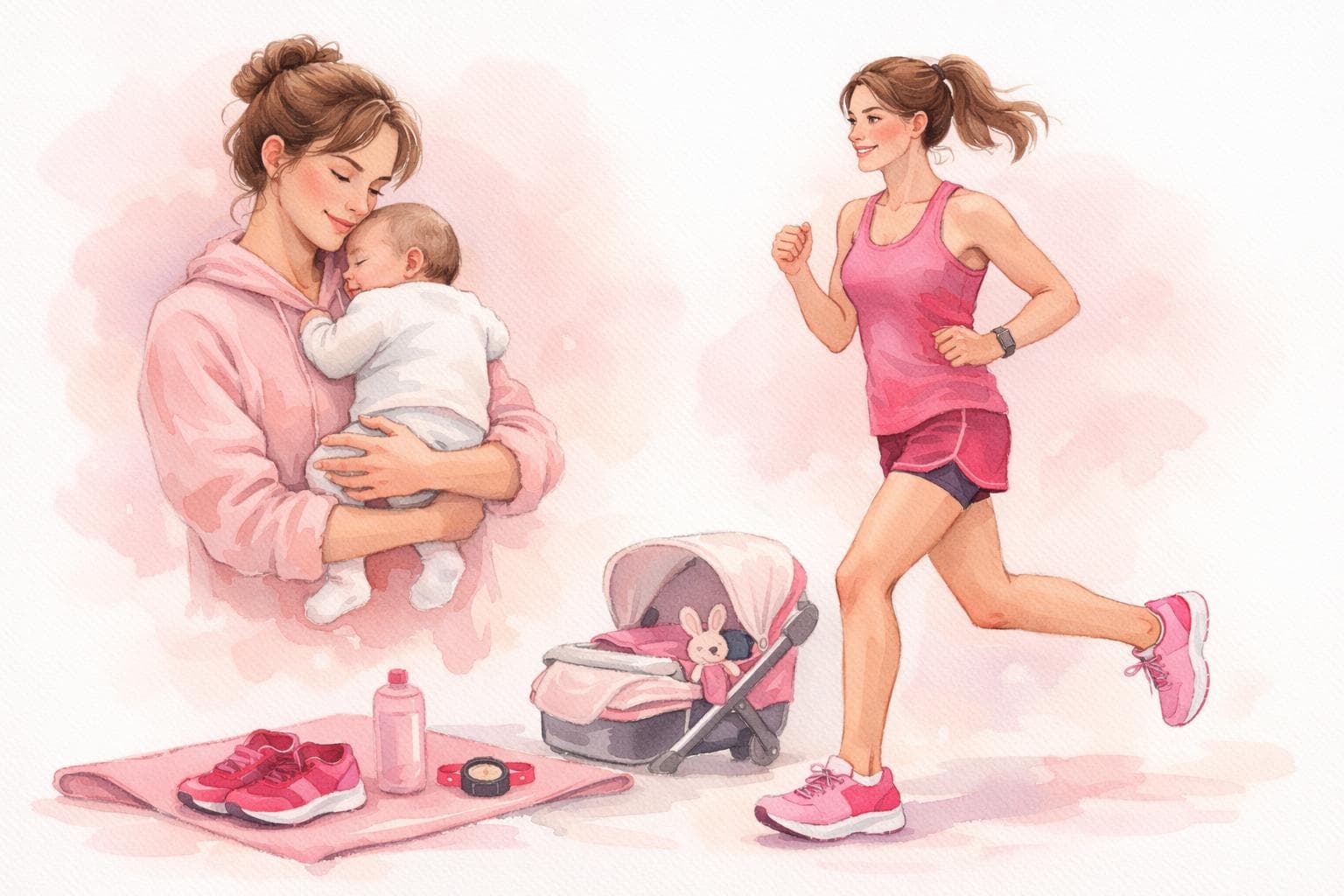
You used to run three times a week without thinking twice. Now you are eight weeks postpartum, staring at your trainers, wondering whether lacing them up will feel triumphant or whether you will leak, or feel a strange dragging sensation, or discover that your body simply is not ready and you were foolish to try.
There is a real answer to when and how, built on actual research rather than a random number someone mentioned at a baby group.
Return to running postpartum refers to a criteria-based, individualised progression back to running after childbirth, guided by pelvic floor readiness, musculoskeletal capacity and symptom monitoring, rather than a single fixed date that applies to everyone. The foundational 2019 guidelines by physiotherapists Tom Goom, Grainne Donnelly and Emma Brockwell recommended that return to running be considered at or around three months postpartum, not before, based on the physical demands running places on the pelvic floor and abdominal wall as a power, endurance and impact activity. A 2024 international Delphi consensus study, published in the British Journal of Sports Medicine and involving clinicians and exercise professionals worldwide, reinforced that postpartum return to running should be symptom-guided and individualised rather than dictated by a fixed timeline alone. This guide walks through the progression those guidelines actually recommend.
Why three months, and why it is a minimum, not a target
The three-month recommendation is not arbitrary. Running is classified as a high-impact, high-load activity that places significant force through the pelvic floor and lower limbs with every stride, depending on pace and surface. A body that has not had time to rebuild pelvic floor and abdominal wall capacity is at meaningfully higher risk of pelvic floor dysfunction, incontinence or pain when that load is introduced too early.
Carrie Pagliano, a physical therapist who works closely with the guideline authors, notes that newer research continues to support at least 12 weeks before postpartum bodies are ready for high-impact activity, and that this is best understood as a minimum threshold, not a universal green light. Some women need considerably longer, particularly if pelvic floor symptoms are present.
The four-phase progression
Phase | Timeframe | Focus | What to avoid |
|---|---|---|---|
Phase 1: relative rest | Weeks 0 to 3 | Diaphragmatic breathing, short walks in small bouts, gentle mobility | Any high-impact activity, prolonged standing or carrying loads that strain the healing pelvic floor |
Phase 2: foundational strength | Weeks 3 to 12 | Progressive walking distance, pelvic floor and deep core activation, gradual resistance training | Running, jumping or any impact-based movement |
Phase 3: readiness assessment | Around 12 weeks | A criteria-based screen: walking 30 minutes, single-leg balance, single-leg squats, jogging on the spot, forward bounds, hopping and single-leg running man, all without symptoms | Progressing to running before passing this screen |
Phase 4: graduated return to running | 12 weeks onward, individualised | Run-walk intervals, gradually increasing duration and intensity, guided by symptom response | Returning to pre-pregnancy mileage or pace immediately |
This structure follows the framework described by Goom and colleagues and reinforced in subsequent research: postpartum readiness is tested through function, not simply awarded by the calendar.
The readiness test, explained
Before progressing to running, the original guidelines propose a specific set of criteria a postpartum runner should be able to perform without provoking pelvic floor symptoms or pain:
- Walk continuously for 30 minutes
- Single-leg balance for a sustained period
- Single-leg squats with good control
- Jog on the spot for a short duration
- Forward bounds without pain or leaking
- Single-leg hops
- The single-leg running man movement pattern
All exercises need to be achieved without symptoms occurring, which includes any dragging sensation in the pelvis, leaking, or pain. If any of these provoke symptoms, that is information to slow down and rebuild strength further, not a signal to push through.
Symptoms that mean stop, not push through
Symptom during or after running | What it may indicate |
|---|---|
Leaking urine during the run | Pelvic floor is not yet managing the load; scale back and rebuild strength |
A dragging or heavy sensation in the pelvis | Possible early sign of pelvic organ prolapse symptoms; worth a pelvic floor physiotherapy assessment |
Lower back or pelvic girdle pain | Research on pelvic girdle pain has found that early, structured, low-impact exercise is associated with reduced pain severity, but pain during running specifically suggests scaling back the load |
Doming or bulging along the midline of the abdomen | Possible sign that diastasis recti needs more targeted rehabilitation before continuing high-impact loading |
Persistent fatigue disproportionate to the run | Systemic factors like sleep deprivation alter tissue healing and pain perception; scaling back intensity and prioritising resistance training may be more appropriate on poorly rested days |
If any of these symptoms are present, our guide to postpartum belly binding and diastasis recti covers what actually helps abdominal separation heal, and a pelvic floor physiotherapist is the right next step for persistent pelvic symptoms.
Why sleep and stress belong in this conversation
A useful, evidence-informed shift in more recent postpartum sports medicine framing treats readiness through a biopsychosocial lens rather than a purely physical checklist. Sleep quality and quantity specifically alter tissue healing and pain perception, meaning a runner operating on significantly fragmented sleep may need to scale back run intensity and prioritise strength work over mileage on particularly depleted days, even once cleared for running generally.
This matters because postpartum recovery does not happen in isolation from the rest of your life. If emotional exhaustion or chronic sleep deprivation is part of your current reality, that context is directly relevant to how your body handles physical load, not a separate issue from your running plan.
"Female athletes have identified a lack of guidance as a barrier to successfully returning to running postpartum, and existing guidelines are vague." - Christopher, Donnelly, Brockwell et al., British Journal of Sports Medicine (2024)
What the newest research adds
A 2025 systematic review and meta-analysis published in the British Journal of Sports Medicine examined the impact of postpartum exercise on pelvic floor disorders and diastasis recti abdominis, adding to the evidence base supporting structured, gradual return-to-activity programming over generic advice. Separately, a 2024 pilot study on gait stability found that only about 75% of female runners return to running at all following childbirth, with pelvic floor dysfunction, musculoskeletal pain and fear of movement cited as the most common barriers, underscoring why a clear, criteria-based framework matters as much as the physical readiness itself.
Key takeaways
- The foundational 2019 guidelines recommend considering a return to running no earlier than three months postpartum, based on the high-impact, high-load nature of running relative to pelvic floor and abdominal wall recovery.
- A criteria-based readiness screen, not the calendar alone, should determine progression. Walking, single-leg balance, squats, jogging, bounds and hops all need to be symptom-free before running begins.
- Leaking, pelvic dragging, pain or abdominal doming during exercise are signals to scale back, not symptoms to push through.
- Sleep deprivation and stress directly affect tissue healing and pain perception, meaning readiness should be assessed through a broader lens than physical capacity alone.
- Only about 75% of postpartum runners return to running at all, with pelvic floor dysfunction and fear of movement as leading barriers, which is precisely why a clear, evidence-based progression matters.
Sources and further reading
- Goom, T., Donnelly, G. & Brockwell, E. (2019). Returning to running postnatal: guidelines for medical, health and fitness professionals managing this population. Absolute Physio. researchgate.net
- Christopher, S.M., Donnelly, G., Brockwell, E. & Deering, R.E. (2024). Clinical and exercise professional opinion of return-to-running readiness after childbirth: an international Delphi study and consensus statement. British Journal of Sports Medicine.
- Deering, R.E., Donnelly, G.M., Brockwell, E. et al. (2024). Clinical and exercise professional opinion on designing a postpartum return-to-running training programme: an international Delphi study and consensus statement. British Journal of Sports Medicine, 58(4), 183-195.
- Beamish, N.F., Davenport, M.H., Ali, M.U. et al. (2025). Impact of postpartum exercise on pelvic floor disorders and diastasis recti abdominis: a systematic review and meta-analysis. British Journal of Sports Medicine.
- Mohr, M., Euler, A., Donnelly, G. et al. (2024). Gait stability in postpartum runners: a pilot study. Current Issues in Sport Science, 9(4).
- Pagliano, C. (2025). Ready or not? A guide to postpartum return to running. carriepagliano.com