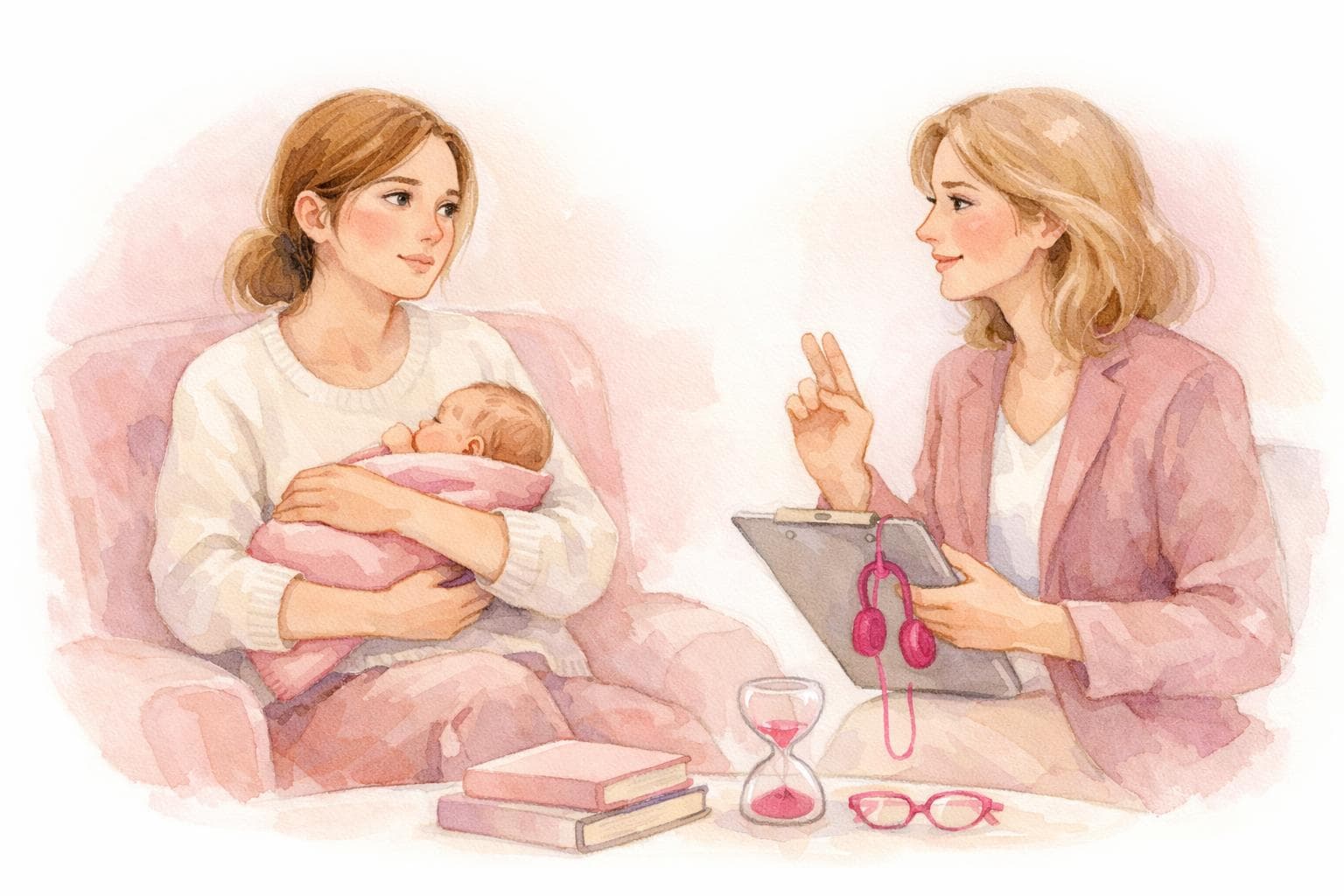

You have finally said it out loud. Something is not right. Maybe you told your partner, maybe your GP, maybe you just whispered it to yourself in the car. Now comes the next question, and it is more confusing than it should be: who do you actually call?
The mental health world is full of titles. Counselor. Therapist. Psychologist. Psychiatrist. Social worker. They all sound like they do the same thing. They do not. And when you are sleep-deprived, already overwhelmed and trying to get help for postpartum depression, the last thing you need is a navigation puzzle.
Here is a clear breakdown of who does what, who can prescribe and who is most likely to help at each stage.
Why the right provider matters
Not all mental health professionals are trained in perinatal mental health. The American Psychiatric Association notes that although perinatal mood disorders are common, not all doctors are trained in diagnosing and treating pregnant and postpartum patients. Choosing the wrong type of provider does not just waste time. It can delay effective treatment during a period when early intervention makes the biggest difference.
A 2021 meta-analysis published in JAMA Psychiatry examined nonspecialist-delivered interventions for perinatal mental health and found that structured, evidence-based support from trained professionals produced significant improvements. The key word is trained. Credentials matter, but perinatal-specific experience matters more.
The main types of mental health providers
Provider | Qualifications | Can prescribe? | What they typically do |
|---|---|---|---|
Counselor (LPC, LMHC) | Master's degree in counselling; state-licensed | No | Talk therapy, coping strategies, emotional support |
Therapist / Psychotherapist (LCSW, LMFT) | Master's degree in social work, marriage and family therapy, or psychology; state-licensed | No | Evidence-based therapy (CBT, IPT, EMDR), deeper clinical work |
Psychologist (PhD, PsyD) | Doctoral degree in psychology | No (in most states/countries) | Assessment, diagnosis, structured therapy programmes, research-informed treatment |
Psychiatrist (MD, DO) | Medical degree with psychiatric specialisation | Yes | Diagnosis, medication management, complex or severe cases |
Psychiatric nurse practitioner (PMHNP) | Advanced nursing degree with psychiatric specialisation | Yes | Medication management, therapy (varies by practice) |
Each of these professionals can be helpful. The question is which one matches where you are right now.
When a counselor is enough
If your symptoms are mild to moderate, if you are functioning but struggling, and if you mainly need a space to process what you are going through, a licensed counselor can be a strong first step.
Counselors are trained in active listening, coping skills and supportive techniques. Many work in community settings, clinics and private practice. They tend to be more accessible and more affordable than psychologists or psychiatrists.
What to look for: a counselor with specific experience in perinatal mental health or maternal wellbeing. General counseling credentials are a starting point, but not all counselors understand the nuances of postpartum mood disorders.
When you need a therapist
If your symptoms are moderate, persistent or involve specific patterns like intrusive thoughts, avoidance, relationship breakdown or trauma from the birth, a licensed therapist offering evidence-based treatment is likely the right match.
The distinction between "counselor" and "therapist" can be blurry. In practice, a therapist typically offers more structured, protocol-driven interventions. For postpartum depression, the two most evidence-based approaches are:
- CBT (Cognitive Behavioral Therapy): effective for changing negative thought patterns and behaviours; strong evidence across multiple meta-analyses
- IPT (Interpersonal Therapy): focuses on relationship conflicts, role transitions and social isolation, all of which are common in new motherhood
Postpartum Support International (PSI) now maintains a directory of over 8,000 professionals who hold the Perinatal Mental Health Certification (PMH-C), validated through a 2024 job task analysis study. Searching that directory is one of the most reliable ways to find a therapist who genuinely understands what you are going through.
If you want a deeper look at how CBT works for PPD specifically, our complete guide to CBT for postpartum depression covers the evidence, formats and what to expect from sessions.
When you need a psychiatrist
A psychiatrist is a medical doctor. They can diagnose, prescribe medication and manage complex cases that involve multiple conditions or severe symptoms.
You may need a psychiatrist if:
- Your symptoms are severe and affecting your ability to care for yourself or your baby
- You are experiencing suicidal thoughts, psychosis or extreme anxiety
- You want to explore medication and need someone who understands breastfeeding compatibility
- You have a pre-existing mental health condition such as bipolar disorder, OCD or PTSD that complicates treatment
- Therapy alone has not been enough after 6 to 8 weeks
A perinatal psychiatrist is the gold standard here. UCSF's Perinatal Wellness programme describes their model as a collaborative team: a licensed clinical social worker as the primary contact providing therapy, with a perinatal psychiatrist consulted for medication decisions and complex presentations.
That model, therapy as the foundation with psychiatry layered in when needed, reflects best practice.
What about your GP?
Your GP can screen for postpartum depression, prescribe SSRIs and refer you onward. For many women, the GP is the first and sometimes the only point of contact.
That is not ideal, but it is reality. If your GP is the only provider available, they can still help. SSRIs prescribed by a GP have strong evidence for PPD. The key is follow-up: make sure someone is monitoring your response and adjusting the plan if needed.
For a detailed breakdown of medication options, see our guide to PPD medication.
A decision framework
Your situation | Start here |
|---|---|
Mild symptoms, need someone to talk to | Counselor with perinatal experience |
Moderate symptoms, want structured therapy | Therapist trained in CBT or IPT (look for PMH-C) |
Severe symptoms or medication questions | Psychiatrist, ideally perinatal |
No local options or long waitlists | Online therapy platform or telephone CBT (evidence supports both) |
Unsure where you fall | GP for initial screening and referral |
"Ask your doctor about their training and knowledge about perinatal mental health conditions. Although these conditions are common, not all doctors are trained in diagnosing and treating pregnant and postpartum people." - American Psychiatric Association
The question that matters most
The most important question is not "which type of provider is best?" It is "does this person understand postpartum depression?" A counselor with ten years of perinatal experience may serve you better than a psychiatrist who has never treated a new mother.
When you call or email, ask directly: do you have experience with postpartum mood disorders? How many perinatal clients do you see? Are you certified or trained in perinatal mental health?
If they hesitate, keep looking.
You can also read about the hidden nuances of choosing PPD treatment and how therapy helps moms who feel stuck for more context on what to expect once you do find the right person.
Getting help for postpartum depression is not a single decision. It is a series of small, brave steps. Knowing who to call first makes the first step easier.
Sources and further reading
- American Psychiatric Association. What is perinatal depression? psychiatry.org
- Singla, D.R. et al. (2021). Implementation and effectiveness of nonspecialist-delivered interventions for perinatal mental health in high-income countries. JAMA Psychiatry, 78(5), 498-509. jamanetwork.com
- Postpartum Support International. Certification in perinatal mental health (PMH-C). postpartum.net
- Postpartum Support International. About perinatal mental health. postpartum.net
- UCSF Health. Perinatal wellness and mental health. ucsfhealth.org
- Byatt, N. et al. (2024). Barriers to help-seeking for postpartum depression. Frontiers in Global Women's Health. frontiersin.org