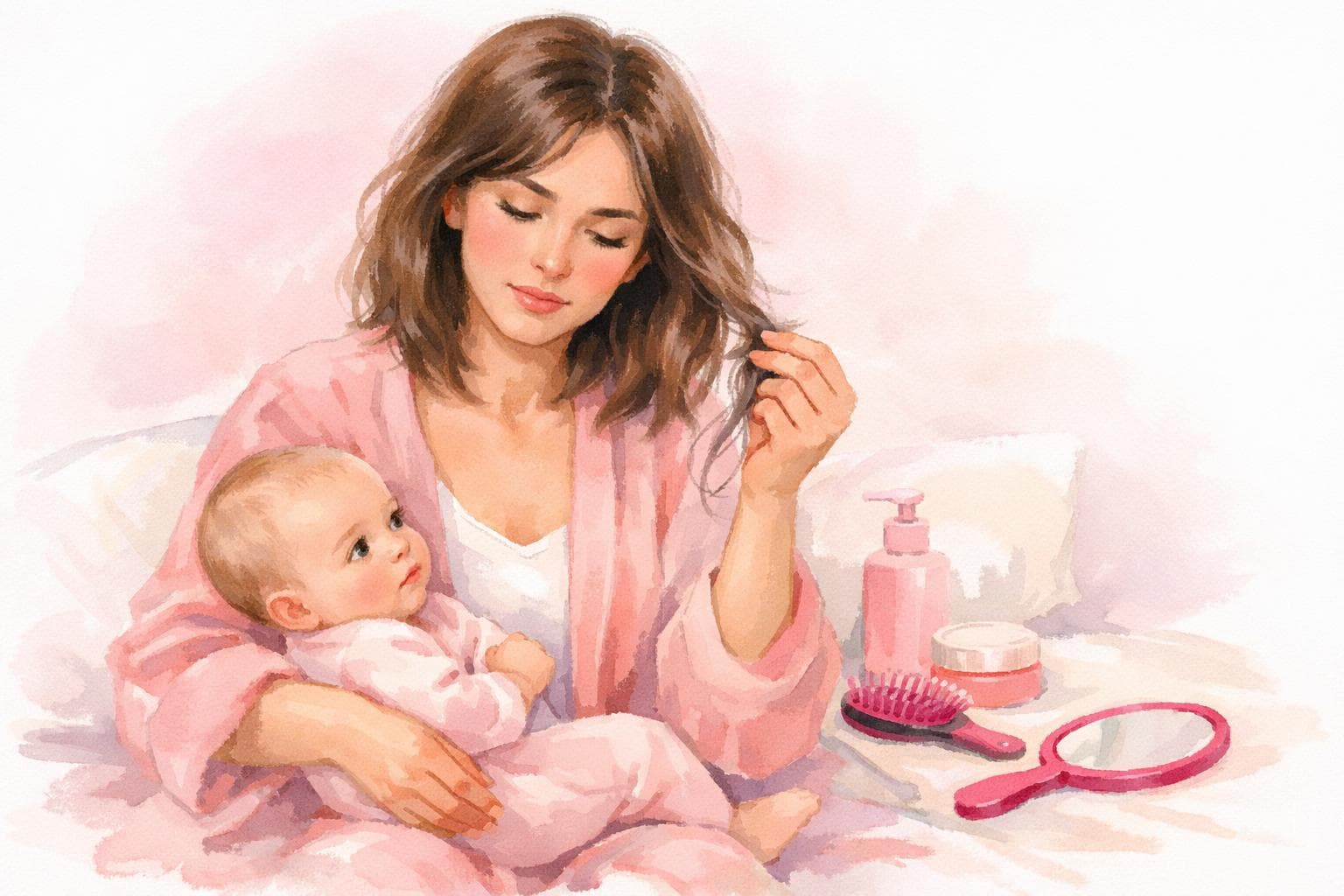
You are standing in the shower watching what feels like half your scalp circle the drain, and your first coherent thought is a quiet, panicked "is this normal, or am I going bald." Then you find another clump on your pillow. Then your hairbrush looks like a small animal. Nobody warned you it would feel this dramatic.
Postpartum hair loss, medically known as postpartum telogen effluvium, is a temporary, non-scarring form of shedding triggered by the sharp drop in estrogen after childbirth, which pushes a large number of hair follicles that pregnancy had held in the growth phase into the resting phase all at once. Roughly 50% of people who give birth experience noticeable postpartum shedding, according to GoodRx's clinical review, and normal daily hair loss of 50 to 100 strands can climb to 300 to 400 strands a day at peak shedding, per Traya's 2026 dermatology-reviewed timeline. It typically begins 2 to 4 months after delivery, peaks around month four, and resolves within 6 to 12 months as the hair cycle resets. This guide covers exactly what to expect week by week, what actually helps, and the specific signs that mean it is time to stop waiting and see a dermatologist.
The full timeline, week by week
Postpartum stage | What is happening |
|---|---|
First 6 weeks | Little to no noticeable change for most women |
6 weeks to 2 months | Some women begin noticing early shedding, especially if breastfeeding, sleep-deprived, or nutritionally depleted |
2 to 4 months | Shedding accelerates as follicles held in the growth phase during pregnancy shift into the resting phase together |
Around month 4 | Peak shedding, often the most alarming point; daily loss can reach 300 to 400 strands |
6 to 12 months | Gradual improvement as normal hair cycling resumes |
By baby's first birthday | Most women regain their pre-pregnancy fullness |
Johns Hopkins Medicine notes that women who breastfeed may experience a longer shedding period than those who do not, since hormonal fluctuations continue throughout lactation, and adoptive mothers or those who underwent fertility treatments can experience similar shedding tied to hormonal shifts, not childbirth specifically.
Why this happens: the hair cycle, briefly explained
Hair grows in three phases: anagen, the active growth phase lasting several years; catagen, a brief transitional stage of a few weeks; and telogen, the resting phase, which normally affects only 10% to 15% of your hair at any given time, according to the NIH's StatPearls clinical reference.
During pregnancy, elevated estrogen keeps a larger share of hair in the anagen phase for longer than usual, which is why many women notice thicker, fuller hair while pregnant. After delivery, estrogen drops sharply, and up to 30% of hair follicles shift into the telogen phase simultaneously. A few months later, that synchronised batch of hair sheds together, which is what produces the dramatic, sudden-feeling hair loss rather than the usual slow, staggered pattern.
What actually helps, compared
Approach | What the evidence shows | Realistic expectation |
|---|---|---|
Time and patience | Recovery from telogen effluvium takes 6 to 12 months regardless of product use, per the American Academy of Dermatology | Full resolution for the majority of cases |
Gentle hair care, volumizing products | Reduces breakage and improves the look of fullness | Cosmetic improvement only; does not shorten the underlying process |
Nutritional support, iron, biotin, protein | Most postpartum shedding is hormonal, not nutritional, per the AAD, but correcting a genuine deficiency can help if one exists | Worth checking with bloodwork rather than supplementing blindly |
Topical minoxidil | FDA-approved; shown to prolong the anagen phase | Can support regrowth speed; typically considered after 12 months of continued shedding |
Rosemary oil | A 2015 study in Skinmed Journal found twice-daily rosemary oil produced hair count improvement comparable to 2% minoxidil, with fewer side effects | A reasonable non-prescription option worth discussing with a dermatologist |
Our guide to grieving your pre-baby body: why it happens and what helps covers the wider emotional weight of physical changes like this one, since hair loss is rarely just about hair.
When shedding is actually masking something else
This is the detail most general advice skips entirely, and it matters. A 2024 observational study of 200 women experiencing postpartum telogen effluvium, published in the Journal of Clinical and Aesthetic Dermatology, found that only 9.5% had telogen effluvium alone. The remaining 90.5% had telogen effluvium occurring alongside an underlying condition: 56% also had androgenetic alopecia, female pattern hair loss, 6.5% had traction alopecia, and 28% had all three conditions together.
This does not mean most postpartum shedding is abnormal. It means postpartum telogen effluvium can act as a trigger that reveals a pre-existing pattern of hair loss that pregnancy's hormonal boost had been masking. A separate 2025 literature review focused specifically on Black mothers found that traction alopecia, hair loss caused by tension from certain hairstyles, is a frequently overlooked factor in postpartum shedding evaluations, and recommended it be considered specifically rather than assumed away as ordinary telogen effluvium.
"Diffuse shedding usually affects the entire scalp and is typically self-limited. Gradual improvement often occurs within the first postpartum year as normal cycling resumes, although the timing and perceived severity vary widely across individuals." - News-Medical, clinical hair loss review (2026)
When to actually worry and call a dermatologist
- Shedding continues past 12 months without meaningful improvement
- Hair loss is patchy rather than diffuse across the whole scalp, which can point to a different condition entirely
- You notice scalp burning, itching or visible redness, not just shedding
- Bald patches appear, rather than overall thinning
- You have risk factors for a coexisting condition: a family history of pattern hair loss, tight protective hairstyles worn regularly, or known thyroid or iron issues
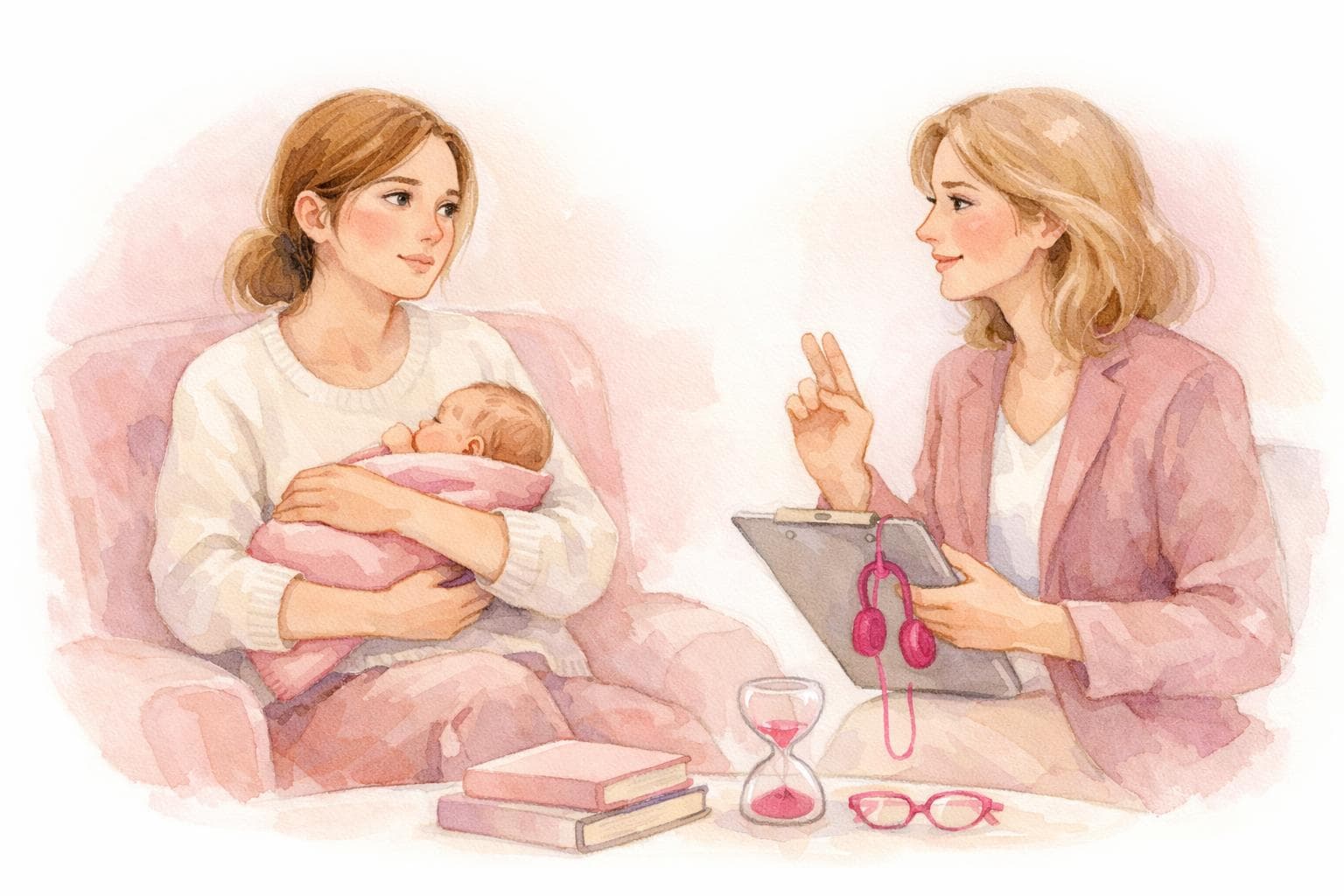
A dermatologist can perform a simple hair pull test and, if needed, dermoscopic evaluation to distinguish straightforward telogen effluvium from a coexisting condition, the same evaluation method used in the 200-patient study above.
Key takeaways
- About 50% of new mothers experience noticeable postpartum hair loss, typically starting 2 to 4 months after delivery, peaking around month four, and resolving within 6 to 12 months.
- Daily shedding can jump from a normal 50 to 100 strands up to 300 to 400 strands at peak, driven by up to 30% of hair follicles shifting into the resting phase simultaneously after estrogen drops.
- A 2024 study of 200 women found only 9.5% had telogen effluvium alone, while 90.5% had an additional underlying condition, most commonly androgenetic alopecia, meaning what looks like postpartum shedding can sometimes be unmasking a separate pattern.
- No product shortens the core recovery timeline, according to the AAD, though gentle hair care and evidence-backed options like rosemary oil or minoxidil can support the process.
- Shedding lasting beyond 12 months, patchy rather than diffuse loss, or scalp symptoms are the clearest signals to see a dermatologist, rather than waiting it out further.
Sources and further reading
- GoodRx. (2026). Postpartum hair loss: causes, diagnosis, and treatment. goodrx.com
- Johns Hopkins Medicine. (2025). Postpartum hair loss. hopkinsmedicine.org
- Traya. (2026). When does postpartum hair loss start and stop? Timeline, causes and recovery. traya.health
- Journal of Clinical and Aesthetic Dermatology. (2024). Postpartum Telogen Effluvium Unmasking Additional Latent Hair Loss Disorders. jcadonline.com
- Thrive Hair Bar. (2025). Hair shedding in the postpartum period: investigating telogen effluvium, nutrient deficiencies, and the unmasking of traction alopecia. thrivehairbar.com
- Samrao, A. & Mirmirani, P. (2022). Postpartum Telogen Effluvium Unmasking Traction Alopecia. Skin Appendage Disorders, 8(4), 328-332. pmc.ncbi.nlm.nih.gov