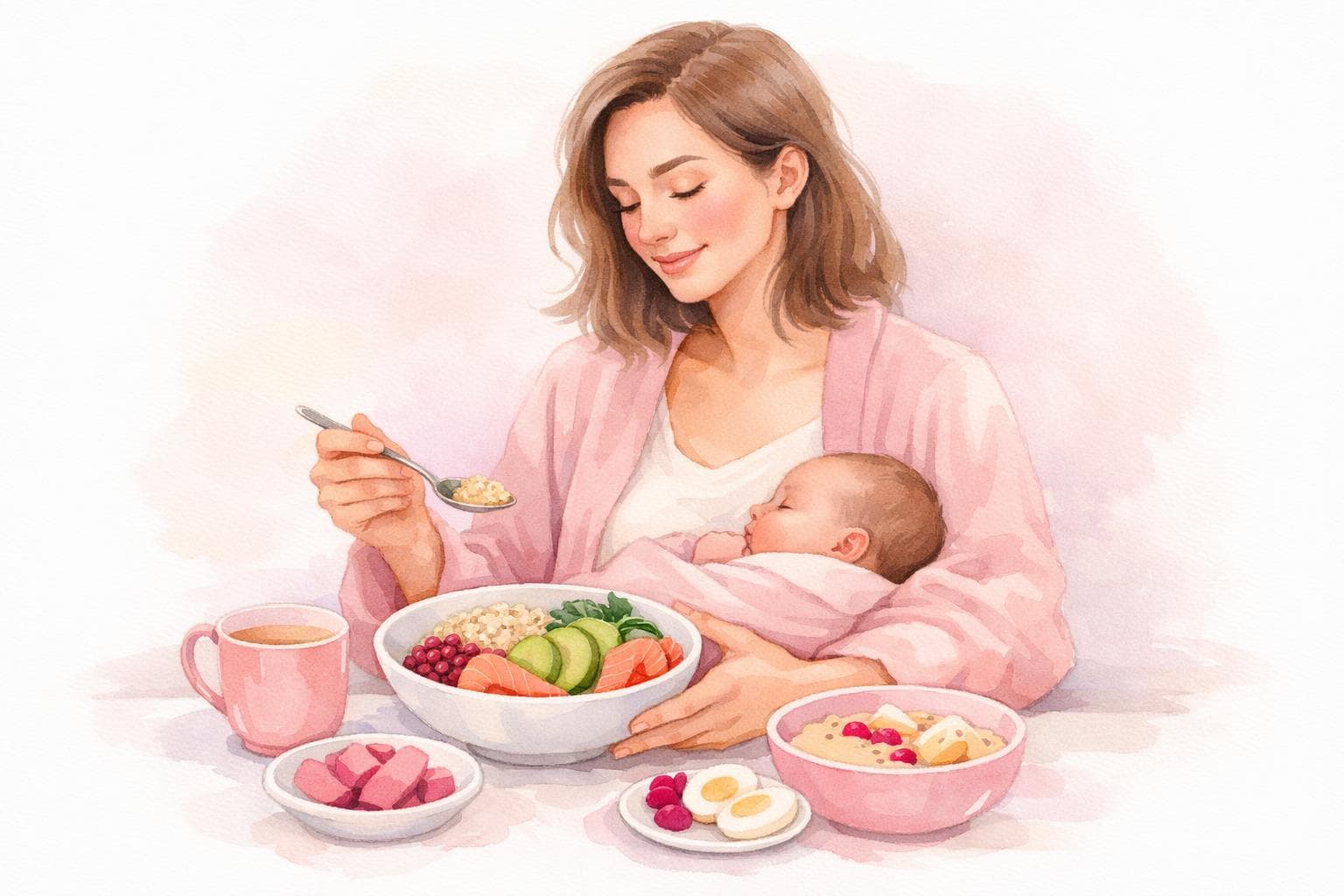
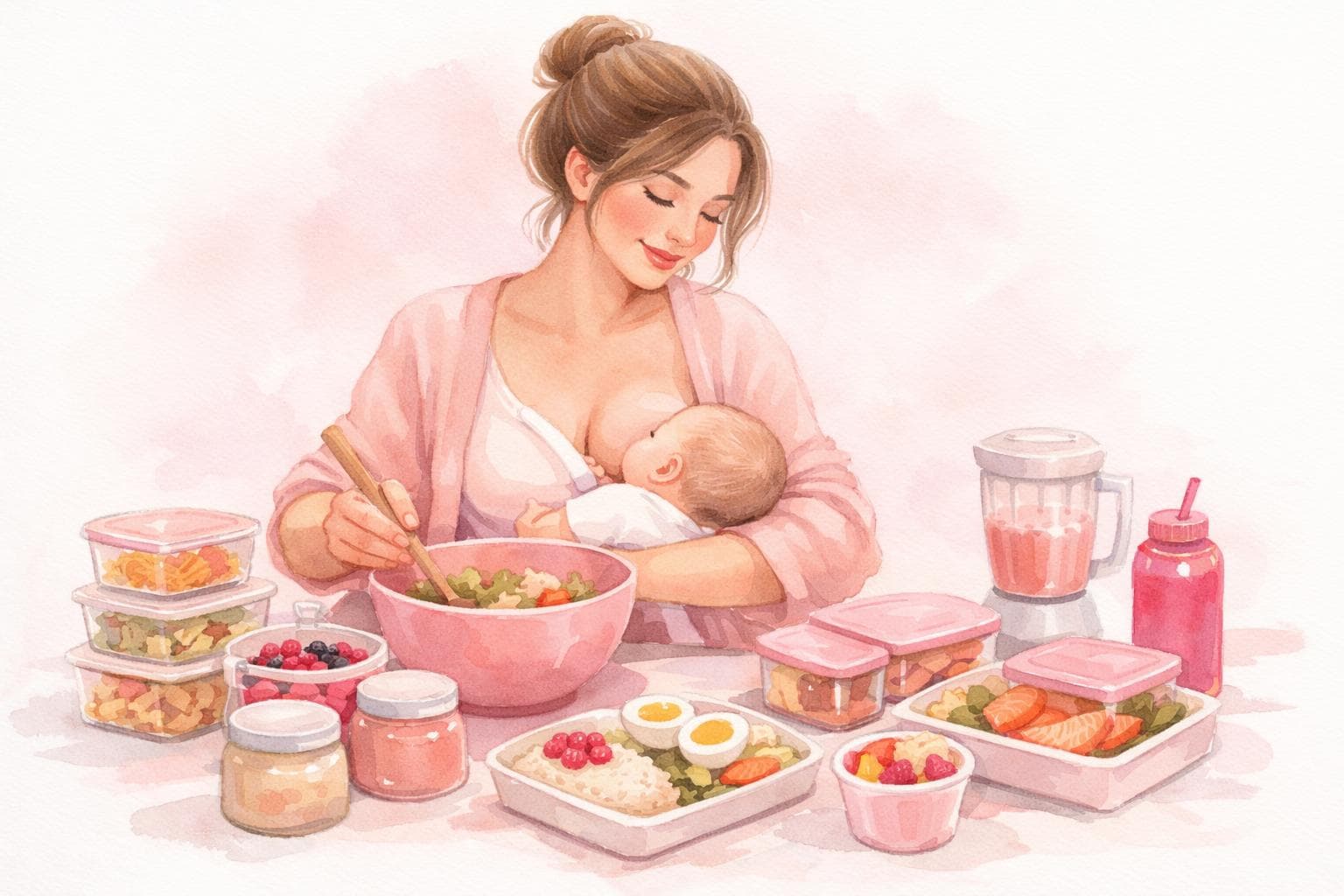
Cooking dinner from scratch every night was never realistic before a baby arrived. Now, with a newborn attached to you for what feels like eighteen hours a day, it is not just unrealistic, it is close to impossible. And yet your body needs more fuel than it ever has, not less, at the exact moment you have the least capacity to produce it.
Batch cooking is the answer, but not the vague "meal prep Sunday" version. A version built specifically around lactation's actual demands.
Nursing mom meal prep is the practice of preparing large batches of nutrient-dense food in advance, specifically structured around the elevated protein, calorie and micronutrient needs of lactation, so that ready-to-eat meals are available without daily cooking during a period of minimal time and energy. Research published in Frontiers in Nutrition by Ford, Underwood and German found that lactation requires measurably more protein, healthy fats, vitamins and minerals than the pre-pregnancy baseline, framing nutrition-based support as essential for the mother-infant dyad rather than a secondary concern. A 2024 study on the nutritional status of breastfeeding mothers, published by Carretero-Krug and colleagues, confirmed that dietary quality and supplementation during lactation directly affect maternal recovery outcomes. This guide turns that research into an actual weekly system.
Why generic meal prep advice does not fit lactation
Most meal prep content is built around convenience or weight management. Neither is the right frame here. A nursing mother's meal prep needs to solve for three things simultaneously: enough total calories, since breastfeeding requires roughly 330 to 500 extra calories daily, enough protein, given research suggesting needs closer to 1.7 to 1.9 g/kg/day for exclusive breastfeeding, and enough micronutrient density, particularly iron, choline and omega-3s, to support both recovery and milk quality.
Generic batch cooking optimises for time. Nursing-specific batch cooking optimises for time and nutrient density simultaneously, which changes what actually belongs in the freezer.
Batch cooking day vs daily cooking: the real comparison
Daily cooking, newborn phase | One batch cooking session per week | |
|---|---|---|
Total time invested | Fragmented across every day, frequently abandoned mid-task | 90 to 120 minutes, once, uninterrupted where possible |
Nutrient consistency | Highly variable; often defaults to whatever is fastest, not most nutrient-dense | Planned in advance for protein, iron and omega-3 targets |
Stress level | High; decision fatigue at every single meal | Lower; decisions made once, executed repeatedly |
Food waste | Higher; ingredients bought with intention often go unused | Lower; batch quantities are used with purpose |
Realistic during newborn phase | Frequently fails during the hardest weeks | Sustainable, since it requires only one functional window per week |
The weekly batch cooking session
Set aside one 90 to 120 minute window, ideally when someone else can hold the baby, or during a longer nap stretch. CompassionateMoms.org recommends scheduling a specific day each week dedicated to bulk cooking, treating it as a fixed appointment rather than something squeezed in if time allows.
What to batch each week:
- One protein base, shredded chicken, ground turkey or lentils, cooked in bulk and portioned for at least four meals
- One breakfast batch, egg muffin cups or baked oatmeal, giving you grab-and-eat mornings without cooking
- One freezer-friendly snack, energy balls or lactation-supportive oat bites, for the hours between meals when hunger hits fast
- One soup or one-pot meal, frozen in individual portions for the hardest days
A sample week built from one batch session
Day | Breakfast | Lunch | Dinner | Snack |
|---|---|---|---|---|
Monday | Egg muffin cups with spinach and cheese | Shredded chicken bowl with rice and avocado | Slow cooker chili with beans | Energy balls with oats and peanut butter |
Tuesday | Overnight oats with Greek yoghurt and berries | Hummus with carrot sticks and whole grain crackers | Frozen one-pot soup, reheated | Apple with a cheese stick |
Wednesday | Baked oatmeal square, reheated | Shredded chicken tacos with black beans | Grilled cheese with tomato soup | Smoothie with yoghurt, banana and peanut butter |
Thursday | Egg muffin cups, repeat from batch | Leftover chili, repurposed with rice | Instant pot chili mac with steamed broccoli | Energy balls, repeat |
Friday | Overnight oats, repeat batch | Shredded chicken salad wrap | Frozen freezer meal, reheated | Hummus and vegetables |
This is not meant to be followed exactly. It illustrates the underlying principle: one batch session produces the raw components for an entire week, recombined differently each day rather than requiring five separate cooking efforts.
Food safety and storage basics
Nourish's clinical guidance on breastfeeding nutrition emphasises using stackable, clearly labelled containers, marked with contents and date, so nothing gets lost or wasted in a chaotic freezer. Reheating guidance generally recommends microwaving for three to four minutes, stirring halfway through, or reheating covered on the stovetop, and any thawed food that goes unused should not be refrozen. Our guide to batch cooking before baby arrives covers third-trimester prep specifically, which pairs well with this ongoing weekly system once the baby is here.
"Lactation requires more protein, healthy fats, vitamins, and minerals. A freezer stash is more than convenience. It's self-care in action." - Freeze & Thrive, citing Ford et al. (2020), Frontiers in Nutrition
What to do when even batch cooking feels like too much
Some weeks, even a 90-minute session is not realistic. Enlisting help from family and friends for food preparation, or leaning on low-effort recipes that yield large amounts of leftovers, like slow cooker meals, is a reasonable substitute rather than a failure of the system. If you have people offering to help, our guide to what to bring a new mom gives them somewhere specific to start. And if the exhaustion behind the meal planning struggle feels bigger than logistics, our guide to emotional exhaustion in motherhood is worth reading alongside this.
Key takeaways
- Nursing-specific meal prep needs to solve for calories, protein and micronutrient density simultaneously, not just convenience, given the elevated demands of lactation confirmed by research in Frontiers in Nutrition.
- One 90 to 120 minute batch cooking session per week can produce a protein base, a breakfast batch, a freezer snack and a one-pot meal, covering most of the week's needs from a single effort.
- Batch cooking reduces both stress and food waste compared to daily improvised cooking, since decisions are made once rather than at every single meal.
- Proper storage, labelled containers and safe reheating protect both food safety and your ability to actually use what you have prepared.
- When even batch cooking feels unmanageable, accepting outside help is a reasonable substitute, not a failure of the plan.
Sources and further reading
- Ford, E.L., Underwood, M.A. & German, J.B. (2020). Helping mom help baby: nutrition-based support for the mother-infant dyad during lactation. Frontiers in Nutrition, 7. doi.org/10.3389/fnut.2020.00054
- Carretero-Krug, A. et al. (2024). Nutritional status of breastfeeding mothers and impact of diet and dietary supplementation: a narrative review. Nutrients.
- Begin with Balance. (2026). 2026 postpartum meal prep guide: easy and nourishing recipes. beginwithbalance.com
- CompassionateMoms.org. (2025). Meal prep for breastfeeding moms: easy recipes to save time. compassionatemoms.org
- Nourish. (2026). Easy 7-day breastfeeding meal plan and prep tips. nourish.com
- Hussey, T. (2025). Freeze and thrive: postpartum meal prep that nourishes you and supports breastfeeding. breezybabies.com